The Cape Town-based Design Academy of Fashion (DAF) launched a game-changing project in collaboration with Mohair South Africa this year. Focused on mohair as a locally sourced, circular, and sustainable fibre, second-year students attended masterclasses about textile construction and textile-making skills, and were then assigned a final mohair-focussed design project that was shown at the academy’s end-of-the-year fashion showcase in November.
DAF‘s head of department Leandi Mulder says, “The project was built on the design theory of farm-to-fashion thinking, encouraging students to engage with the entire design process of a garment—from raw fibre to the final runway look… Students gained a deep appreciation for mohair as a local, sustainable fibre and fell in love with its versatility and beauty.”
 Design Academy of Fashion lecturer Leandi Mulder with students in a masterclass. Photo Cayly Warner
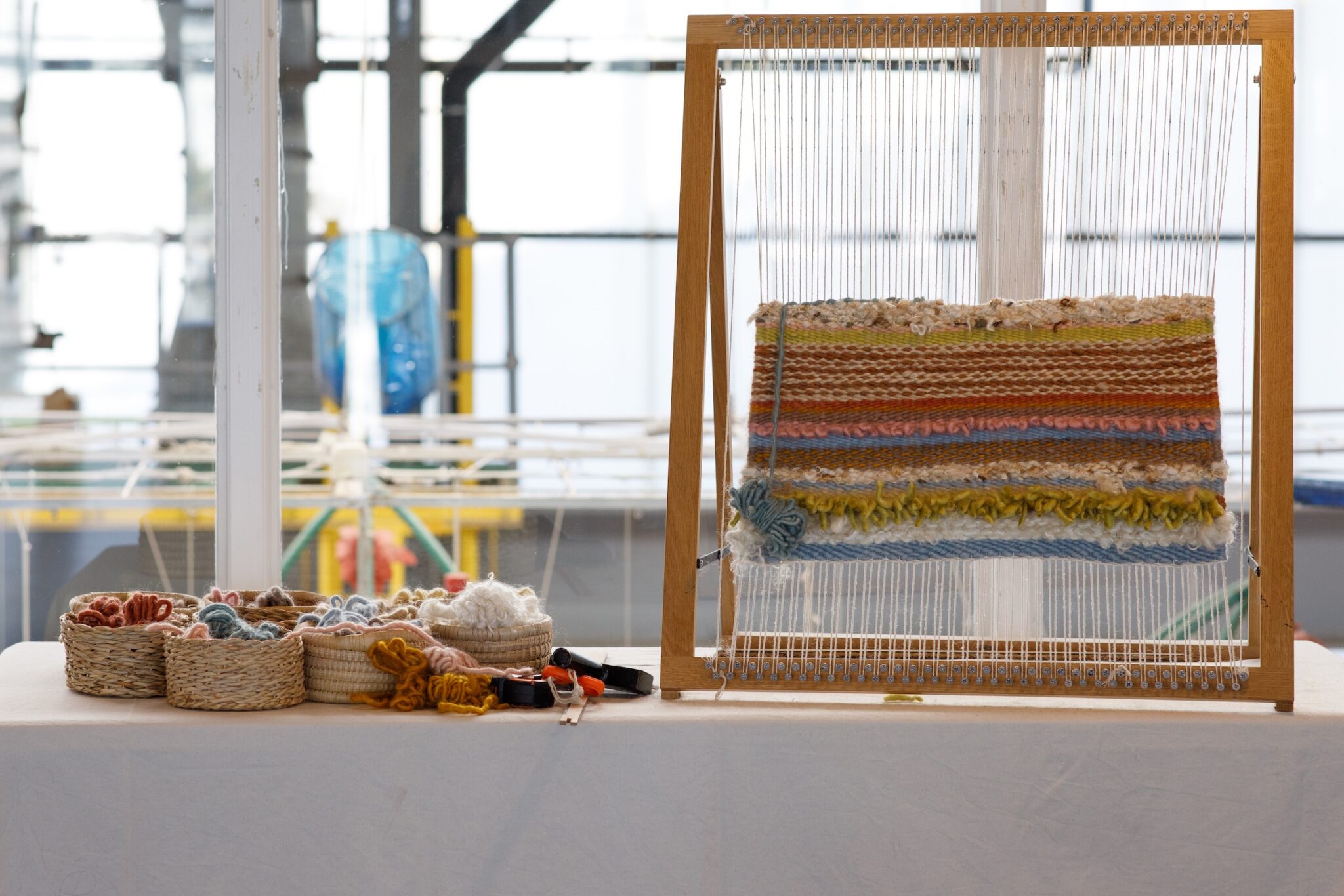
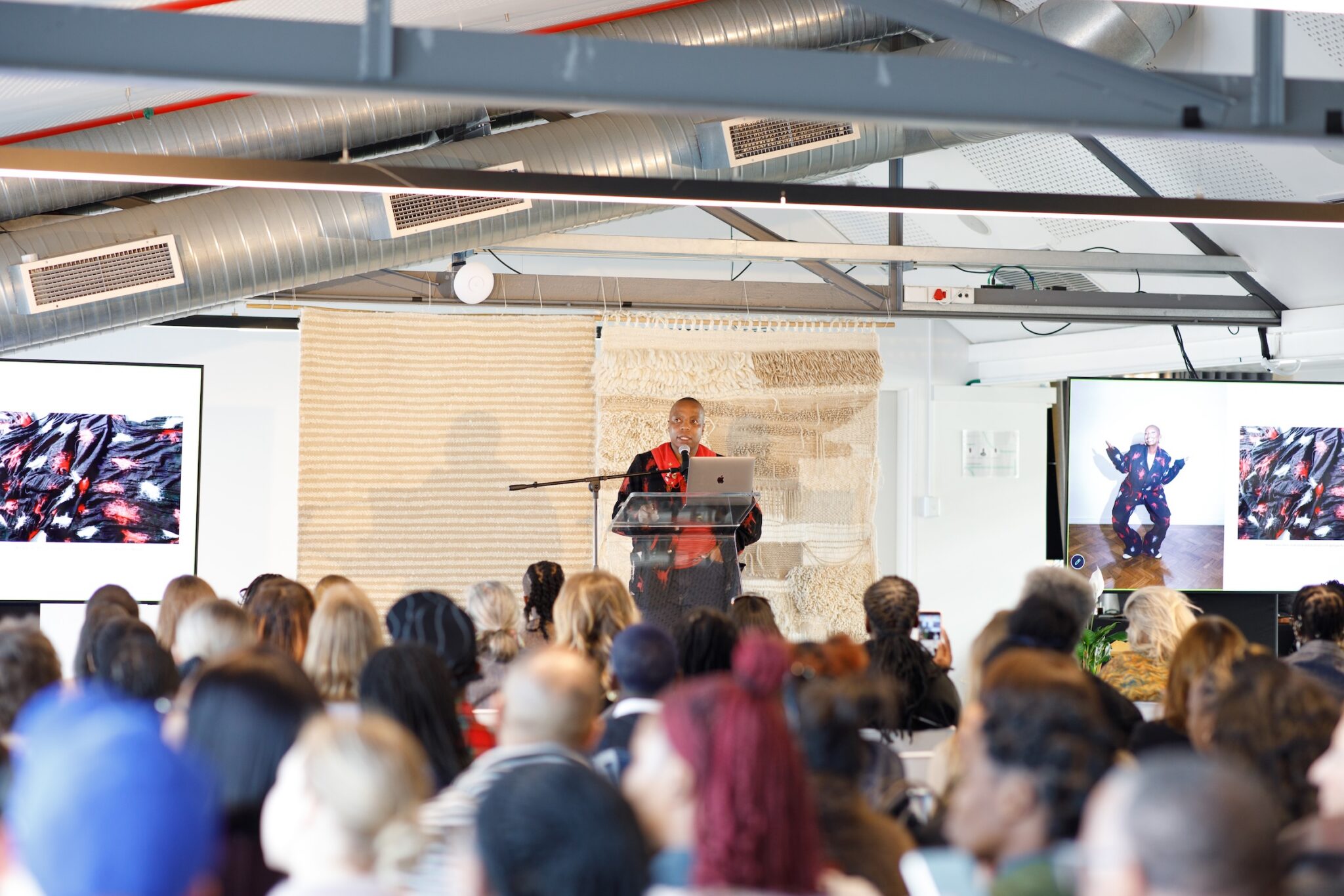
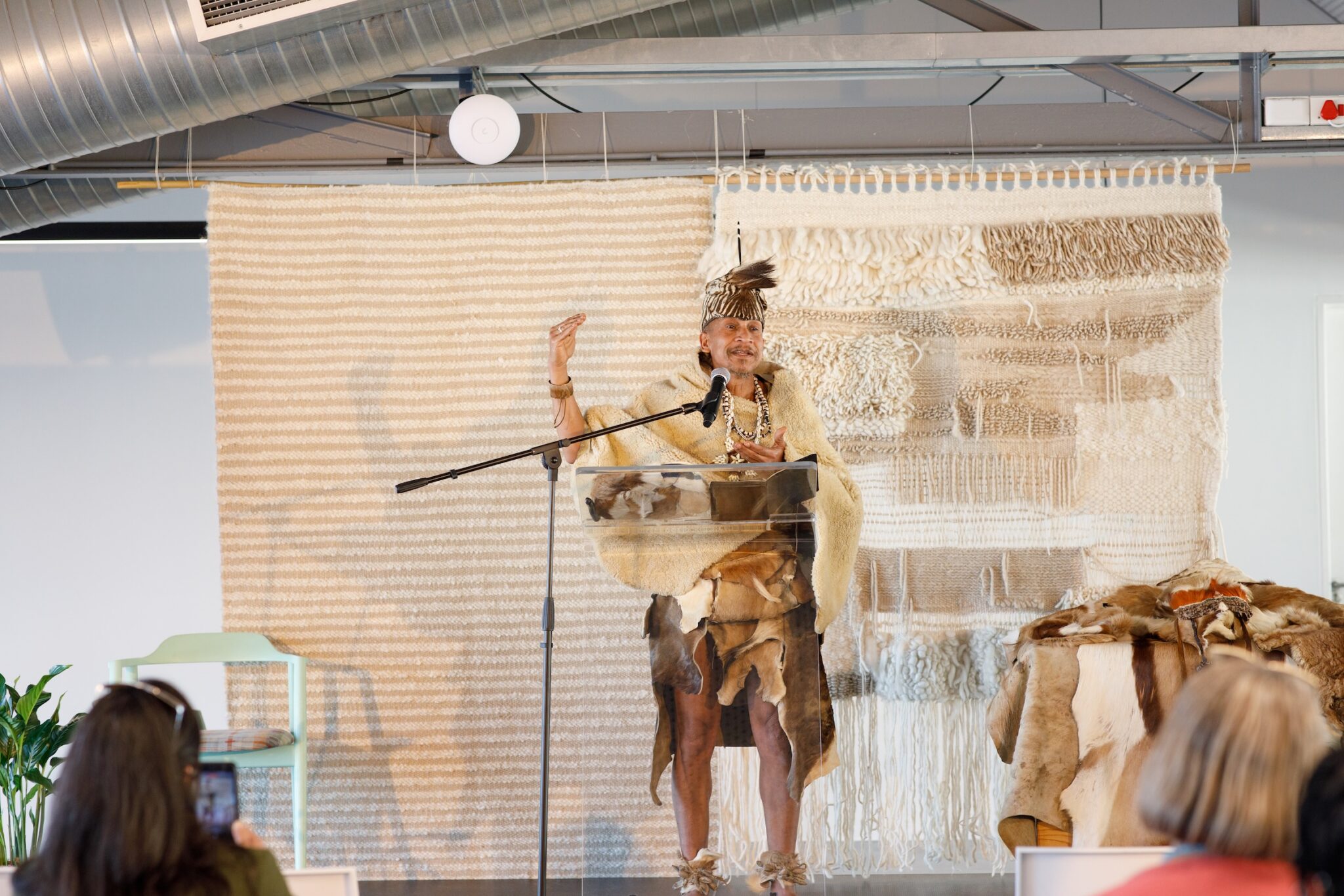
Throughout the year, students participated in hands-on workshops, learning traditional handcrafting techniques like knitting, weaving, felting, and dyeing, alongside conceptual skills like sustainable design principles. Industry experts shared their skills including Bridget Henderson, founder of Cowgirlblues who taught the art of dyeing mohair yarns in vibrant colours. Adéle Cutton, founder of Adéle’s Mohair showed students how to hand knit. Frances van Hasselt presented a masterclass that explored Farm to Fabric design thinking and drawing inspiration from the natural environment to shape every aspect of design and process. SAMIL Natural Fibres, a South African manufacturer and exporter of yarns provided yarns and processed raw mohair, while Gerber & Co supplied processed raw wool.
 Adéle Cutton, founder of Adéle’s Mohair. taught the students handknitting
Funder Lauren Moore who is head of communications and sustainability at Mohair South Africa says, “This partnership aims to inspire and empower the next generation of fashion designers to develop a deeper understanding of the materials they use—focusing on their origins, sustainability, and potential.” By supporting students she says, “We encourage these future designers to reimagine their design processes, prioritising natural fibres like mohair, produced in South Africa.”
South Africa is one of the world’s largest producers of the fibre, and many students are likely to engage with the industry at some point in their careers. “Beyond technical skills, the project aimed to foster a deeper connection to the materials they work with, inspiring a more thoughtful, responsible approach to design,” says Leandi.
 Students at DAF explore mohair during a workshop. Photo Cayly Warner
“Many found it meditative, losing themselves in the rhythm of textile construction—whether it was knitting, crocheting, weaving, or felting. By the end, it wasn’t just about completing a garment; it was about creating something meaningful and personal,” she says.
The students’ final task was to create a complete mohair-focused look, from fibre and yarn to fabric and fashion. This included designing and crafting all their accessories as well. The garments represented a blend of creativity, technical skill, and sustainable design principles—a true reflection of their journey throughout the project.
Three students received DAF awards for their final looks:
Luthandolwethu Pase
For the design that makes the most immediate and lasting impact, Luthandowethu won the First Impression Award. This award highlights the piece that captivates through its visual appeal, emotional resonance, and strong presence on the runway.
 Felted mohair look by Luthandolwethu Pase. Photography by Kim van Zyl
What did you learn about mohair and natural fibres this year? I looked into and got inspired by a lot of Stephanie Bentum’s work, from her collaboration with former DAF alumni Tamara Cherie, to her current work with collaborators Viviers Studio and Luke Radloff of UNI FORM, and lastly her amazing innovations with her work in Nuno felting. Most of what I learnt was driven by experimenting and that was backed by my understanding of natural blends and their properties, informed by my short time at FIELDS. Ultimately, I learnt that mohair wasn’t just a vintage textile that was outmoded and old-timey but could be subverted and re-adapted for a new generation of consumers.
What inspired the garment that you created? I decided to look into the three men who have shaped my journey so far. My father happened to be born in Graaff-Reinet, which is a huge producer of Mohair. I was naturally drawn to felting as a technique as it was the best way of highlighting the mohair’s natural properties. My stepdad had instilled a natural spirit of curiosity, experimentation and exploration in me, which led to the introduction of my mentor Fabrice Moyo of Franc Elis. Uncle Fabrice served as a large inspiration to me: his body of work consists of over 20 years in the industry, creating bespoke tailored suits, and showing across the world from Milan to Johannesburg. The look pays homage to Uncle Fabrice’s craft of suiting, however I incorporated my own flair by adding layering and draping to subvert the common notions of menswear.
How will you take what you learnt this year into your third year and possibly your future? Having formed a personal bond with mohair due to its proximity to my father’s place of birth, there’s a lot I could explore—not only in working with the fibre but also in connecting with the local community, and celebrating and telling their stories as beacons of the industry. My passion for working towards restoring South Africa’s position within the textile industry globally also serves as a promise and testament to making natural fibres a pillar within my brand moving forward.
Theo Blatcher
Theo was awarded the Excellence in Textile and Design Innovation Award for demonstrating the most creative and innovative approach to mohair textile manipulation and design. This includes the imaginative use of mohair, innovative combinations of fibres and/or yarns, and originality in concept and execution.
 Knitted and felted mohair look by Theo Blatcher. Photography by Kim van Zyl
What inspired the garment that you created? Alive At Last was inspired by the feeling of coming into recovery out of active addiction and experiencing the world for the first time. Each stitch serves as a memory of all the firsts I was able to have. The first time I looked around me and actually saw the brightness of the sun, how the earth felt under my feet, the peace of lying in the ocean with the water rushing over my body.
I felted half a black blazer and a pair of shorts to showcase the fragmented person I was before. I tied both pieces tightly at the hips and waist to show how stuck I was and I let the knitting flow over these pieces. This look is a visual representation of what it was like being pulled out of the darkness that I was fully prepared to let swallow me.
How will you take what you learnt this year into your third year and possibly your future? This year has taken my love of experimentation and creating my own textiles to a new level. Before this, I experimented a lot with cutting up fabric and patch working it, with manipulating textiles to change them into what I wanted them to be. I never knew how much was possible until this project.
It has shown me that there is so much more to fashion than a sewing machine, thread and fabric. The reason I love fashion design so much is because of how it makes me feel—how much excitement and energy it fills me up with. I like how much power it holds and how it can be used as a means of telling stories of pain and joy. This mohair project showed me how much deeper I can go. How I can use a fibre to bring my feelings to life.
What surprised you about working with mohair? Working with mohair involved so many mistakes, which taught me an immense amount. There were many late nights spent using the knitting machine where I would leave having nothing to physically show for it. However, each dropped stitch and “error” showed me something. I discovered that mohair needs to be engaged with gentleness and that a ‘friendship’ needs to be formed. I learned that beyond this, there are no rules, and how fun it is to take risks and experiment.
Marc Terblanche
Marc won the Excellence in Technical Construction Award for the most refined technical skills in garment construction. Judges assessed the precision, craftsmanship, and structural integrity of the design.
 Felted mohair look by Marc Terblanche. Photography by Kim van Zyl
What inspired the garment that you created? As the dawn of 2024 approached, I found myself confronted with a darkness that would shatter my newfound sense of self. I was sexually assaulted, an event that felt like a violent storm, ripping away the very essence of who I had become. I am not the person I was before that night; 2023 has irrevocably altered my trajectory. Yet, amidst the wreckage, I encountered someone who illuminated facets of my being I had never dared to explore. This connection has been a beacon, guiding me toward the person I was always meant to be.
Through this collection, I seek to reclaim the armour that was stripped from me, to create a visual dialogue between my internal demons and the artistry of my hands. In sharing this journey, I hope to transform my trauma into art, allowing the hidden messages within to resonate with others who may find themselves in similar battles. My journey is not just my own; it is a testament to the resilience of the queer community, a celebration of the beauty that can emerge from the ashes of adversity.
What techniques did you apply and learn to create it? The numerous workshops we attended, led by the incredible facilitators at DAF, equipped us with a comprehensive understanding of mohair manipulation techniques. Among these, felting captivated me the most; it felt like a destined connection. I took the skills I acquired from the felting workshop and transformed my backyard into a creative haven, working on an old rustic wooden table draped with mosquito netting. This space quickly became my second home, where I dedicated countless hours to felting large rectangular pieces, each unique in its own right.
To enhance the texture of my felt creations, I spent additional hours hand-sewing mohair yarns of various sizes into different sections of the felt, resulting in intricate and textured designs.
What surprised you about working with mohair? I was initially surprised to discover the structural integrity of mohair. As I began designing, my thoughts immediately turned to the garment’s structure, and I recognised that this would be my most structured piece to date. The question I faced was whether mohair could provide that necessary structure. The answer is a resounding yes; however, it entirely depends on the techniques and manipulations you, as the designer, apply to the fibre.
- To find out more about studying fashion at Design Academy of Fashion visit their website
- Mohair South Africa has collaborated with Italy’s Polimoda and Li Edelkoort’s Farm to Fabric to Fashion Textile Masters Programme. It also funds the Farm to Fabric to Fashion Course at Fashion Institute of Technology in New York. The institute’s Lorenza Wong and South African textile designer and weaver Frances van Hasselt created this programme