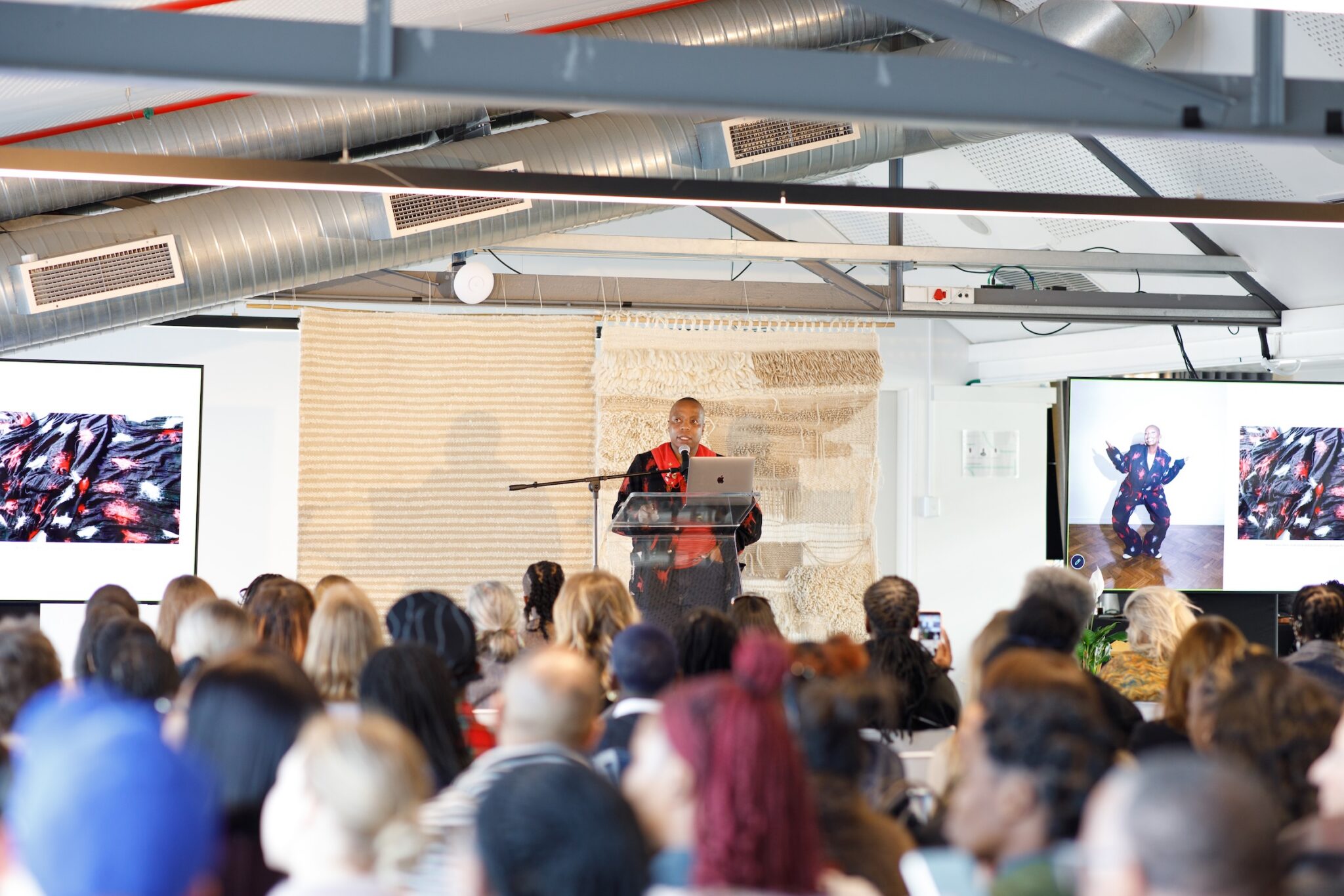
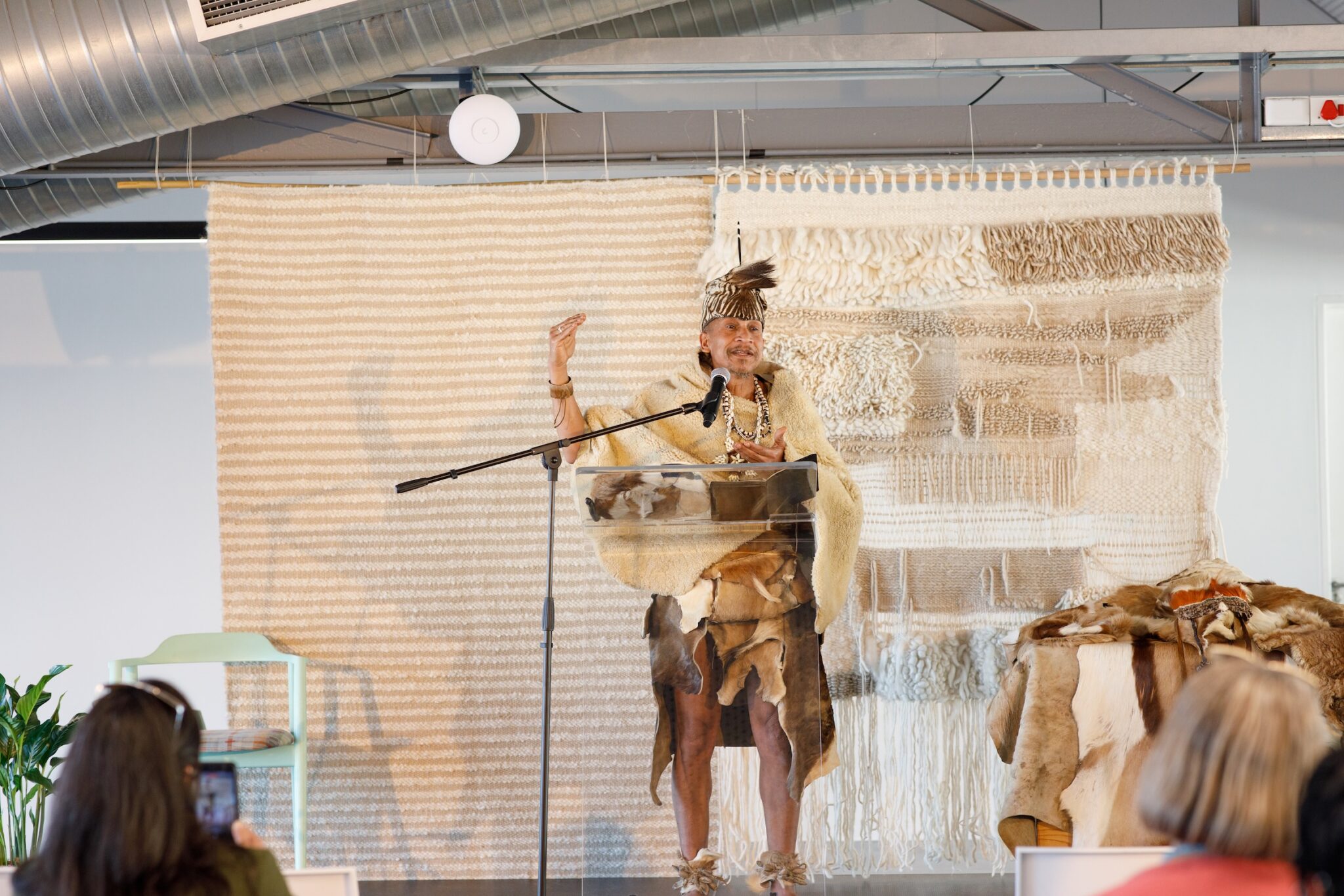
Three thousand people gathered at the annual Karoo Winter Wool Festival for much more than trading locally crafted woollen goods. They travelled to Dwarsvlei Farm near Middelburg in the Eastern Cape earlier this year (3 and 4 July) to connect with experts and learn new skills.
Sbulelo Jacobs came to the festival to teach crochet and left knowing how to knit. “We need to learn. Nowadays, there’s a problem with electricity, so if you can make something with your hands without needing any electricity, then you have a better chance to earn a living”.
Currently, South Africa’s official unemployment rate is 33.6%, and considerably higher in rural provinces, reaching 47.5% in the Eastern Cape. Over 90% of South African wool is exported as a raw material, removing it early in the value chain from the South African economy. At the same time the country is losing wool processing skills. Experts agree that there is potential to create jobs and add more value to the local economy if raw materials are processed locally.
According to Sarah van Lingen, who co-founded the annual festival five years ago, this year the festival offered 28 workshops. There has been a huge demand for workshops. “People are so keen to learn,” she says. The festival organisers curated a wide variety of workshops including needle felting, knitting, crocheting, weaving, lanolin balm and soap making and natural indigo dyeing.
Africa’s largest disaster response organisation, Gift of the Givers, hosted a centre for knitting and crochet training at the festival. Project co-ordinator Mario Ferreria says, “Professional knitters and crocheters from the area were invited to help teach skills. Most local people have these skills. It’s part of daily living.”
“It doesn’t matter what type of skill, it is important that people learn new skills.”
Mario says, “Everyone at the festival was welcome to learn. We had 1000s of people come to see what we were doing. It was wonderful.”
Skills development is important, explains Mario. “It doesn’t matter what type of skill, it is important that people learn new skills. It could awaken a talent in someone along with an opportunity to use their new-found skill to earn money.”

There is a demand for workshops and skills training at the Karoo Winter Wool Festival. Photo: Sam Reinders
The festival organisers invited Middelburg resident, Sbulelo, to help Gift of the Givers with the training. The self-taught crocheter says she was exposed to “yarn-based activities” that she didn’t know existed in South Africa.
After teaching herself how to crochet by watching YouTube videos, Sbulelo started her small business. “A person orders something, pays a deposit and then I make it for them. First I go and buy the yarn to do the work, then you pay the balance when you’re collecting your product.”
Sbulelo says, “It’s a great industry but my generation is not into it, because there’s a stereotype that craft is for elderly people. But when I make these things, young people want them, but they don’t want to learn the skills. They don’t realise that learning new skills gives you an opportunity to be a job creator – that’s very powerful,” says Sbulelo.
Corps Africa’s country director for South Africa, Kelu Kubu, and her colleague, Mzuzile Nqabeni, arranged for two volunteers and two community-leaders from a North West community to travel to the festival. The goal of the trip was for the four women to learn transferable skills including weaving, knitting, and soap and lotion-making.
“When the volunteers return from the festival, they have to report back and share what they learnt with other volunteers who are not here. We’ve got a cohort of 45 volunteers so the knowledge transfer is not just for those attending, but also for the others. This skills training is very valuable. As well as the exposure to the world of wool,” says Kelu.
“We work with people who have goats and sheep, but in some communities wool is not used for commercial purposes. This training is about optimising what is available and accessing a broad range of tools to help create jobs and stimulate local economies.”
Kelu hopes that new seeds will be planted and continue to grow. “Then at some point the learners can stand on their own, even when we are not there,” says Kelu.
“Who knows, next year they could be exhibiting one or two products at the festival,” says Kelu.
Twenty people drove by bus from the Mountain Kingdom of Lesotho arriving on the farm at 2am on Friday morning. Representing Lesotho’s Ministry of Agriculture and Food Security, Leoana Mokhanya says, “We want to see what women and men of South Africa are doing with wool, so that we can learn about the whole value chain of production and extend what we do in our country.”
“We have a lot of farmers. We have lots of sheep and goats. We have a lot of wool but it is for export. We are not using our wool. We want to learn.” says Leoana.
“Most of our youth are unemployed – it was declared a crisis last year. If they can learn some skills, they can earn income. What they need is income.”
The skills acquired at the festival help rural women in Lesotho diversify their income streams. Several groups of weavers operate at a very small scale. Leoana says that there is a problem with marketing their product. “They are making some jerseys, some throws, some capes, some hats, but as a country we are not doing enough to support and promote what is already being done.”
Most people, especially the youth, in Lesotho wear imported clothes. Sometimes they are wearing jumpers imported from Ireland or Scotland that are made of wool from “the sheep that are in front of his or her own house,” says Leoana. This knowledge has to be shared.
“Our children don’t know that a sheep produces the wool for our clothes. We want to show them how products are made from natural materials…. Most of our youth are unemployed – it was declared a crisis last year. If they can learn some skills, they can earn income. What they need is income.”
In rural economies, where unemployment is high and wool is plentiful, rebuilding the skills to process and transform fibre locally could help keep more of its value in the communities that produce it. The enthusiasm for the festival’s workshops suggests that the appetite to learn is already there.
As Leoana says, “There’s a lot that can be done.”
- Twyg is a Karoo Winter Wool Festival media partner
- Images are from workshops from previous KWWFs
- Photos: Sam Reinders for Karoo Winter Wool Festival
- Georgia Altbeker and Kasper Knudsen are Twyg interns
- This article was edited by Jackie May