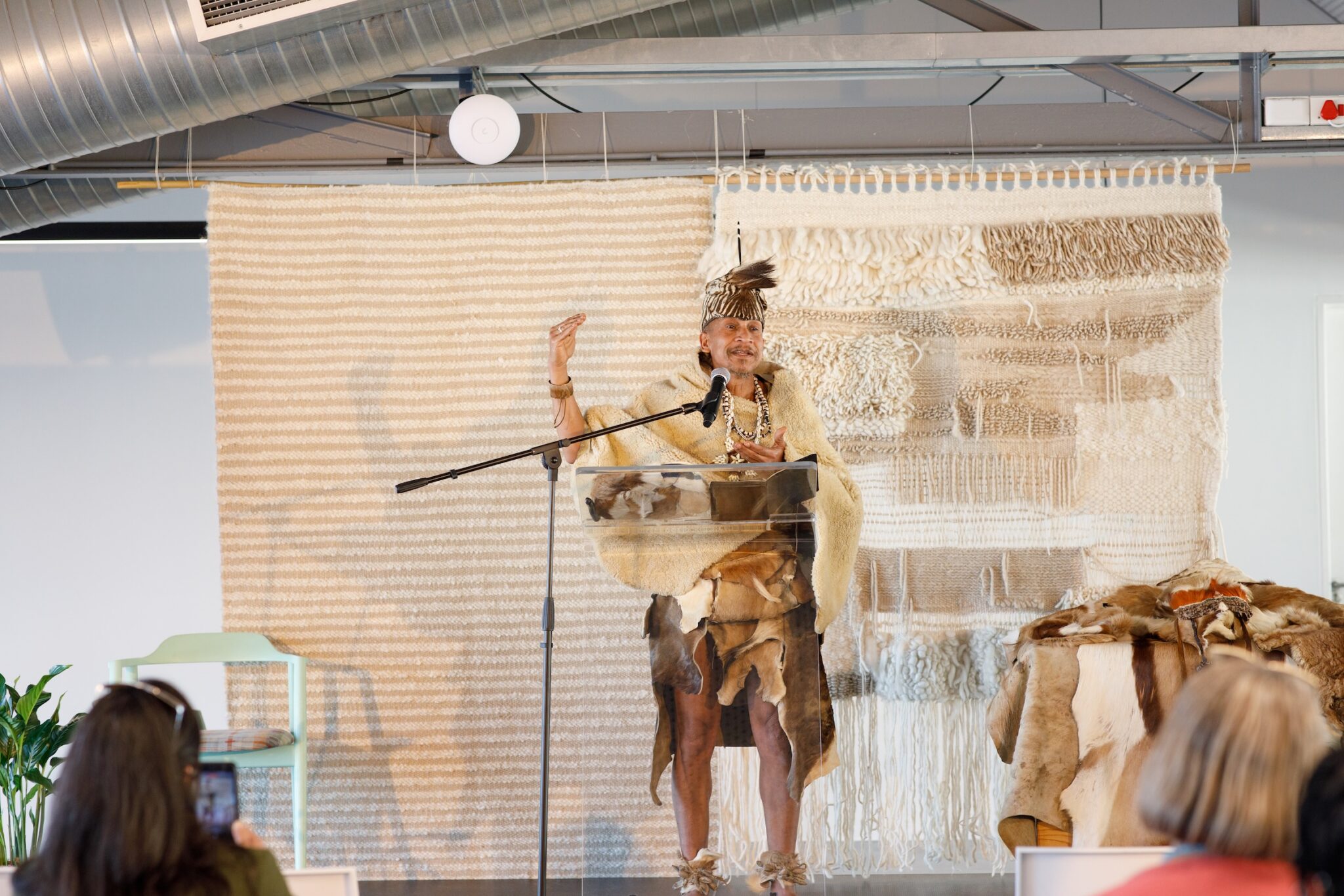
There are several high-profile fashion weeks across the continent. Images of these circulate widely online, front rows fill with local and international celebrities and influencers. Global media is paying attention. But do these events translate into sustainable economic participation?
Lagos Fashion Week has attracted significant international attention, prompting The Guardian to ask whether it is “the world’s most exciting fashion week.” Last year, the global artist Ciara walked the runway for Nigerian brand Fruche which further amplified the event and reinforced Lagos’s growing cultural and commercial influence.

Fruché creative director Frank Aghuno with Ciara and two members at the Lagos Fashion Week in 2025. Credit Lagos Fashion Week
Dakar Fashion Week emphatically closed the season with an open-water finale that went viral in December last year, asserting itself not merely as a showcase of garments but as a multidimensional cultural, social and economic platform. Now in its 24th edition, curator Adama Paris positioned the event as an ecosystem integrating shows, fashion business forums, sustainable policy engagement, youth development initiatives, and cross-border collaboration, including a partnership with Turkish Embassy.
Further south, Zimbabwe Fashion Week demonstrated how fashion weeks function as employment generators. With international model turned producer Andiswa Manxiwa serving as creative director, the platform prioritised skills transfer, model development and production. Highlighting fashion weeks as sites of labour, not just luxury. Andiswa’s work foregrounds an often-overlooked truth: beyond designers and buyers, fashion weeks employ entire creative economies.
In a conversation with Twyg, creative Director at GRP/cr8/, fashion consultant and founder of Menswear Week South Africa Simon Deiner’s spoke about post-show economic output, the challenges of scaling fashion businesses sustainably, and the substantial financial realities of hosting a fashion week. He has worked across multiple fashion week systems (including Swahili Fashion Week, South African Menswear Week and Lagos Fashion Week) for 25 years and is clear-eyed about a persistent flaw. He interrogates whether visibility, in its current form, meaningfully converts into revenue, longevity or ownership for African designers.
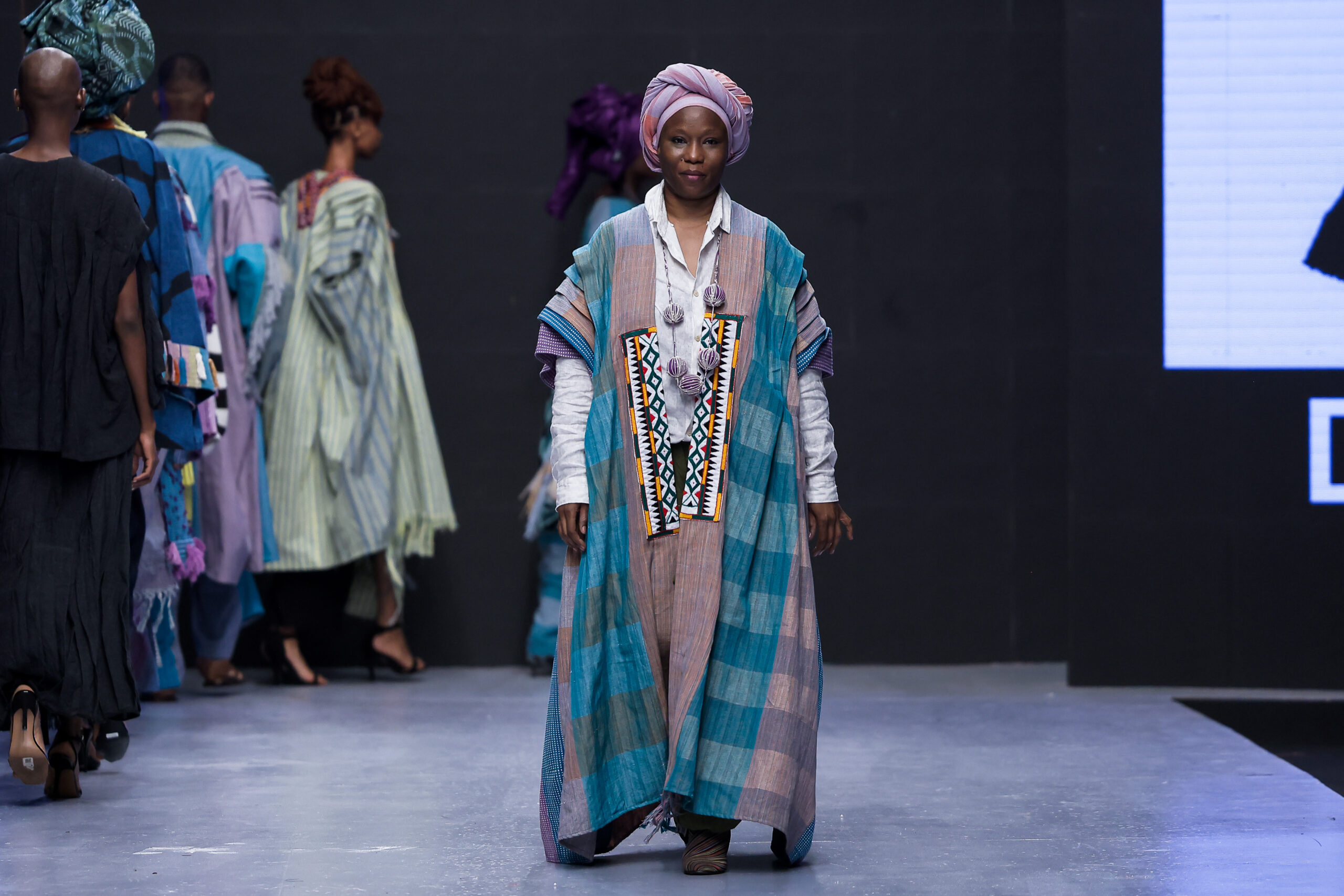
Malian designer and cultural activist, Awa Meite, shows at Lagos Fashion Week in 2024. LFW is produced by Simon Dernier at GRP/cr8/. Credit: SDR Photos
For much of the continent’s fashion week history, he argues, these platforms have functioned primarily as “entertainment rather than economic engines”. While there are dozens of fashion weeks across Africa, only a small number, in his view, have developed sustained international gravitas.
Intention of fashion weeks
“The priority needs to shift,” he says, “for the benefit of the bottom line, the brand and the business.” Without intentional post-show mechanisms, designers are becoming highly visible but financially stranded. Caught in consignment models that favour retailers and platforms, designers are left to absorb the risk. In some cases, platforms themselves are bleeding money into stores that fail to generate sales, reinforcing a cycle where exposure is celebrated but economic return remains elusive.
Simon introduced changes to the shows he produces intentionally aligning what designers showcase with actual market demand, connecting collections to buyers and territories already expressing interest. About 60% of invites are allocated for retail or brands, marking a move away from spectacle toward strategy.
He refers to a particularly fertile period in South African fashion history. Between 2011 and 2013, the industry saw a concentration of strong platforms; South African Menswear Week, South African Fashion Week, AFI Fashion Week and Durban Fashion Fair, creating what he describes as “golden years.” It was during this time that designers such as Gavin Rajah and David Tlale successfully leveraged fashion weeks as launchpads for international export and commercial growth, demonstrating what becomes possible when visibility is tethered to infrastructure.
It’s about curation, about putting the right clothing in front of the right audience, so the right media picks it up and the designer’s phone starts ringing
Simon argues that fashion weeks are marketing platforms. Designers must choose the platforms that best serve their goals, whether that is buyer access, brand positioning or media reach. “It’s about curation,” he explains, “putting the right clothing in front of the right audience, so the right media picks it up and the designer’s phone starts ringing.”
Make a business from being seen
Shaldon Kopman offers a complementary perspective, shaped by his dual experience as both designer and producer. He is not only the founder of the design house Naked Ape, he is also a producer and consultant for fashion shows across Africa and internationally. While acknowledging the costs and limitations of fashion weeks, he highlights their role in brand legitimacy, long-term credibility and market positioning, particularly within emerging fashion economies where infrastructure is still uneven.
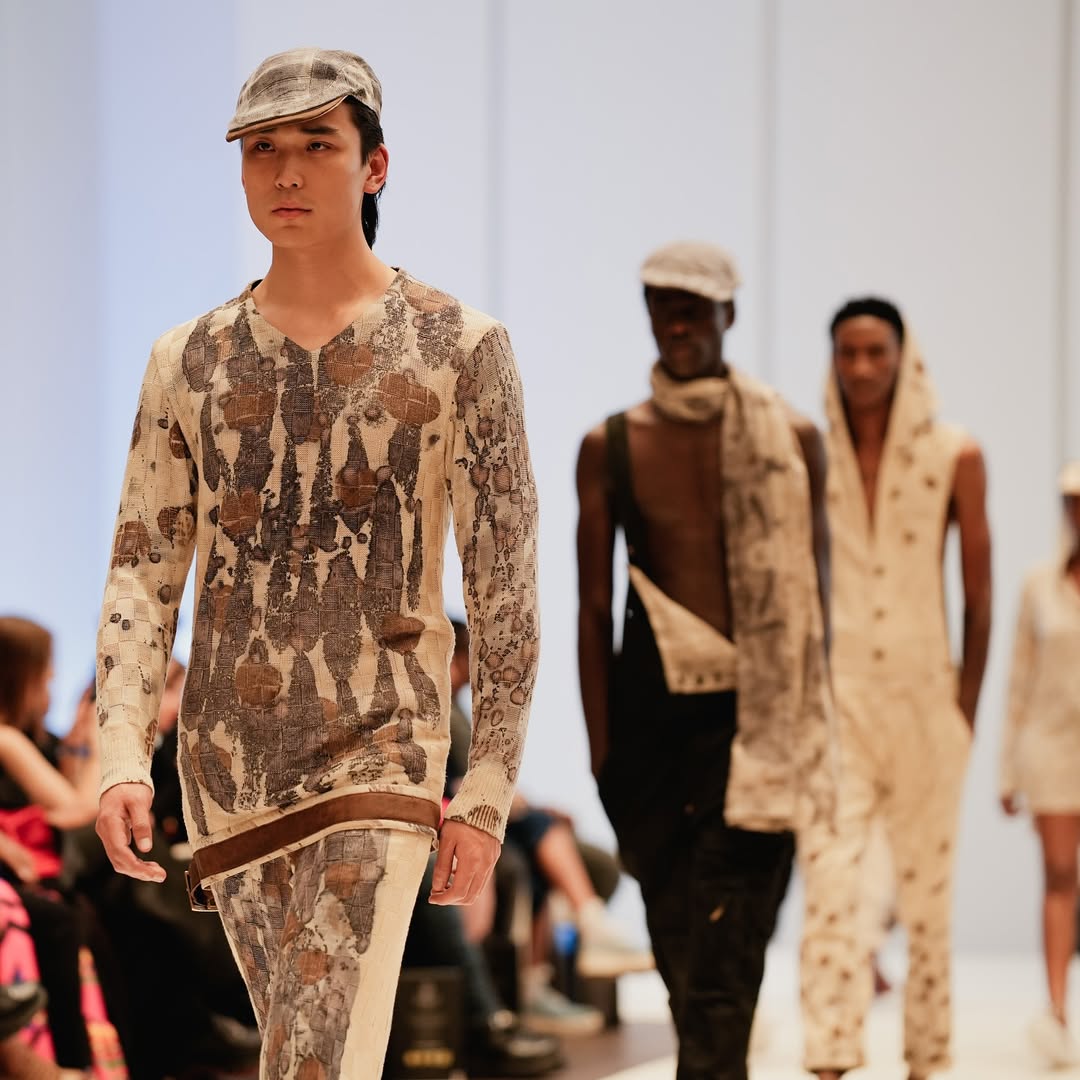
A Naked Ape runway moment at South African Fashion Week 2025. Credit: South African Fashion Week
Shaldon says the power of fashion weeks lies in consistency. He emphasises the importance of showing across multiple seasons, arguing that repeated participation signals seriousness, discipline and market readiness. Even in the absence of immediate media coverage, he stresses the value of engaging directly with a brand’s supporters and industry stakeholders, treating each showcase as an opportunity to reinforce identity rather than chase virality.
Shaldon places responsibility not only on the platform but on the designer’s preparedness. He advocates for intentional packaging; working with PR teams to document moments properly, making strategic media invitations, securing stylists, photographers and production teams that understand the brand’s language. In this framing, fashion weeks are not passive stages but active tools that require investment, planning and professionalisation.
Speaking from his own experience as a designer, Shaldon credits fashion weeks with opening doors that extend beyond the runway. Showcasing, he argues, creates access to consultants, producers, fashion media and buyers and relationships that often materialise long after the lights have dimmed. “We guard these relationships,” he says, underscoring the idea that fashion weeks function as relationship economies.
Who can afford this visibility?
If fashion weeks reward long-term participation, professional teams and repeated visibility, an unavoidable question emerges: who can afford this model?
For many African designers, the cost of participation extends far beyond show fees. Collection development, sustainable production practices, logistics, PR, documentation and travel are often self-funded, with no guarantee of commercial return. Particularly in markets where wholesale buying and retail infrastructure remain inconsistent.
As a result, designers frequently diversify their income streams to remain visible. Many pivot into art circuits, installations, costume design, brand partnerships, consulting or creative direction, not as departures from fashion, but as ways to subsidise it. Garment sales alone rarely generate enough capital to sustain repeated showcasing.
This reality creates an uneven playing field. Designers with access to capital or institutional backing are better positioned to treat fashion weeks as long-term brand investments, while others must continuously balance creative output with financial survival. Endurance, in this context, is often less about talent than access.
These strategies should not be begrudged. The real issue is not designers’ adaptability, but sustainable individual resourcefulness and shared industry infrastructure.
Fashion weeks and value chains
Any interrogation of fashion weeks in Africa would be incomplete without engaging Lucilla Booyzen, founder of South African Fashion Week – one of the continent’s longest-running and most recognisable fashion platforms. For 28 years, SAFW has maintained consistency in an industry defined by volatility, attracting major brand investment from partners such as Cruz Vodka, L’Oréal, TRESemmé and Isuzu, while also enduring sustained criticism around relevance, format and audience shift.
SAFW has previously been described as outdated, overly brand-led, or increasingly influencer-facing. Yet its longevity complicates easy dismissal. Earlier this year, the platform announced “a strategic pause for 2025”, committing to a return this year (2026) with a hybrid, digital-first model. An acknowledgement that the traditional twice-yearly runway no longer reflects the realities of the fashion business.
In her written responses to questions, Lucilla is unequivocal about the function of a fashion week. A well-produced show, she argues, is not merely a cultural moment but a “fashion stock exchange” or a compressed business engine that concentrates visibility, credibility and commercial opportunity into a short window. For designers, its value lies in market positioning, sales enablement, network access, operational discipline and post-show content longevity. For sponsors, it offers measurable media value, cultural relevance and access to a curated creative economy.
Lucilla positions SAFW as South Africa’s only dedicated B2B fashion marketing platform, underpinned by structured pipelines from education to industry through national college partnerships and talent development initiatives. Her emphasis is not on spectacle, but on system and on designers who are retail-ready, business-literate and capable of contributing to employment and the country’s gross domestic product.
Where earlier critiques expose the uneven burden placed on designers to self-fund visibility Lucilla’s perspective reframes the challenge as institutional. African fashion weeks, she argues, will only compete globally when they move beyond being seen as events and begin operating as value-chain platforms. Integrating manufacturing access, buyer infrastructure, governance standards, sustainable funding models and digital-first distribution.
Importantly, SAFW measures success not in attendance or hype, but through audited media value, digital performance, partner ROI and post-show designer outcomes. In this framework, the runway is not the conclusion of the season, but its beginning.
Together, these perspectives reveal the central truth of African fashion weeks today: visibility is not inherently valuable but when embedded within systems, strategy and accountability, it can become transformative. The future of fashion weeks on the continent will not be decided by aesthetics alone, but by whether they evolve into institutions that distribute opportunity as intentionally as they distribute attention.
- Feature image: Dakar Fashion Week