

Made from botanically dyed natural fibres, Naked Ape’s latest collection took inspiration from an unlikely source: the city of Johannesburg. “It is almost an urban forest; a different kind of serenity within this really chaotic city,” says designer Shaldon Kopman. “You’ll never find wildlife within a city environment quite like what you find in Johannesburg.”
The collection titled Urban Camo debuted at South African Fashion Week in April this year, where botanical hues were achieved with leaves, branches and rust. The colours were the result of a collaboration with Ira Bekker, the Botanical Nomad. Inherently unpredictable and slow to produce, natural dyes and handmade prints are rarely seen at mainstream fashion weeks. The sight of these pieces on the runway of SAFW made a powerful statement: a bold commitment to the slow fashion movement.
“It feels important and groundbreaking that this slow, natural and sustainable collection was shown and received so well at a show that is glamorous and high-profile,” says Ira, the winner of Twyg’s Farm-to-Fashion Award in 2023.
Shaldon and Ira first crossed paths in 2018. Ira had been experimenting with botanical prints for two years and had wanted to apply them to a menswear range. The two connected over a shared philosophy that beautiful fashion can and should be made with biodegradable materials and a no-waste approach. “Shaldon’s designs are at once fashionable and timeless, and so a perfect match for a mark-making process that is in its own way timeless and natural,” says Ira.
They developed fabric samples, created initial garments, and filmed a video for the collection they named Urban Camo. COVID hit, and the garments sat in Shaldon’s studio, awaiting their moment.
At the beginning of 2025, SAFW invited Shaldon to show. “It was time to give Urban Camo what it deserved, because it had never debuted on the runway,” Shaldon says. Once participation was confirmed, the duo put together the collection in just six weeks.
 Samuel Besong in a raw silk jacket printed with leaves and rust. Photo by Jabu Pix
For years, Ira has been honing her botanical printing skills to levels of mastery. Then came the time when Shaldon provided her with swatches of the natural fibres he planned to use for his signature tailored gender-fluid silhouettes, and she began experimenting. At this stage of her career, experimenting is less about trial and error, and more about exploring artistic possibilities and refinement.
My work is to decide what to use, how to combine it and how to manipulate the leaves to create interesting effects
This range saw botanicals used to create both organic shapes and geometric prints, a play between nature’s gentle pace and the rhythm of the city. Ira set out to innovate within the realm of natural dyes and the shapes already found in nature, spending hours cutting leaves into new silhouettes. “This opened up a whole new angle to botanical printing,” she says. “My work is to decide what to use, how to combine it and how to manipulate the leaves to create interesting effects.”
My selection process, as far as raw materials are concerned, is always based on what is abundantly available locally
The cream tones of the natural fibres used – including raw silk, hemp, linen, and rayon – create an ideal canvas for the softly saturated earth tones and rusted browns. Cohesive and harmonious, the colour palette was decided by Ira’s environment. “My selection process, as far as raw materials are concerned, is always based on what is abundantly available locally,” Ira says. Surrounding her studio are many non-indigenous trees such as oak, maple, and eucalyptus. Each tree lent its own pigment signature, providing the blues, aubergines, russets and browns.
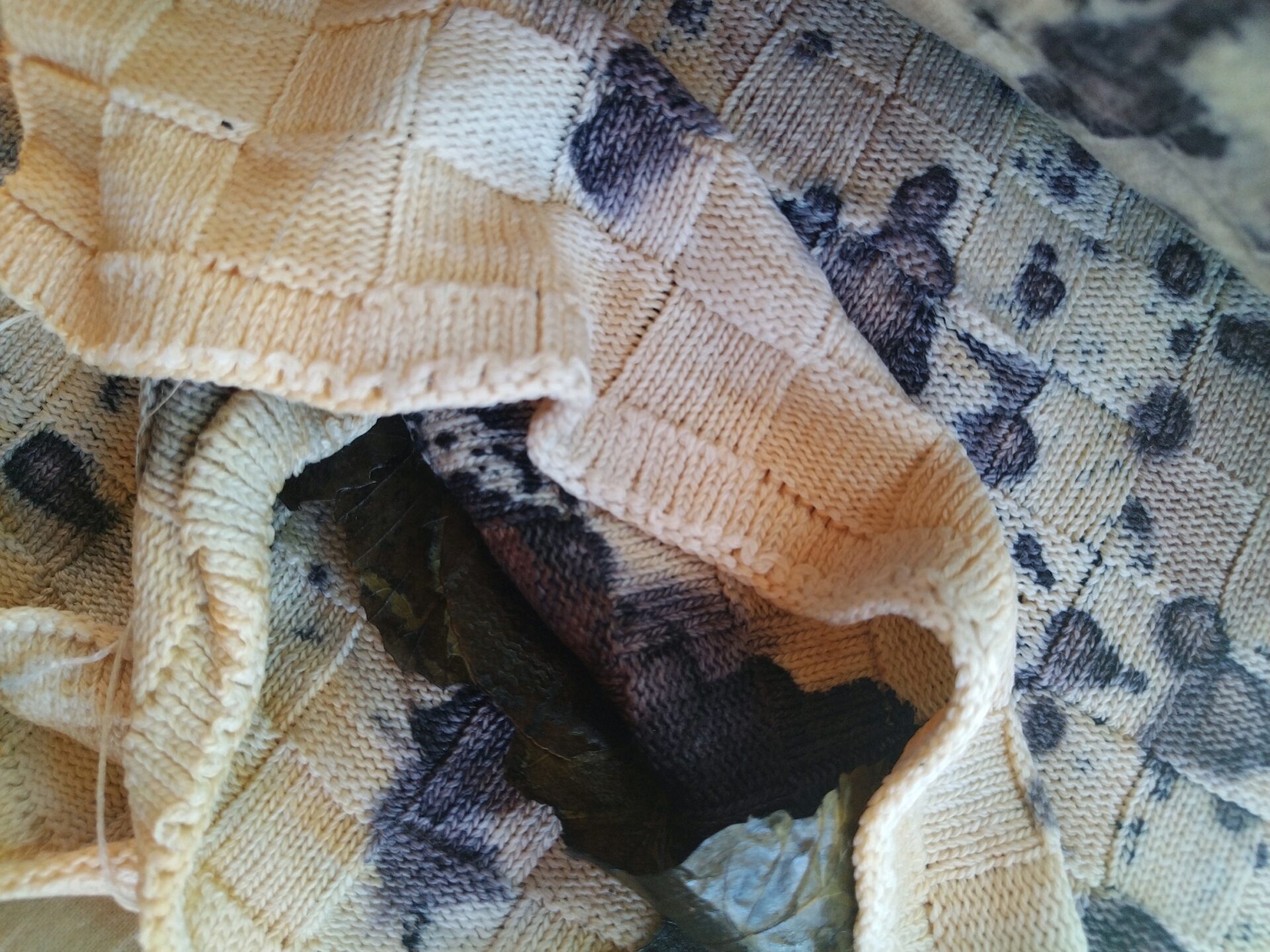 Ira dyes Shaldon’s knits using sawtooth oak leaves, grown in a small plantation on the farm where she lives
“My interest in natural dyes comes from wanting the pieces to be fully biodegradable,” says Shaldon. “It’s difficult to show that, but it’s important.” The process uses minimal water, avoids synthetic chemicals, and produces no waste; the botanicals used returned to the soil and the rusted objects kept. This reflects their shared philosophy of fairness and integrity. “We pay what it’s worth, and the entire process has to be considered every step of the way,” Shaldon says.
Even on the high-fashion stage, making textiles in this hands-on way is unusual. Naturally printed textiles are ever-changing, requiring understanding and patience from customers that no two pieces will be exactly the same. Naked Ape’s clients, both locally and internationally, understand and appreciate this, with most willing to pay a price that reflects the bespoke nature of these unique pieces.
The response for the SAFW show was overwhelmingly positive. “The interest was phenomenal. People really appreciated what they saw,” Shaldon says. The collection represents not only a slow fashion ethos but a commitment to craftsmanship, sustainability, and a uniquely South African expression of style.
At the heart of their collaboration is a shared integrity. “We both gravitate towards slow, natural processes and excellent craftsmanship,” says Ira. “This places the collection and our work together on a very different level from fast-paced, trend-driven fashion leaving space for something more experimental, more organic to arise.”


