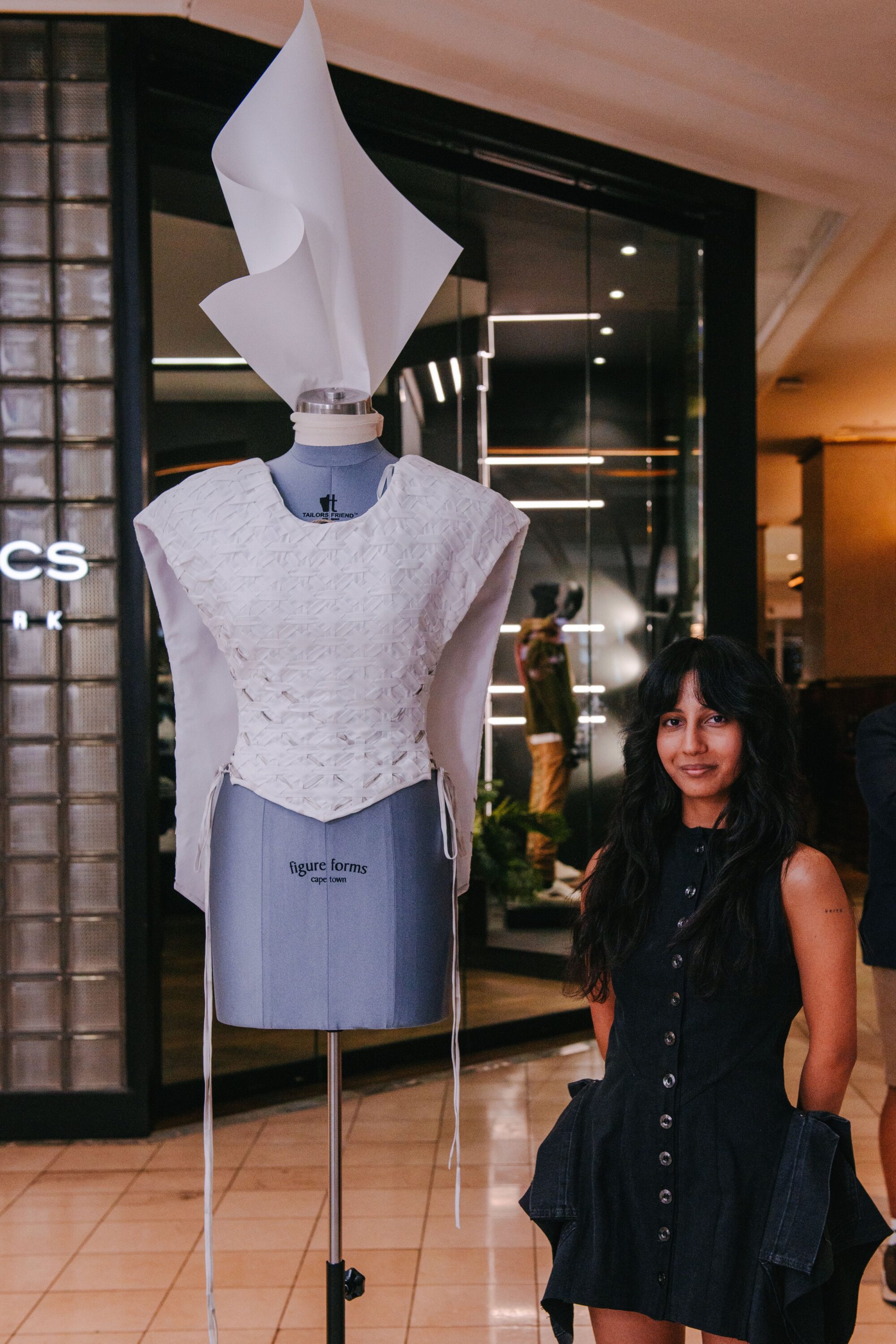
Nawaal Joosub is a fashion design student from STADIO School of Fashion and the founder of House of Nyx. She was recently chosen as the winner of the 2025 SAFW Student Competition for her interpretation of the competition’s theme Show Us Your Shirt. Her winning design was a corset and cape crafted from 100% cotton secondhand fabric, cut into strips and handwoven in a process that took nearly 40 hours.
What inspired you to enter the SAFW Student Competition?
I felt ready to test myself in a space that demanded both intention and clarity. South Africa Fashion Week carries a standard of design thinking I’ve always respected — a place where the work must speak for itself. I wanted to be challenged, to step into a room that required confidence not only in my technique but in my voice. Entering was my way of saying, “I’m ready to be seen.” It felt like the right moment to push my limits, to grow beyond the comfort of school, and to honour how far I’ve come as a designer.
How do you balance your design aesthetic with sustainability?
My design aesthetic lives in the tension between structure and emotion — garments that feel architectural but still vulnerable, textured, and human. For this piece, weaving became both technique and metaphor. The shirt holds a strong silhouette but has a tactile, handmade intimacy. Sustainability shaped the entire process, not just the materials. I used a single discarded white bedsheet from my sister, transforming it into strips and weaving it by hand. Nothing went to waste. Limitation became a design language of its own. It let the garment feel honest, intentional, and rooted in the idea that beauty can emerge from what already exists.
Tell us about your choice of material.
For this garment, I used one discarded white bedsheet — nothing more. It belonged to my sister, who was giving it away, and I loved the idea of taking something from home, something with history, and transforming it entirely. I cut the sheet into strips and wove every piece back into the structure of the garment. No fragments were thrown out. I wanted to show that sustainability doesn’t need multiple sources or complicated systems; sometimes it’s about reimagining a single overlooked material. The sheet dictated weight, drape, and rhythm, becoming both the medium and the message of preservation and rebirth.

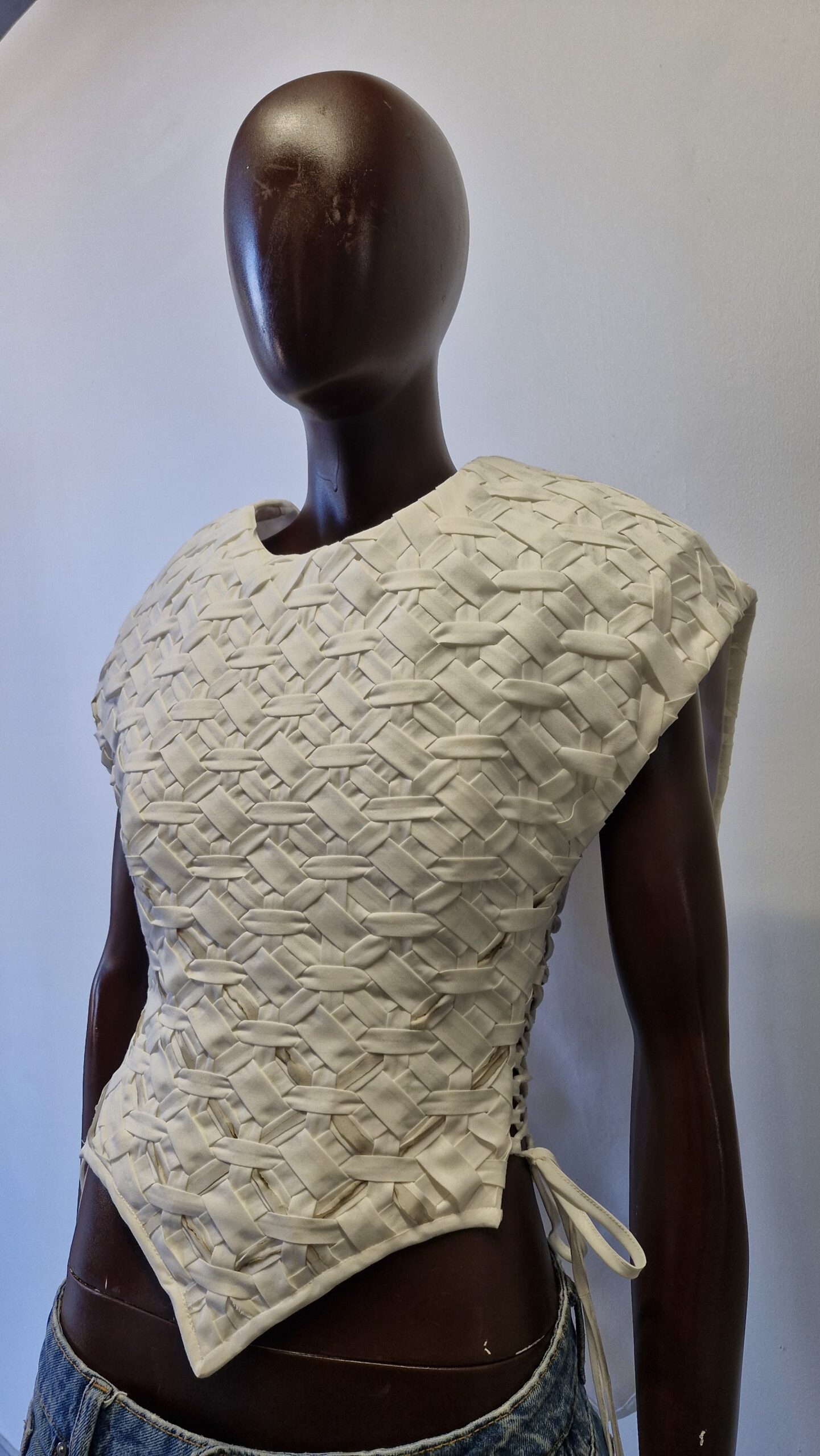
Cape and corset by Nawaal Joosub, a zero-waste piece made from a discarded 100% cotton bed sheet
What have you learned from the competition experience?
This competition taught me the value of clarity — not in the sense of perfection, but in knowing the emotional centre of my work. When you understand the story you’re telling, the technique follows naturally. I also learned to trust myself again. Fashion school is full of opinions and comparisons, and it’s easy to lose your voice in the noise. Creating this garment reminded me that instinct is part of craft. Winning was incredible, but the deeper lesson was realising that my work resonates when I honour what feels true to me.
What impact do you hope for your work to have?
I hope my work helps people reconnect with clothing as something living — something that carries memory, touch, and emotion. In a world obsessed with disposability, I want to revive reverence: for materials, stories, and the human effort behind every garment. My work often explores preservation and transformation, and I hope it encourages others to see change not as loss but as evolution. So many young people feel constantly undone by life. I want my designs to say, “Being rewoven is not failure. It’s power.” If my work inspires gentleness, introspection, and care, I’ve contributed something meaningful.
What’s on your moodboard right now?
I currently have about six moodboards open, each holding different textures, colours, and symbols. But recently, moths and snakes have become dominant. Moving into 2026 feels like stepping into a transformation phase — quiet, internal, and strangely tender. Moths captivate me because they’re misunderstood; they embody metamorphosis in a raw, haunting way, shaped by darkness and drawn to light. Snakes reflect shedding and renewal — letting go of what no longer fits. Together, these symbols echo the place I’m in creatively and personally. I’m gravitating toward themes of rebirth, mystery, and the beauty of becoming something new.
Who would you love to collaborate with, from any field?
I’d love to collaborate with world-builders. People who expand reality instead of replicating it. Filmmakers like Nadia Lee Cohen or visual artists like Erik Johansson fascinate me because they create atmospheres rather than just images. I love the idea of placing fashion inside surreal, immersive narratives where garments feel like characters rather than objects. Even collaborating with choreographers or performance artists interests me, especially with my background in ballet. Movement brings garments to life. Beyond that, I’d love to collaborate with new and emerging talent, especially other graduates or creatives who, like me, carry a fire to be unique and unapologetically themselves. There’s something electric about working with people whose ambition and curiosity are raw and fresh.
What are your hopes for the future of House of Nyx?
In the next decade, I want House of Nyx to be recognised for conceptual storytelling, craftsmanship, and sustainability that feels sincere and poetic. I want to create collections that can sit in galleries, museums, and archives. Pieces that people study, photograph, and reference. Success, for me, is longevity: work that continues to speak long after its season ends. I’d love to see my garments at the Met Gala or in cinematic worlds, but more than that, I want a body of work that feels cohesive, memorable, and emotionally resonant. If my designs live beyond their moment, I’ve succeeded.
Do you think true sustainability in fashion is possible?
I think that true sustainability requires honesty. Fashion will always have impact, but we can choose how intentional that impact is. For me, sustainability isn’t perfection — it’s responsibility. It’s acknowledging limitations, respecting materials, and refusing to treat people or resources as disposable. I don’t believe in flawless sustainability because fashion, by nature, uses energy and labour. But I believe in meaningful sustainability. Practices that minimise harm, value longevity, and honour the emotional and environmental cost of making something new. If brands embed care into every stage of creation, we move closer to a future where sustainability is standard, not optional.
- Follow House of Nyx on Instagram