

Clothes are everywhere at the Gallery of the University of Stellenbosch on Dorp Street in Stellenbosch. Bright, appealing life-size marker drawings of clothes hang on the walls of the main gallery space. In the same space, about 80 items of clothes are piled on a stand; nine pieces are neatly displayed on shelves as if in a luxury fashion boutique and several more hang from two clothing rails. In an adjoining room, there are small black ink drawings of clothes pegged on a string running from one wall to another. A film – with sea gulls as the soundtrack – depicts secondhand clothes strung between poles on a beach in Tanzania.

Dutch artist Jan van Esch is a visiting artist-in-residence at the Stellenbosch Academy for Design and Photography whose current art project uses clothes as a metaphor to understand the Western concepts of altruism and gifting. According to curator Mike Mavura, this exhibition, titled Mitumba: Invasive Species, is a meditation on the production of clothes, their circulation, their allure (from fast fashion to couture), more importantly our relationship to clothes and (once we lose our affinity with them) their afterlife.

Jan worked as an international development aid worker in Russia, Nigeria and Tanzania until he quit to become a full-time artist in 2010. During a 2016 residency in Berlin, he volunteered at the non-profit humanitarian organisation Red Cross where he worked with donated clothes, sorting them into what was given to people who needed them (at the time Syrian refugees were recipients of many of these clothes), what was sold at the Red Cross shop and the bulk of which would go to secondhand clothing companies that sent the clothes to other parts of the world.

By now it’s well documented that millions of secondhand items of clothes end up in city markets in Kenya, Ghana, Nigeria, Tanzania, Zimbabwe, and elsewhere creating competition for local fashion industries and environmental issues almost everywhere.
Having questioned how development aid is carried out by international NGOs when he was working for them, Jan now focusses these questions on donations of secondhand clothing. Influenced by the 1925 essay, The Gift by Marcel Mauss, he is interested in the power play of exchange and how this shapes relationships between humans. “A gift is always something you receive, and which is reciprocated by you giving in return,” says Jan. By receiving and giving, there is a balance of power, and both parties are treated as equals. But in Western altruism, by giving without receiving in return, the recipient is not treated as equal. Jan says, “People love the concept of altruism. But a lot of Europeans don’t see the poison in the gift. We send our gifts to anonymous people and we don’t allow people to give it back to us – it’s a power play.”
In questioning the subliminal motive of giving, Jan plays on the meaning of the German words for “to give away” and “to forgive”. He says that Western aid is framed as a gift to forgive ourselves for our culture of excess. He explains, too, that the word “gift” in German (which has the same root as gift in English) means poison – gifted clothes in the Global South often end up poisoning the environment.
A gift without a counter gift is garbage
Giving and receiving should be circular. It should not be one-directional. “A gift without a counter gift is garbage,” says Jan who has returned clothes he finds in Tanzania to Europe. “I found high-end clothes and took them back to the streets of Berlin as a performance, but no one wanted them. But when I did something similar in a museum in Sweden, people wanted them. In Berlin, the performance was in the street, but in Sweden it was in a museum. My conclusion is that people are mostly persuaded by the way clothes are presented, not what they are.”
While on the residency in Stellenbosch, Jan spent time with students understanding the relationship we have to our clothes and understanding identity, sustainability and fashion. The fashion industry frames clothes with identify. If we associated our identity to clothes, why do we need to change them so often? Jan thinks we over-estimate what our clothes do for our identity. “Funnily, the same argument is used for tattoos – they are about identify. You’ll put a tattoo on your arm which is permanent. So, why do clothes have to change? The way it is framed by the fashion industry is very convenient for the fashion industry.”
Jan started drawing clothes to gain a better understanding of them, to study them closely. By giving them attention, he is giving them value. “I started drawing clothes – I was making very small line drawings. How can people have a different connection with clothes, other than as useable tools.”
The small line drawings of clothes on exhibit have contact details of the original owners of the clothes. When the physical items are given to a new owner, they can contact the original owner to share experiences of the clothes. These lines of communication would be global of nature, like the trade of clothes. Looking at the stand of clothes in the gallery you can’t tell what came from Europe and what comes from South Africa. “It’s interesting that we have such a globalised system. Using the clothes as indicators, it is hard for me to see this is as another country,” says Jan.
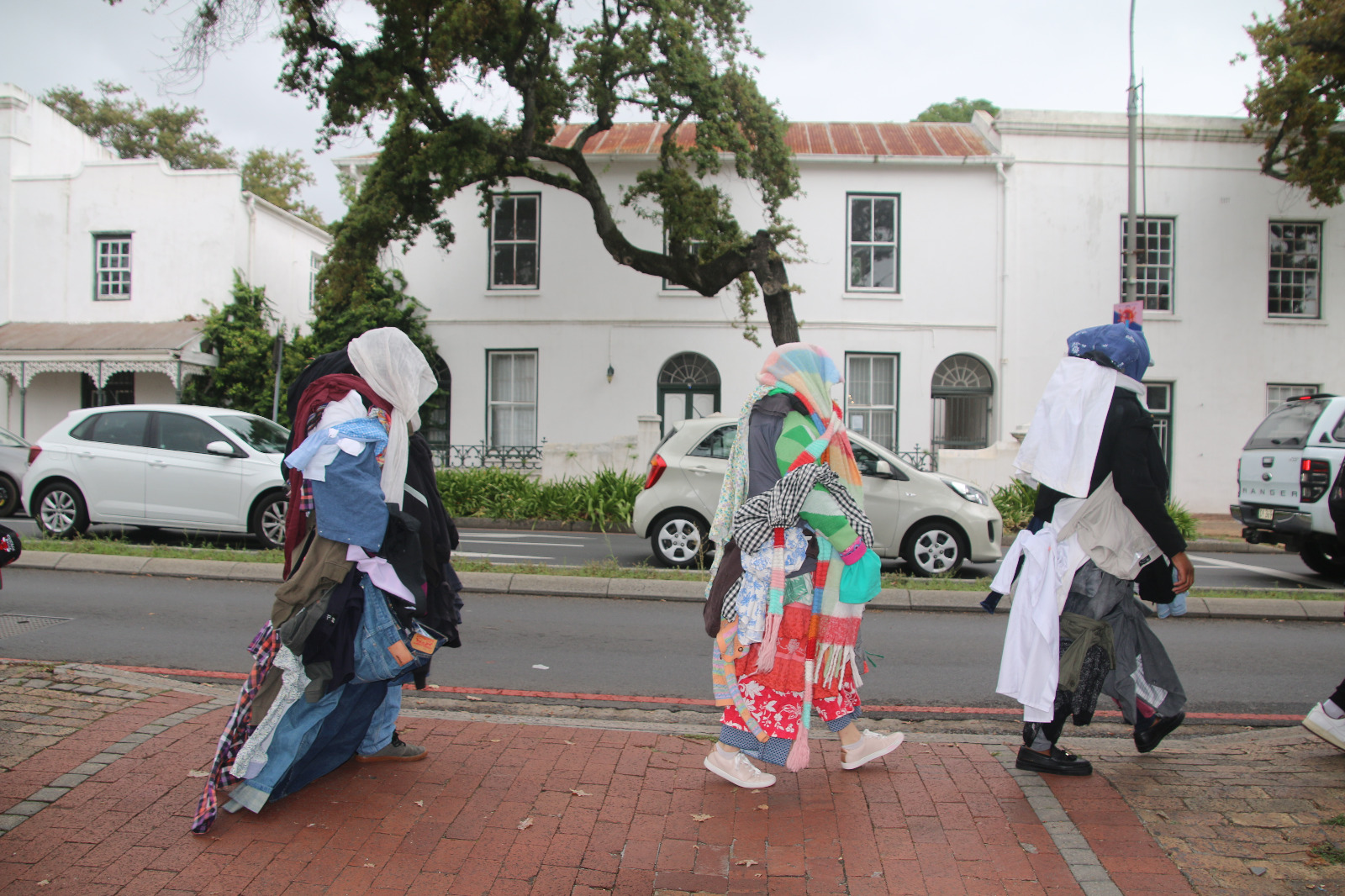
For the exhibition opening on 17 March (and which closed on 27 March), Jan along with 20 academy staff and students wore all their clothes, between 50 and 200 items each. Outside the gallery, they undressed, and stood amongst a heap of clothes. “Most people aren’t aware of how many clothes they have – 85% of the clothes we throw away end up in landfill.”

On the day of this interview, Jan is wearing a black logo T-shirt, a pair of synthetic sweat pants and flip flops. “Two years ago, I would never have worn this,” says Jan pointing to the well-known Swiss brand Mammut logo on his outfit. He wears clothes he has scavenged and which he intentionally does not alter. If he upcycled them, he would be buying into the fashion system of constant change.
His found clothes are good enough to wear for another several years, a statement against fast fashion’s value proposition of newness and scarcity.
PS: Jan does allow for an exception to his found wardrobe: he does not scavenge for his underwear and socks.

- Follow Jan on Instagram @jplvanesch and @drawnclothes_jve and visit his website here
- Images © Emily Clarke except the final one which is by © Janie Heyns, featuring curator Mike Mavura, GUS’s Rabia Abba Omar and Jan


