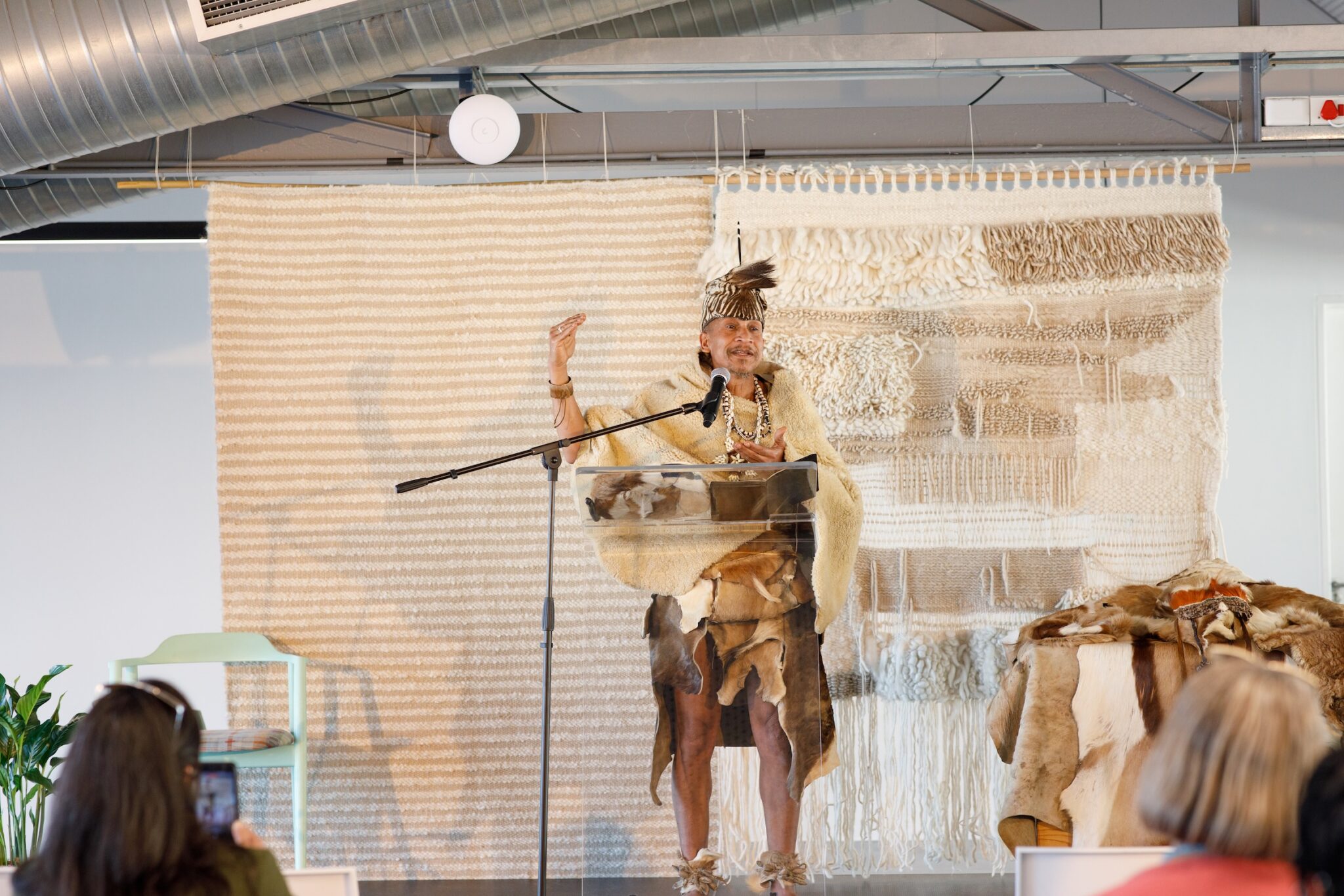

“Before any fabrics were made by hand, the original form of garments was natural skins.” This is what southern African language activist and researcher, !Khōdanab Bradley van Sitters said at the Africa Textile Talks in Cape Town in August.
In southern Africa, animal hides and skins are manifestations of heritage and pre-colonial histories, and are archives for many of knowledge and spiritual practices. !Khōdanab’s work is focussed on preserving the Khoi and San people’s culture and languages. He uses oral storytelling as a medium for studying indigenous southern African knowledge and sharing it with the public.
In modern culture, animal hides and skins have become separated from their cultural context and associated with environmental degradation and animal cruelty. !Khōdanab said our view of animals is skewed as we have positioned ourselves as their protectors not their equals. According to !Khōdanab, entities that were once seen as one with us are now exploited. Many South Africans have abandoned leather and use cloth textiles instead during ceremonies.
“When Europeans came here [to South Africa], they made us feel primitive about a lot of things, including our clothing,” !Khōdanab said in an interview after Africa Textile Talks in August. Europeans disregarded the versatile ways that animal skin was used in our societies, including wearing them.
“Indigenous people didn’t create rubbish. Every part of an animal was used. Even for the stitching of the leather garments, parts of the insides were used as thread,” !Khōdanab said.

!Khōdanab Bradley van Sitters at Africa Textile Talks 2026 in Cape Town. Image: The Dollie House
In the traditions he described, the relationship was spiritual. Traditionally animals were seen as sentient beings that connected people to the spiritual realm. They were a channel to communicate with the ancestors and a vessel to heal people. He said, “Healers entered a trance state and connected with the animal and took the form of an animal.” The animal’s perceived potency was used to heal people through touching.
“Animals were seen as relatives. People were animal and animals were people,” he said in the interview. Clans had totem animals that they traded in and to which they had a spiritual connection.
“Among the Kora [nomadic Khoikhoi], you have those [whose] clan name is linked to the buffalo and the springbok,” !Khōdanab said. For the Nama, a people who reside in South Africa, Namibia and Botswana, the zebra had significance as it was the animal that led them to water in the desert area. Clans would barter the different animal skins amongst themselves.
Referring to the San or Khoi of Southern Africa, ! Khōdanab said, “For any ritualistic aspect of a person’s life, the eland was always there.” Gaining the name ‘people of the Eland,’ they used the animal in various rights of passages as it was considered a blessing of anointment. Before entering manhood, a boy would hunt an eland and wear its skin to show his first garment of adulthood. The animal appears in rock art, representing spiritual and divine connection.
!Khōdanab said the challenge now is to reconnect people with these histories and rethink the way that people view animals.
Many of practices and belief systems have been lost but not completely eradicated. There is a rising interest in decolonisation amongst the youth. Dominant systems of knowledge are being challenged in contemporary African fashion. For instance, leather accessories brand, Project Dyad, and the sustainable tannery in Wellington, Mossop Leather, are championing care in a complex industry.
We have the power to preserve and respect our history. “Leather reminds us of our original state of being,” !Khōdanab said. “It is deep cultural identity.” Centring this reminder can guide us on how to use the material in a considered way in the modern context.
- Feature image of !Khōdanab Bradley van Sitters at the Africa Textile Talks in Cape Town in August. Credit: The Dollie House