The classic mantra of sustainability – reduce, reuse, recycle – has never been more of a pertinent call to action than for today’s fashion industry. It’s estimated that only 13% of clothing is recycled globally, with less than 1% actually recycled back into the textile supply chain, according to the National Cleaner Production Centre South Africa. With more than two thirds of all clothing on the planet made of plastic materials, the result is that most of our discarded apparel ends up in landfills, taking over 200 years to decompose.
These types of statistics are well known, but we are also seeing innovative and creative solutions for reuse and resale of clothing taking hold. In South Africa, second-hand fashion has seen significant growth, accounting for an estimated 9% of the country’s apparel market revenue. In the UK, that’s likely an even higher number, with an estimated 40% of consumers saying they shop second-hand to afford high-end brands. It’s probable that this trend will increase globally, as second-hand takes over 10% of global fashion sales.
Anyone who has dug through a pile of second-hand clothing looking for treasures will know that with the evolution of style, fit and sizing, a perfect piece is hard to come by. That’s why good thrifting often goes hand in hand with upcycling, modifying old or outdated existing products to refresh their second life. But it’s not only savvy thrifters who have taken to upcycling. Fashion brands themselves have seen the opportunity to create revenue from excess through upcycling, bringing new consumer appeal to outdated items and promoting circular and sustainable fashion.
There are many potential benefits to upcycling at scale. By increasing the lifespan of clothing and accessories and preventing the frequency of items being discarded in landfills, upcycling has an important role to play in the path to a more sustainable fashion industry. There’s a creative upside as well, as deconstructing and reconstructing garments creates new styles, often with a unique fit and fabric composition. Upcycling also involves various aspects of the design process and can be labour intensive, creating scope for high-end upcycled clothing, including unique, one-off pieces which can be sold at a premium. This is unlike second-hand styles which are often heavily discounted.

Miu Miu upcycles its vintage garments. This dress is from a collection designed in collaboration with Catherine Martin. It is made from vintage scarves featuring nautical prints
Luxury brands such as Balenciaga, Miu Miu, Loewe, and others, have embraced upcycling – particularly after the pandemic, which led to approximately USD 179 billion worth of excess inventory from the spring/summer 2020 collections. And it seems that there is a market for it, especially among younger generations – according to Deloitte’s 2024 Gen Z and Millennial survey across 44 countries, approximately 64% of these generations are reportedly willing to pay more for sustainable and environmentally friendly products.
Like anything involving creating, branding, retail and consumption, there could be a legal framework applicable to upcycling
While there is an upward trajectory for upcyclers, it’s important to ask if there are pitfalls to these practices. Like anything involving creating, branding, retail and consumption, there could be a legal framework applicable to upcycling. Although your average upcycler mixing fabrics at home might not be affected, businesses who bring upcycling into their designs may need to consider the intellectual property implications associated with upcycling.
How does this work?
Branded products (especially big brands) will usually be trademarked to protect the IP of the brand, particularly to protect them from counterfeiting. According to the trade mark exhaustion principle, once a trademark owner introduces trademarked products into the market, they can no longer prevent the further commercialisation of the same items by a third party as their ability to control the further distribution of that item is ‘exhausted’. In other words, if a trademark owner sells goods bearing their trademark, the trademark owner cannot prevent the purchaser or another person who comes into lawful possession of the goods, from reselling the items under the original trademark. For example, when you buy an Adidas jacket from an Instagram thrifter, the seller is perfectly entitled to advertise that jacket as ‘Adidas’ and benefit from the revenue that brand creates.
If the infringing party uses the trademarks without the owner’s consent and the use of the trademarks could lead to a likelihood of confusion amongst consumers as to the source of the products, there is potential for trademark infringement
However, this principle may not always apply to upcycled products that use materials displaying trademarks, as it may constitute trademark infringement if the products are materially different from the originals. In such an instance, if the infringing party uses the trademarks without the owner’s consent and the use of the trademarks could lead to a likelihood of confusion amongst consumers as to the source of the products, there is potential for trademark infringement.
Although there have not yet been any cases in the South African courts, there are a few interesting examples of this from the United States. In the US, the courts have applied the “exception of material difference” to the trademark exhaustion principle, specifically in upcycling cases.
Chanel unbuttoned
In Chanel, Inc. v Shiver and Duke, LLC, Shiver and Duke, an upcycling company, was refashioning original Chanel buttons bearing the iconic CC monogram on chains, earring and bracelets. Chanel issued a complaint against Shiver and Duke for trademark infringement, unfair competition and trademark dilution. The Southern District of New York gave judgment in favour of Chanel, permanently preventing Shiver and Duke from upcycling and refashioning authentic Chanel buttons bearing the CC monogram.
The court’s reasoning was twofold. First, there was an obvious material difference in the buttons not being used on clothing but instead for jewellery. This means that the items were not being resold under their original trademark (i.e. as buttons), and the exhaustion principle was not applicable. The second reason was that the commercial interest in the jewellery produced by Shiver and Duke was in the use of Chanel’s CC monogram and in the use of the Chanel name to promote and market the jewellery. For both reasons, the use of the mark was deemed to be trademark infringement.
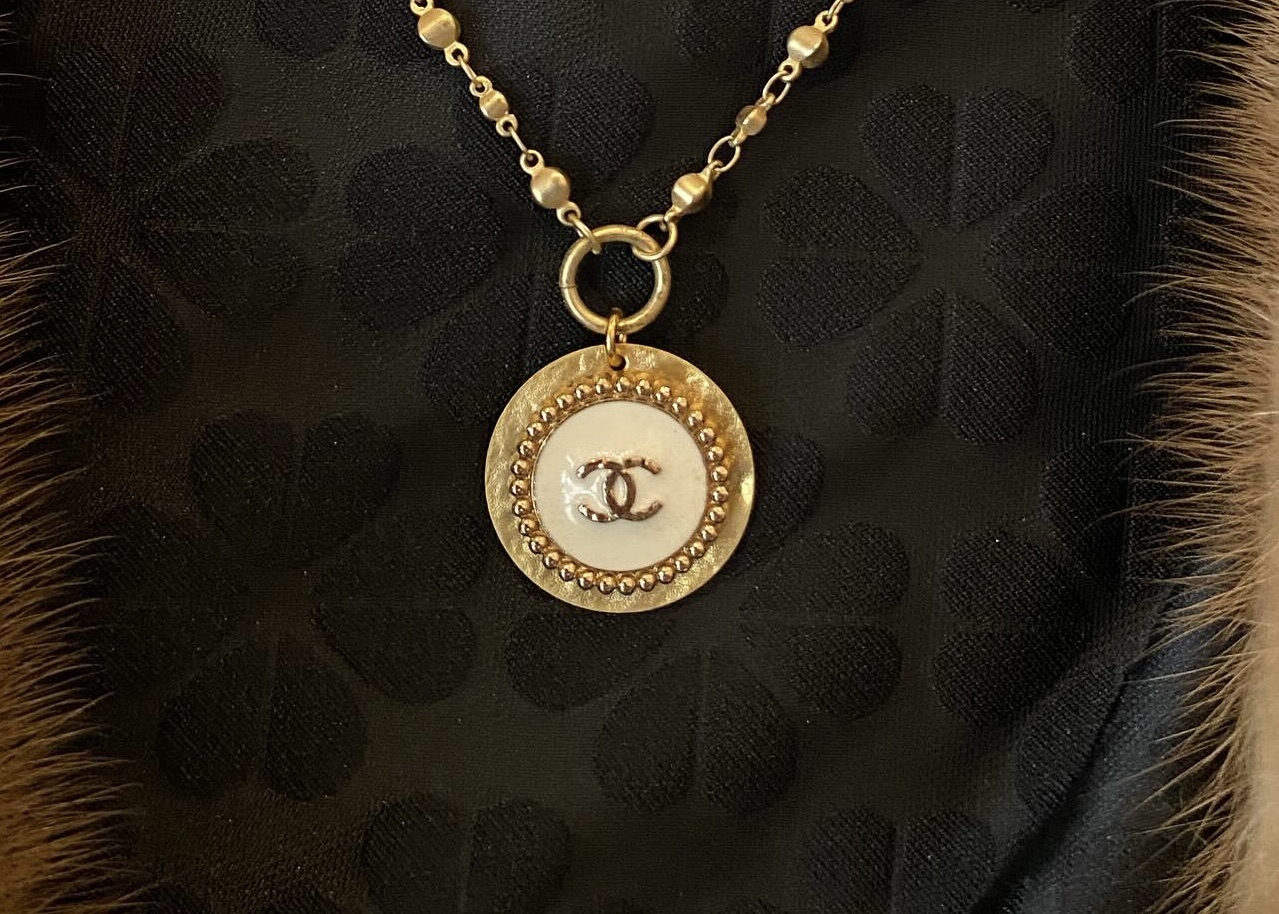
Shiver and Duke upcycled jewellery using the Chanel monogram which was found to be an infringement of copyright by a court in the United States. Image: Facebook
Louis Vuitton, but make it tasselled
In Louis Vuitton Malletier S.A.S. v Sandra Ling Designs, Inc, Louis Vuitton alleged trademark infringement by Sandra Ling Designs for the sale of apparel, handbags and accessories made from supposedly authentic pre-owned Louis Vuitton goods customised with stones, tassels, and beading. Sandra Ling deconstructed the Louis Vuitton products, in particular the logos, and added them to her own creations. Louis Vuitton argued that her actions fell within the material difference exception, that the use of the signature ‘LV’ allowed her to benefit from the Louis Vuitton reputation and customer base that the branding suggested that Louis Vuitton had in some way approved the goods.
For a small upcycling business, that’s a hefty fine which certainly acts as a deterrent to other upcyclers
The items themselves no longer bore any close resemblance to the original Louis Vuitton products and Ling argued that no customer would believe that the goods were connected to Louis Vuitton, as they were clearly upcycled. The case ultimately settled with Ling ordered to pay Louis Vuitton $603 000, so there was no court opinion which leaves some uncertainty as to the legal principles – but Sandra Ling was permanently prevented from refashioning Louis Vuitton items. For a small upcycling business, that’s a hefty fine which certainly acts as a deterrent to other upcyclers.

Examples of goods made by Sandra Ling Designs using the Louis Vuitton goods. Image: Court papers from United States District Court Southern District of Texas
These examples clearly show that there are legal limitations that can be placed on upcycling. Although South Africa hasn’t had the type of legal challenges seen in the states, our IP laws do also prohibit using trademarks in a way that confuses consumers or misrepresents the origin of goods, so its worth taking note of these examples.
But litigation in this area shouldn’t deter upcyclers from creating – rather, it should prompt bigger brands to reflect more broadly to ensure that they don’t take legal action that may be at odds with their sustainability commitments. Upcycling represents sound environmental principles which major brands will be quick to pay lip service to, so this represents a good opportunity to endorse these principles in practice. Some brands have already found a possible solution by upcycling their products themselves, allowing them to maintain full control over their processing and avoid third parties doing so. Brands may also consider partnering with upcyclers to have greater control while still encouraging the upcycling process.
The exhaustion principle can also be seen to support upcycling rather than limiting it, by enabling consumers to repurpose materials after the first sale – as long as the item remains largely in its original form. On the other hand, the exception to the principle and other IP limitations can limit the scope of upcycling, conflicting with the goal of reducing waste and promoting sustainable consumption.
To stay clear of legal issues, the best approach for upcyclers will be to avoid using the original product’s branding in a way that misleads consumers.
- Additional reporting by Robyn Moriarty (Associate, Intellectual Property) and Refilwe Riba (Candidate Attorney, Intellectual Property) at Webber Wentzel
- Emily Gammon is an ESG Knowledge Lawyer at Webber Wentzel
- Images sourced from Miu Mui, Facebook and court papers from United States District Court Southern District of Texas
- Feature image: Marine Serre campaign State of Soul
- This is updated version of an article that appeared in Polity and the Mail and Guardian