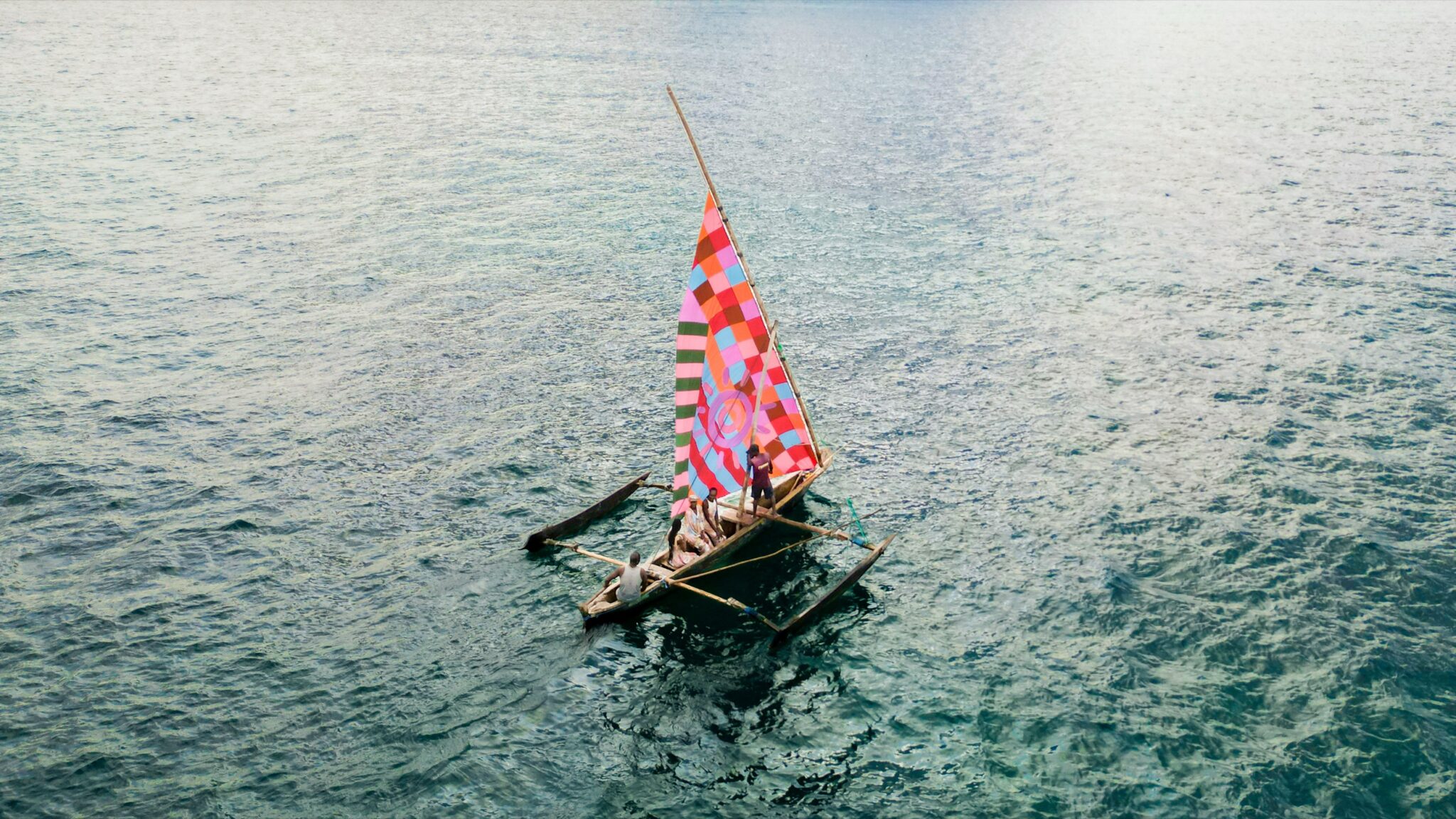
Across the continent of Africa, memory lives in rhythm and thread. Memory is in the pulse of a song, the weaving of cloth and in the repeated gestures of passing down knowledge from one generation to the next. Long before archives had shelves, textiles and music held our histories, preserving stories that refused to be forgotten.
Within the second iteration of the exhibition Threads of Renewal at The Library of Things We Forgot to Remember, this legacy gathered again where cloth, rhythm and ritual met as acts of healing and future-making with artists weaving memory into matter, turning craft into care and care into quiet resistance.
Curated within Kudzanai Chiurai’s archive of African cultural memory, this iteration gathered artists and textile practitioners exploring cloth as a living vessel through which stories, gestures, and spirits of the past continue to breathe.
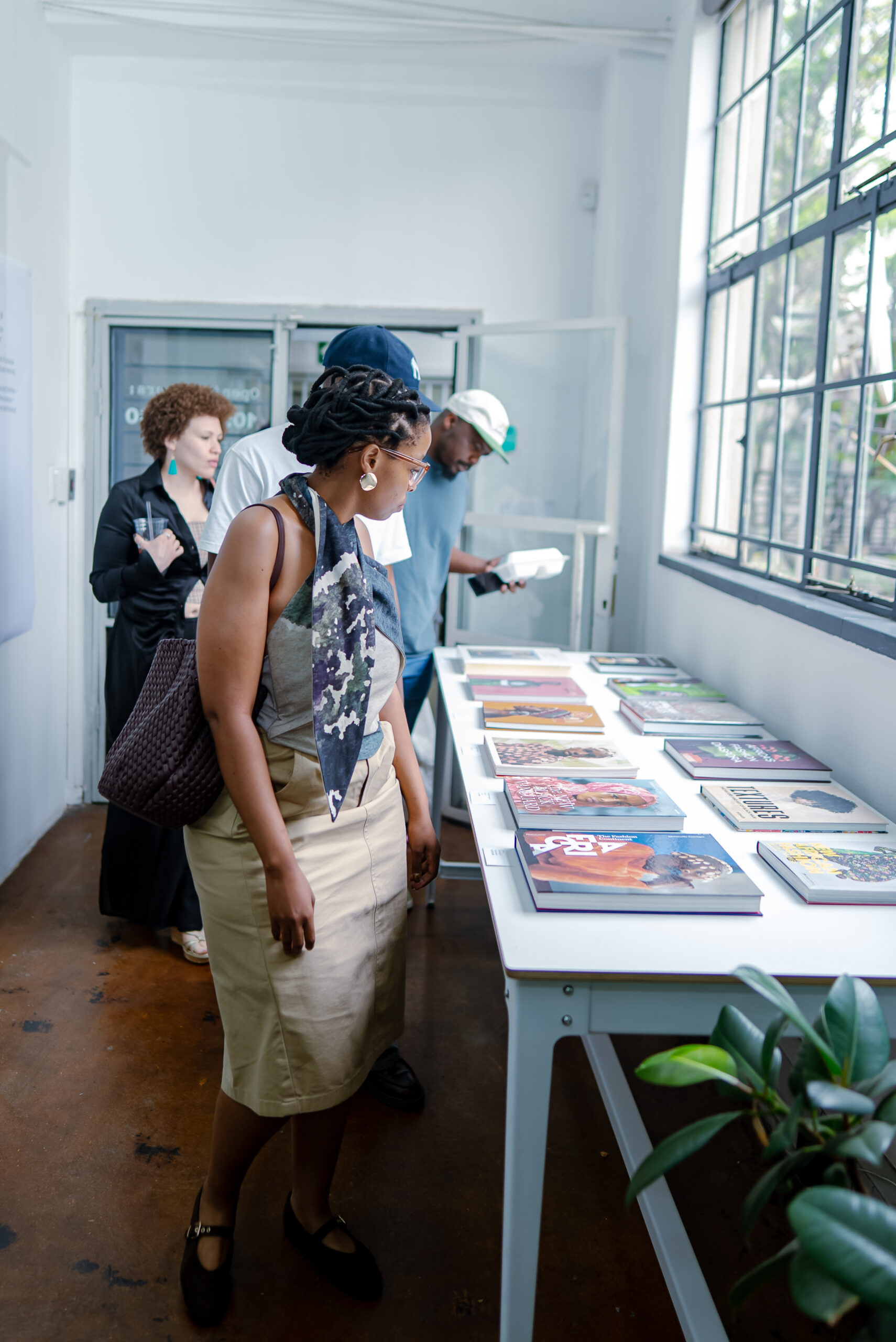

Selection of African fashion, textile and craft books from Clarkes Bookshop. Images by Tshepi Seeri
Working within The Library of Things We Forgot to Remember, which features a sonic archive including popular music, resistance songs and speeches, grounded the exhibition in a site-specific space and linked to the themes of Memory & Ancestry and Healing & Resistance. In the same way, cloth is a medium for cultural continuity, music within the context of African traditions has been used as a tool for passing down stories, defiance and resisting erasure. Keitu Gwangwa, The Library’s co-ordinator, curated a vinyl selection attendees could experience in the listening area. This selection featured King Kong’s All African Jazz Opera (1959), Busi Mhlongo’s Urban Zulu, Apala, Apala Groups in Nigeria 1967-70, Juju A Message from Mozambique (1973), Niger: La Musique des Griots (1969) and Zaria Julius’s Whatever You Throw at the Sea (2023).
The exhibition also featured a selection of African fashion, textiles and craft books from Cape Town-based bookstore Clarkes Bookshop. Curated by Andre Sales, the literary selection held titles such as Chris Spring’s African Textile Today, Christine Giuntini and Jenny Peruski’s How to Read African Textiles, and Thandiwe Muriu’s Camo. These titles and others were available for sale and based the exhibition in research, expanding its educational dimension and affirmed that African design, fashion and textile making are not only aesthetic traditions but rich knowledge systems. The presence of these books sought to inspire attendees to continue exploring these histories long after leaving the space.

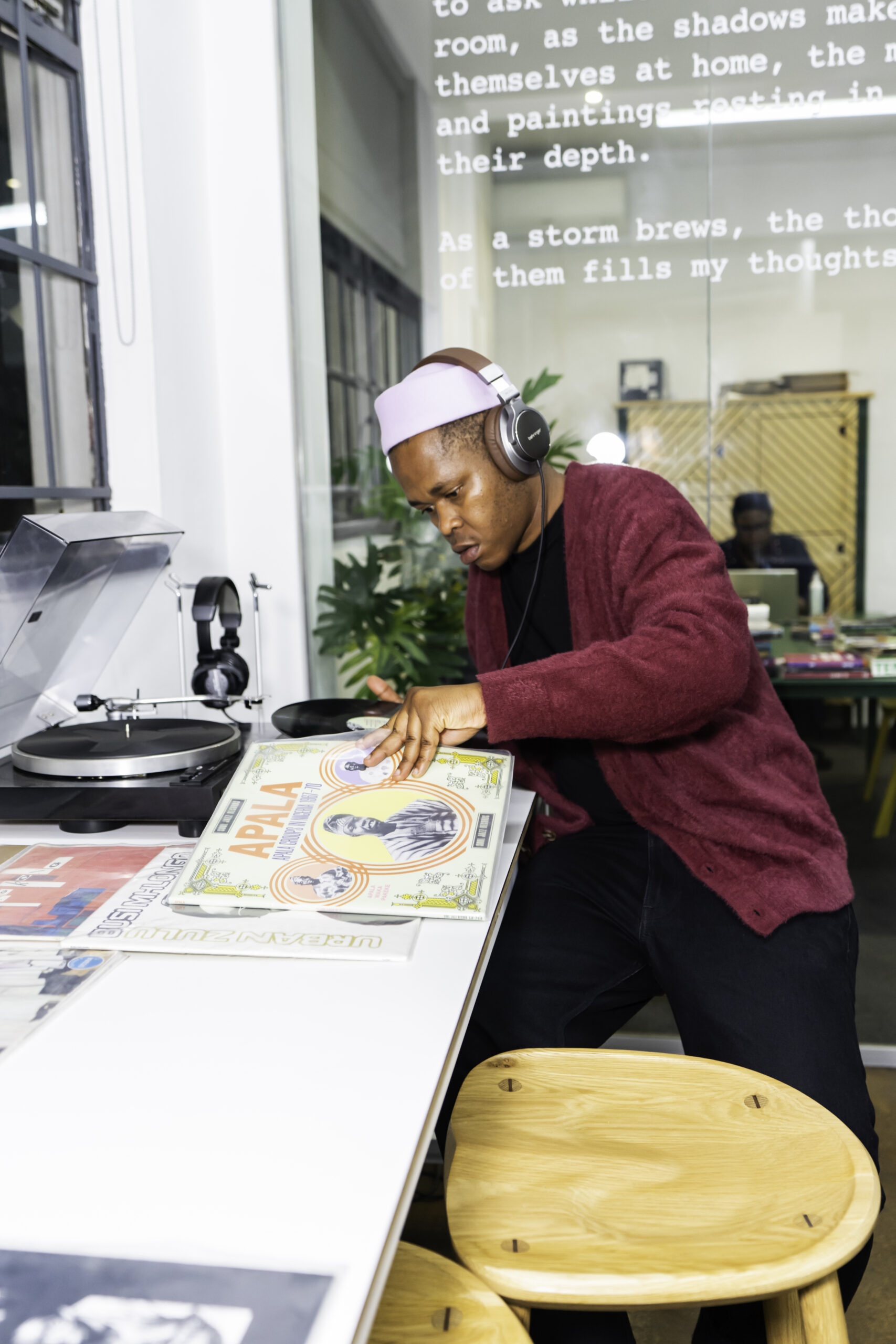
The vinyl selection curated by Keitu Gwangwa, The Library’s co-ordinator. Images by Tshepi Seeri
At its heart, Threads of Renewal begins with the act of remembering. Through cloth, the artists summon ancestral presences and suppressed narratives, stitching together histories fragmented by colonial erasure. Here, textiles become testimony that carry encoded knowledge and spiritual resonance.
If the first movement of the exhibition is remembrance, the second is repair. Healing & Resistance considers cloth as a radical site of mending, a material metaphor for resilience, reclamation and renewal. Within these works, resistance is not only a stance of defiance, but a practice of care: the quiet labour of restoring what violence and exploitation have torn.
Bulumko Mbete’s Earthsong, Earth’s Time (2025) performs a choreography with nature, tracing the alchemy that arises when traditional crafts meet ecological ritual. Working with woven discarded fabrics, beading and ceramic, Mbete’s practice reclaims the tactile intelligence of Southern African women’s craft as an archive of love and continuity. Similarly, Sibabalwe Ndlwana’s Mountains of the Moon (2016) meditates on identity and belonging through handwoven tapestry. The tension between structure and freedom in her work mirrors the delicate balance between preservation and transformation, reminding us that craft itself is a living, evolving archive.

Mountains of the Moon (2016) by Sibabalwe Ndlwana

Earthsong, Earth’s Time (2025) by Bulumko Mbete
Namibian designer and lecturer Maria Caley extends this inquiry of repair through her engagement with indigenous knowledge systems, mission histories and local material culture. Her textiles interpret Namibian heritage through design, asserting fashion as both remembrance and reclamation.
Caley designed the ondhelela dress on display for Tuli Mekondjo’s performance of Saara Omulaule/Black Saara (2023), which she improvised after reading Keri Miettinen’s book On the Way to Whiteness – Christianisation, Conflict & Change in Colonial Owamboland. The book features the story of Black Saara – The little Negro Girl, which prompted an avenue of questioning of why Mekondjo’s ancestors would abandon their Aawambo cultural traditions to convert to Christianity. The dress stands as a symbol of the impact of colonial erasure of African traditional practices and insists on cultural reclamation.
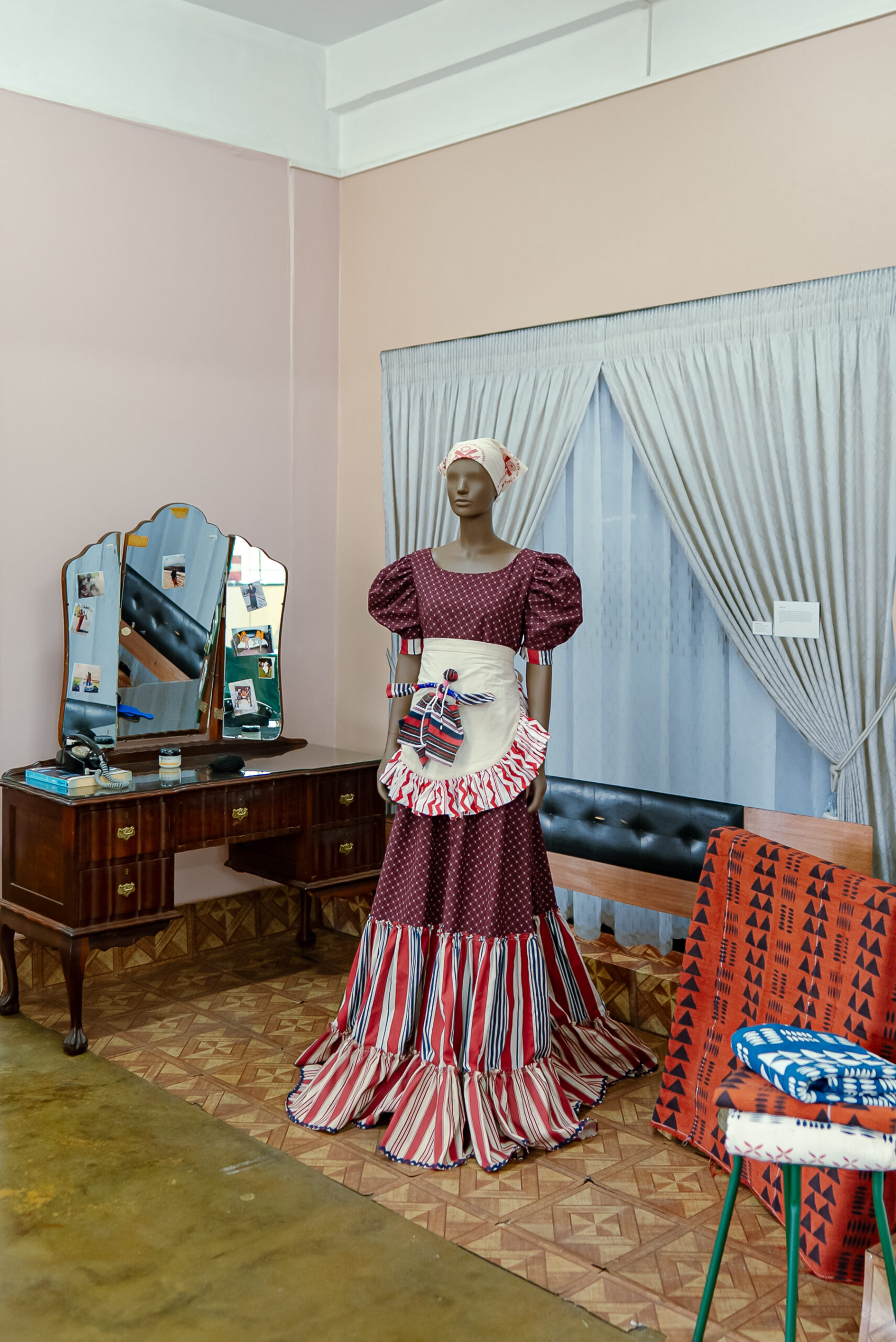
Ondhelela dress, designed by Maria Caley, on display for Tuli Mekondjo’s performance of Saara Omulaule/Black Saara (2023)
For Yonela Makoba, memory is ritual. Through performance, installation, and print, Makoba’s iTi Ritual Studies series reimagines the Xhosa matriarchal ritual iTi, transforming time and movement into methods of healing and ancestral dialogue. iYeza (2022) is a tea bag quilt which marks the artist’s first entry into the study of the iTi ritual. As a quilt of memory and invocation, it set in motion her ongoing research into ritual, performance, wayfaring and critical fabulation. Makoba’s practice reminds us that remembrance is an act of becoming as well as resistance in the face of historical rupture.
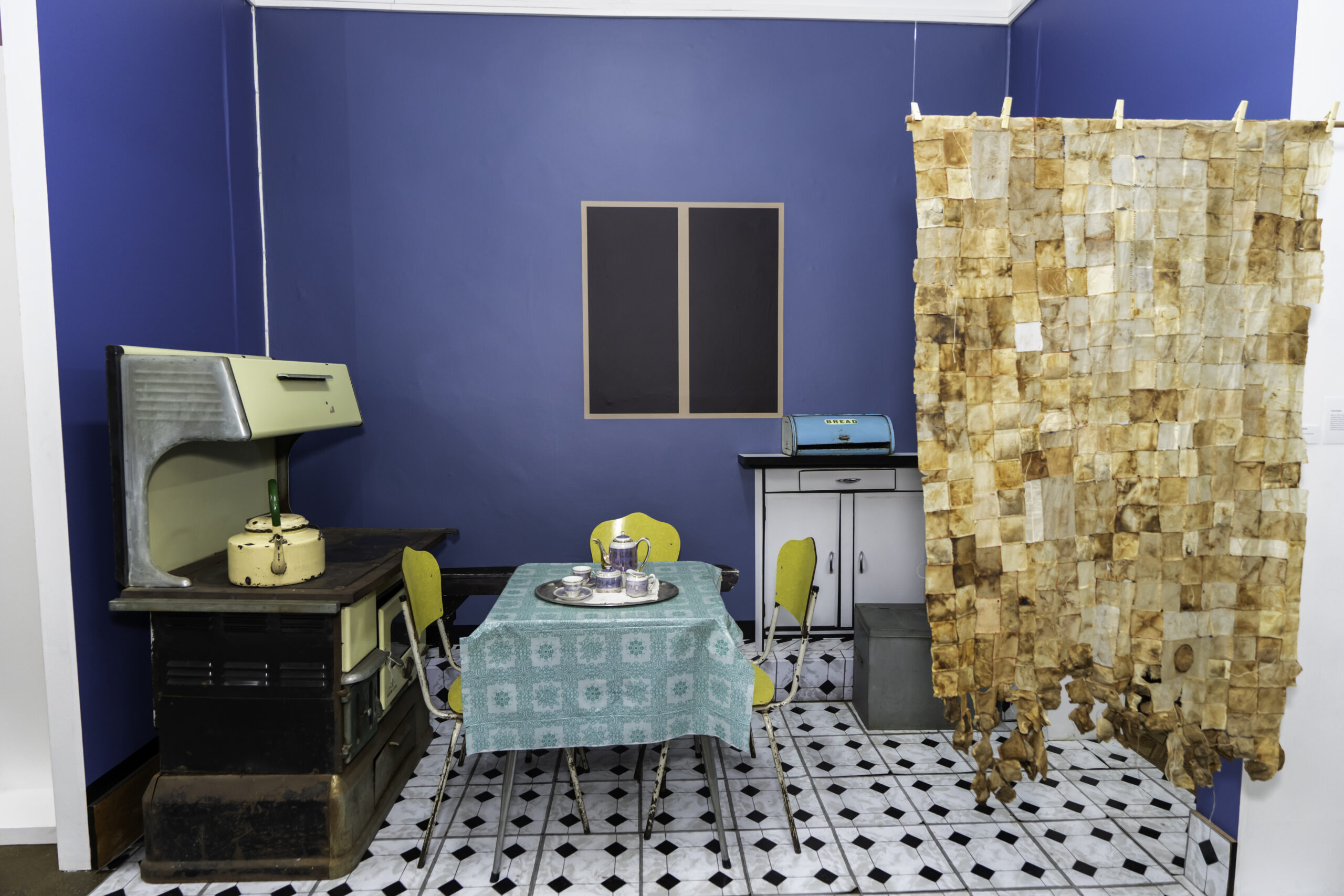
iYeza (2022) by Yonela Makoba
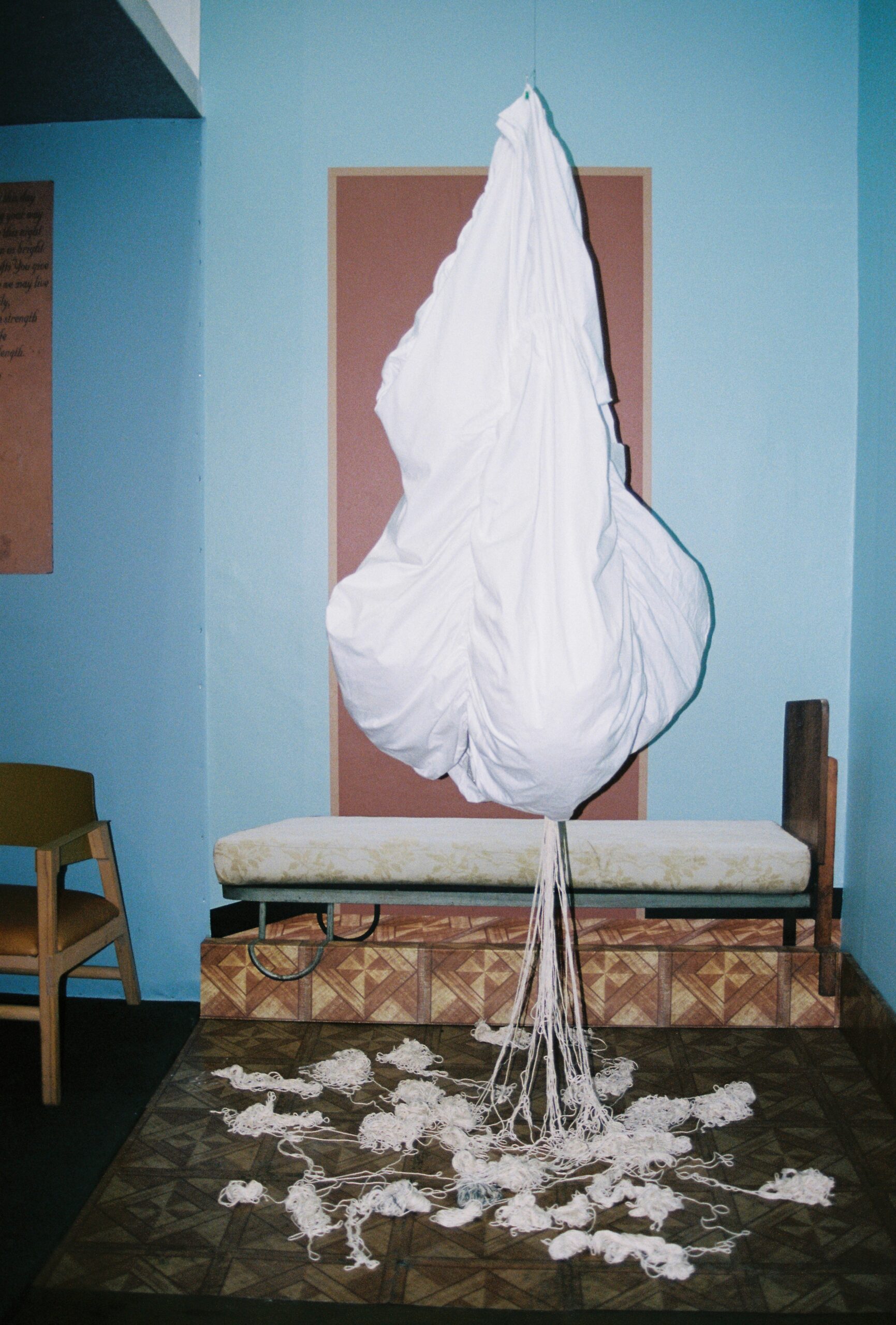
Ditiro Mashigo’s tactile works draw on African spirituality and womanhood, using materials like silk, rope, and plastic tubing to sculpt visual prayers of gratitude and continuity. Her use of fibre becomes a devotional act, translating faith and lineage into form. Mashigo’s artwork titled Kala (2022) refers to kalana which is the seSotho word for umbilical cord composed primarily of clothing, some her own, some from manufactured waste and some sourced from the local fashion industry. The long cord has no end and no beginning; it winds and overlaps enmeshing itself within itself and the space it occupies. Kala stands as a poignant visual representation of the ancient connection’s women hold within themselves and pass down generationally.
“Ditiro Mashigo’s tactile works draw on African spirituality and womanhood, using materials like silk, rope, and plastic tubing to sculpt visual prayers of gratitude and continuity”

Kala (2022) by Ditiro Mashigo
Likewise, Nwabisa Ntlokwana transforms upcycled materials into wall sculptures that speak of transformation and renewal. Ntlokwana turns discarded objects into meditations on care, resilience and the evolving nature of womanhood.
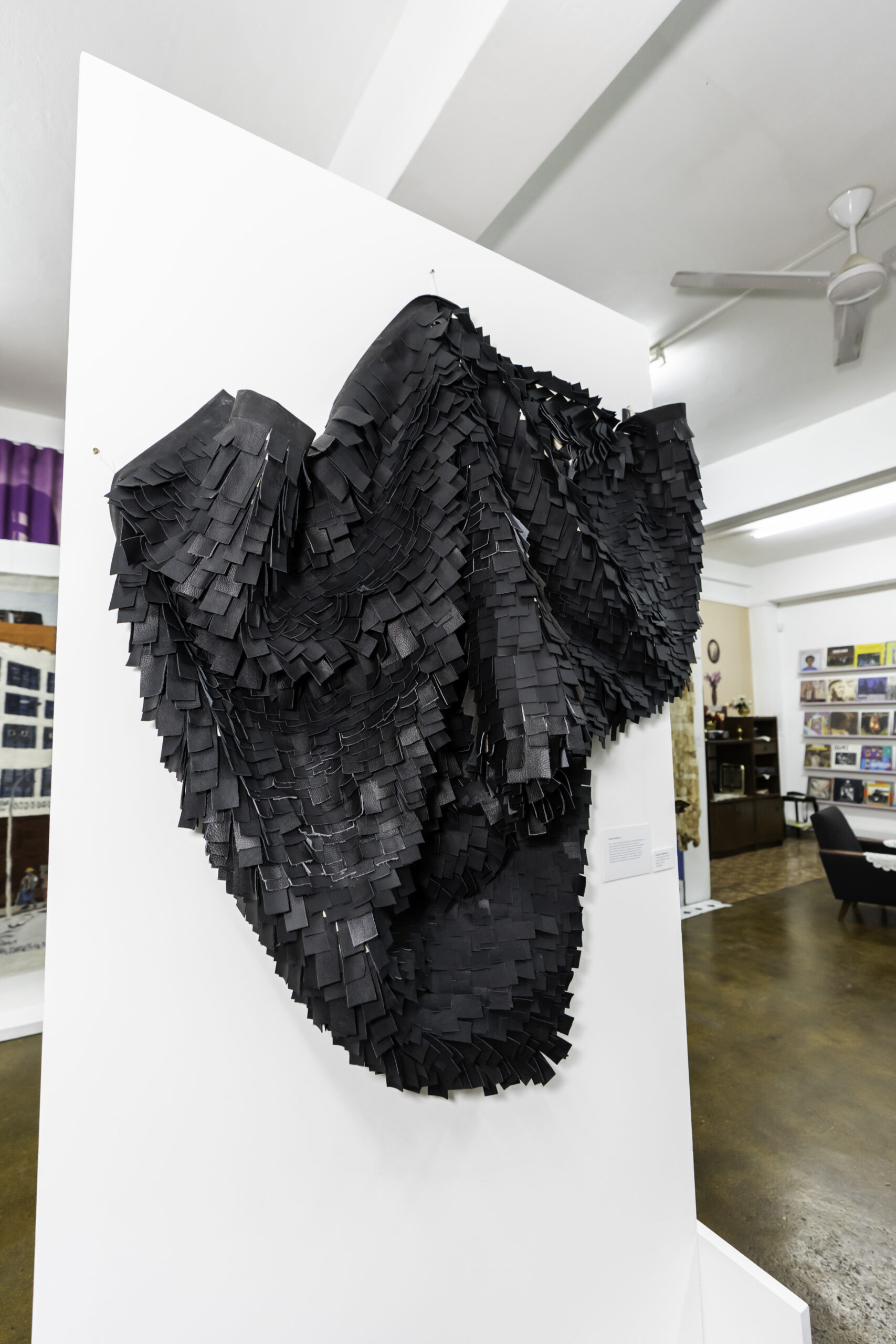
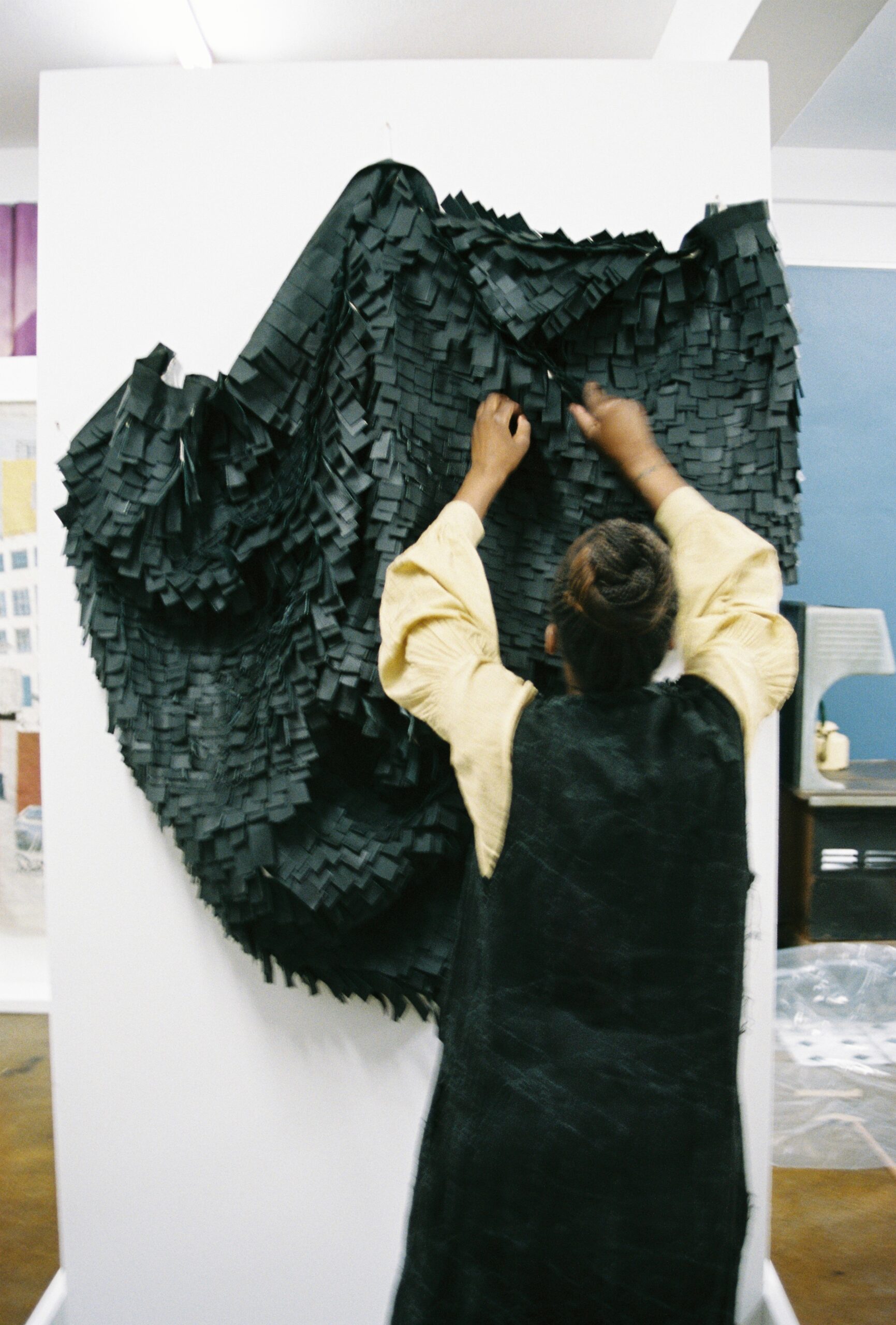
The beginning to the end by Nwabisa Ntlokwana
In Ghanaian Kente: Cloth and Song, Dr Kofi Anyidoho asserts that, “weaving, like drumming and singing, is a rhythm-based aesthetic performance,” Uno July and Onesimo Bam pick up this lineage through their conceptual framework. Their exchange between spoken word and cloth turns rhythm into a material force where beat becomes thread and garment becomes pulse. Uno’s introspective lyricism and Onesimo’s minimalist, meditative design create a shared vocabulary of reflection and resilience, positioning their work as both sartorial and sonic resistance. Their collaboration situates spoken word and fashion as twin practices of storytelling where every word and every thread, become part of an unfolding archive of contemporary African creativity.

Collaborative exchange between Uno July and Onesimo Bam
Throughout the exhibition, design functions as cultural storytelling. The Ninevites, founded by Nkuli Mlangeni-Berg, exemplifies this through the tactile engagement with African diasporic narratives. By weaving design, social innovation and collaboration, The Ninevites reimagine the textures of Black life and memory by transforming everyday materials into stories of presence, identity, and possibility.
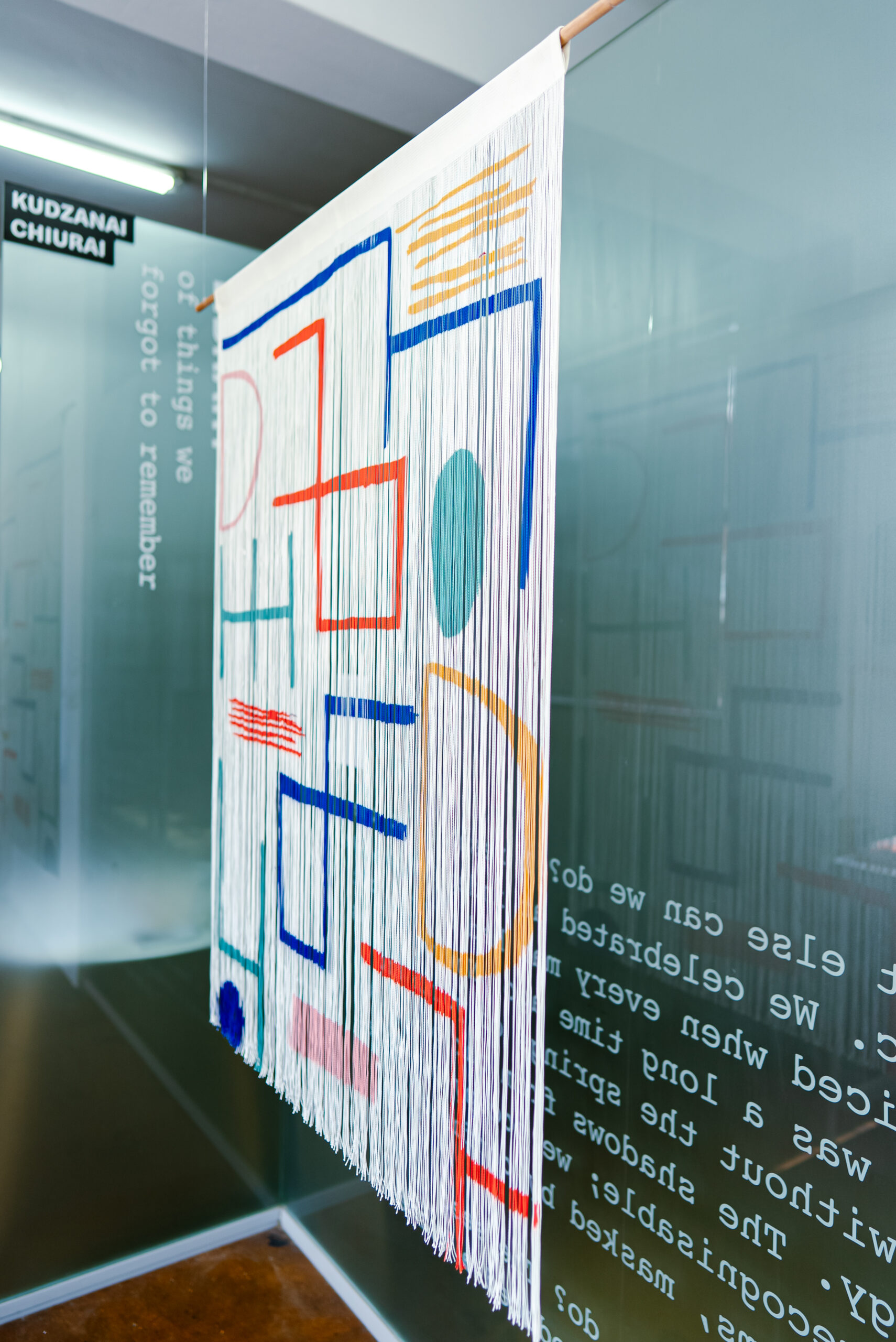
Wall hanging by The Ninevites
“The Ninevites reimagine the textures of Black life and memory by transforming everyday materials into stories of presence, identity, and possibility”
Sam Nhlengethwa is a renowned South African luminary whose work traces the textures of urban life, history and cultural transformation. Working across painting, collage and printmaking, he is celebrated for his vivid evocations of Johannesburg rhythms, its jazz, street style and everyday intimacies.
Ascot Corner (2019), woven in collaboration with Marguerite Stephens and Stephens Tapestry Studio, translates Nhlengethwa’s distinctive visual language into the layered depth of mohair tapestry. The handwoven medium softens and enriches his urban imagery, turning passing scenes of city life into the enduring textile form.
The work stands as a testament to the studio’s legacy of masterful craftsmanship. The partnership between Nhlengethwa and Stephen’s Tapestry Studio brings together fine art and South Africa’s weaving tradition,s transforming his visual language through the depth and rhythm of tapestry.
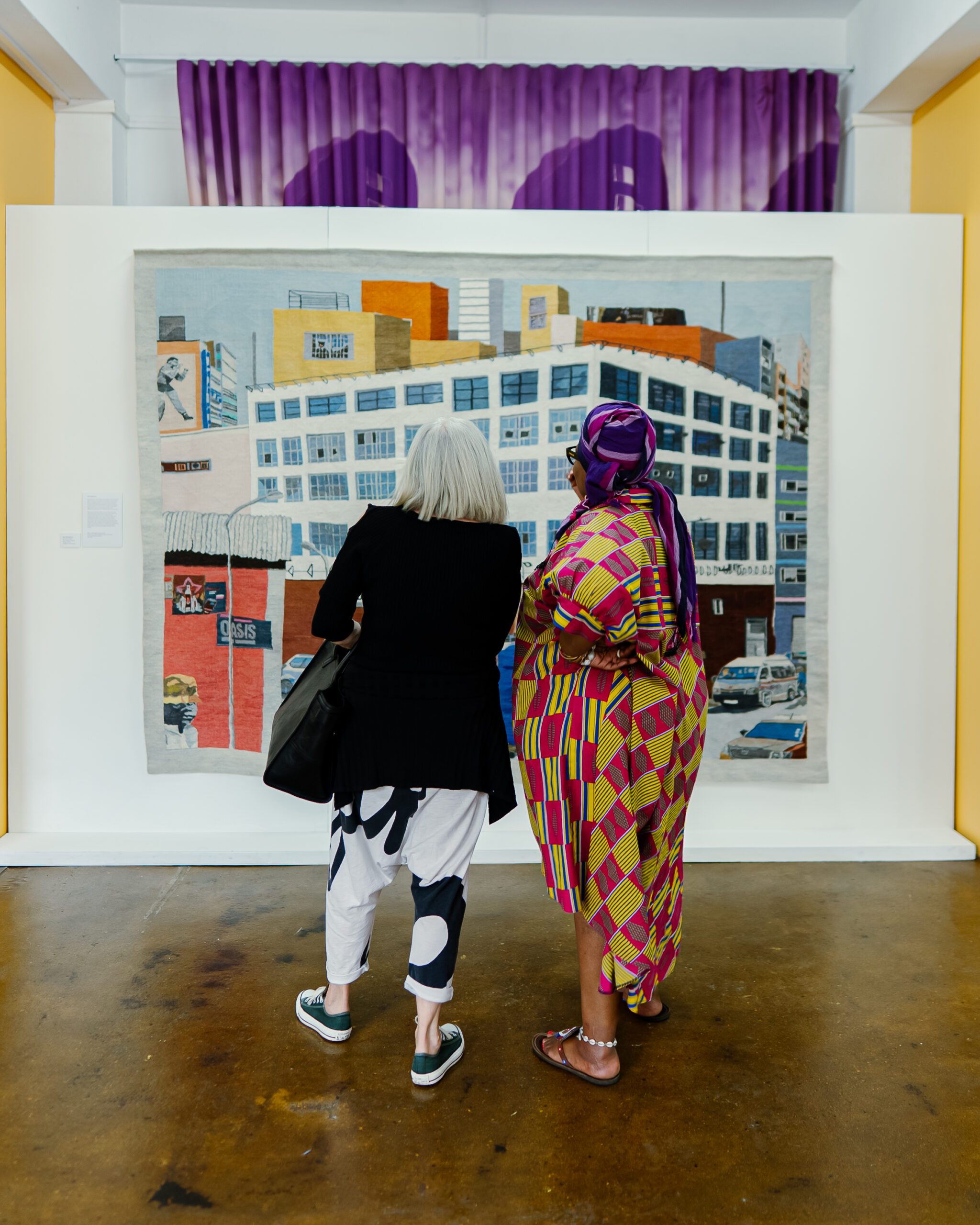
Ascot Corner (2019) by Sam Nhlengethwa, woven in collaboration with Marguerite Stephens and Stephens Tapestry Studio
Within Chiurai’s Library of Things We Forgot to Remember, Threads of Renewal opens a dimension where imagination and ancestry meet. Across its varied works, the exhibition reveals how memory and making, care and resistance are not separate but threads of the same cloth. Fabric becomes a bridge between the past and the future.
Ultimately Threads of Renewal is a ritual of re-membering. It gathers what was scattered, listens for what refuses to be silenced and tends to what endures. In this second iteration, remembrance is a pulse that guides artists as they stitch lineage into form, reclaiming stories that continue to shape us, and opening space for new ones to be woven into being.
Threads of Renewal II
Curated by Tandekile Mkize
Assisted by Larah Fisher
Threads of Renewal II unfolds within Kudzanai Chiurai’s sonic archive of African cultural memory.
This exhibition explores two interconnected themes — Memory & Ancestry and Healing & Resistance — transforming fabric into a vessel for remembrance, care, and renewal.
Sam Nthlengethwa
Bulumko Mbete
Yonela Makoba
Sibabalwe Ndlwana
Onesimo Bam x Uno July
Nwabisa Ntlokwana
Ditiro Mashigo
The Herd x Liz Maelane
Maria Caley
The Ninevites
Photographs courtesy of Tiisetso Moreki, Tsepo Ncube & Tshepi Seeri