When Nisha Kanabar founded Industrie Africa in 2018, the global conversation around African fashion felt stagnant with repetitive tropes, heritage clichés, and little space for evolution. This motivated her to challenge Western perceptions of African design, and to boost international visibility of African designers.
Nisha launched the e-commerce function of her platform in 2020. Instead of forcing designers into systems designed for Western infrastructure, she built something from scratch: a digital space that looks clean and aspirational on the outside, but actually supports the ecosystem from within. “Our focus has always been infrastructure over spectacle. Editorial that informs, distribution that respects, and curation that centres quality, not quotas.”
This has all contributed to a real shift from token visibility to real agency. In our email interview, Nisha says, “Designers no longer ask to be seen, but seek to shape the terms.”
 Models wear dresses by Marrakshi Life, earrings by Pichulik and Ami Doshi Shah. Rings and bracelets by Ami Doshi Shah
Nisha believes that the fashion industry needs holistic, multi-layered ecosystem initiatives for Africa’s designers and brands to thrive across sectors, spaces, and customer touch points. Since its launch, Industrie Africa has featured 75 designers from 21 African countries, shipping to 56 nations with a community spanning 193 countries.
Taking another step – a natural evolution of the brand – Nisha opened SoLA, a concept store on Bawe Island in Zanzibar along with a consultancy called SELECT in July this year. “These projects are natural extensions of one another. Whether you passionately hand-pick a limited-edition garment online or discover something collectible on your travels, these are different access points to the same product narrative. It’s a new space to explore, and we’re just getting started,” says Nisha.
What prompted you to launch SoLA?
The opportunity came to us via Bawe Island, a private island about 15 minutes off the coast of Stone Town, and it immediately felt aligned. It is an intimate, hospitality setting with a glaring gap in meaningful retail. We saw the chance to create something far more considered than your average hotel boutique: a concept store that engages the guest emotionally, not just commercially.
 Models wear swimsuits by Away That Day (left) and Andrea Iyamah. Necklaces (left) by Jiamini (top) and Ashepa. Bracelet (left) Jiamini and Ashepa
What criteria do you use to select designers for the store?
SoLA is a concept store shaped by context, and about provenance and artisanship. We start with understanding the property itself: its values, aesthetic language, and guest profile. Curation here isn’t just about what’s sexy, but what feels transportive, innovative, and emotionally resonant in the setting of Zanzibar. We asked: what would feel meaningful after a morning snorkelling coral gardens, bathing under the sun, or exploring the richness of Stone Town? The answer lies in tactile, grounded pieces that feel like an extension of the same nuanced language.
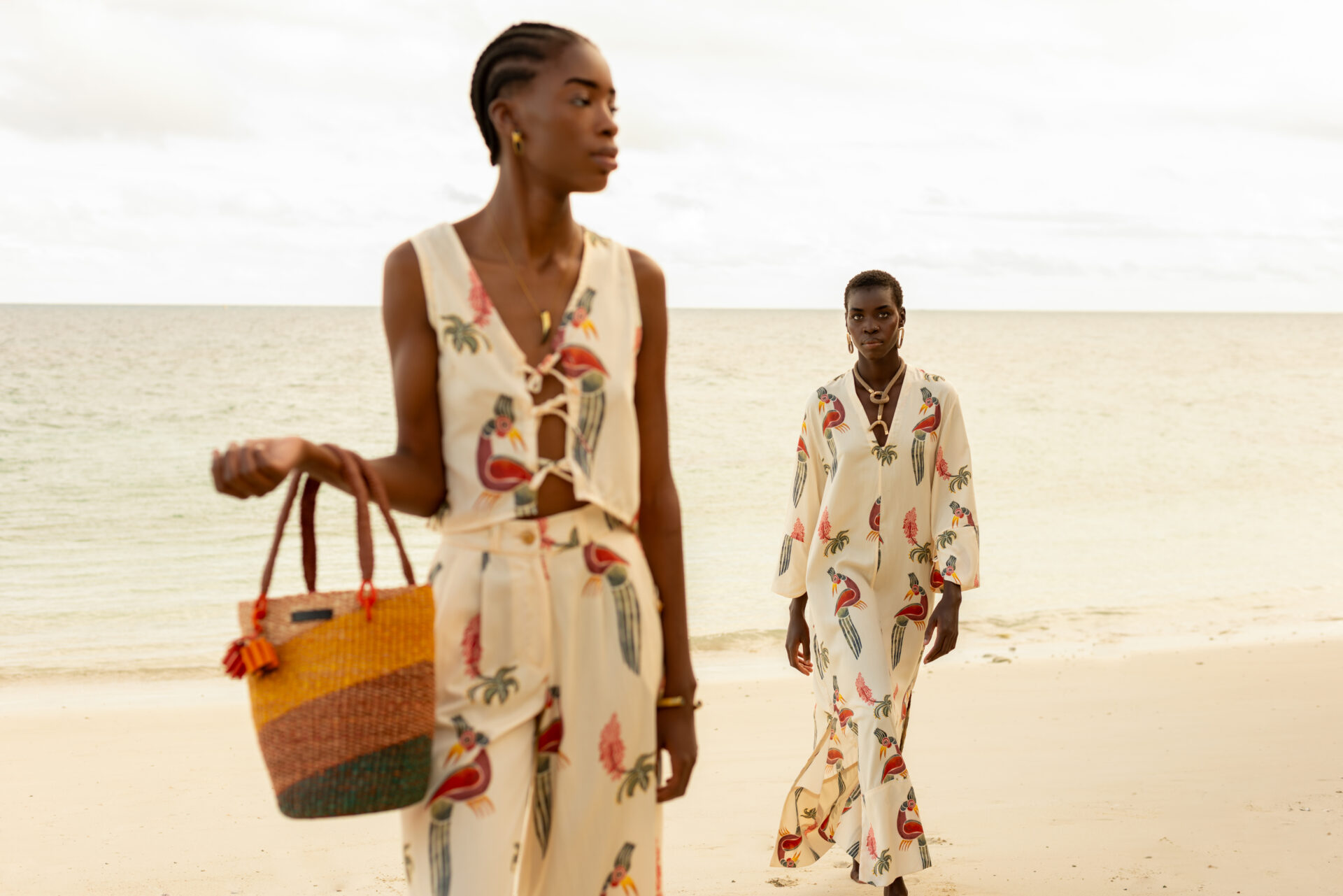 Model (left) wears top and trousers by Hamaji, handbag by AAKS and necklace, earrings and bracelet by Ami Doshi Shah. Model on the right wears dress by Hamaji and accessories by Pichulik
Some labels are hyperlocal like Doreen Mashika. Others speak to a broader regional language: Dye Lab, Lisa Folawiyo, Marrakshi Life, Andrea Iyamah and This Is Us. We also introduced thoughtful international voices like Hunza G and Agua by Agua Bendita. What matters is that every piece belongs both aesthetically and narratively. SoLA isn’t a souvenir shop. It’s a retail story designed to reflect its surroundings.
 All garments This us Us and earrings by Patrick Mavros
Tell us about the collaboration with Tongoro.
Creative director Sarah Diouf is a force. She is brilliant, generous, and deeply attuned to the cultural conversation. Tongoro has long been one of the continent’s most recognisable fashion voices. A brand that is playful, confident, unapologetically pan-African. When we envisioned our first designer collaboration at SoLA, Tongoro felt right. The collection speaks to the rhythm of Zanzibar, reimagined through Tongoro’s world. It’s joyful and grounded, and marks the first in a series of designer-place capsules that SELECT will be rolling out with our partner properties going forward.
And I see that creative consultant Sunny Dolat played a role in SoLA. Will it be an ongoing partnership?
Sunny was our creative director on the project and brought a layered, sensual narrative to the space. Together, we sourced installations from across the continent to reflect the artistry behind each object, and guided the curation of the space. We work wonderfully together. It’s a creative relationship built on trust.
 Sunny Dolat is the creative director of the new SoLa concept store on Bawe Island
When will you launch a store in Cape Town?
We’ll be opening a second location soon in the heart of Stone Town’s historic architecture. Nothing in Cape Town just yet but never say never…
Nisha, how are you feeling?
Grateful, energised, and maybe a little exhausted in the best way. I’m experiencing the same sort of jitters I had when starting Industrie Africa, and have anytime I venture a new path.
And finally, I’m always curious to ask people about their most worn and loved item. What’s yours?
That’s a tough one. Almost everything I own is tied to an experience or a place I’ve travelled, and carries sentimental value. But, a few pieces come to mind. A soft Dye Lab kaftan that’s perfect for a loungey Sunday but somehow still works for sundowners with friends. A delicate gold string-of-hearts necklace my parents picked up for me in Mumbai. It feels confident and irreverent at once. I really could go on!
 Nisha Kanabar says almost everything she owns carries sentimental value
Credits for the launch campaign
- Creative director and stylist: Sunny Dolat
- Photographer: Maganga Mwagogo
- Make-up artist: Sinitta Akello
- Models: Nyariek Wiyual and Tanya Onyango
Feature image: Dress by Diarrablu