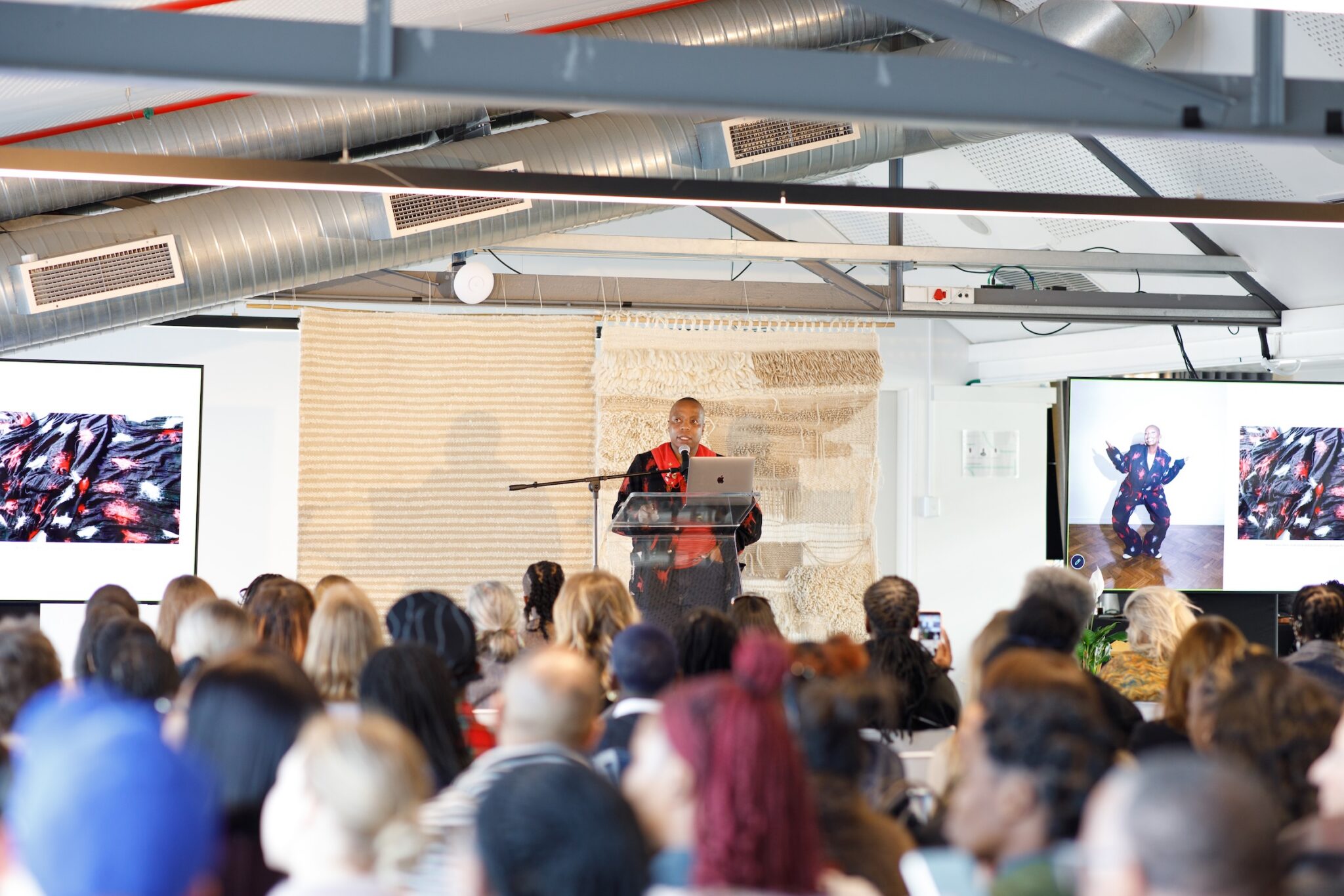
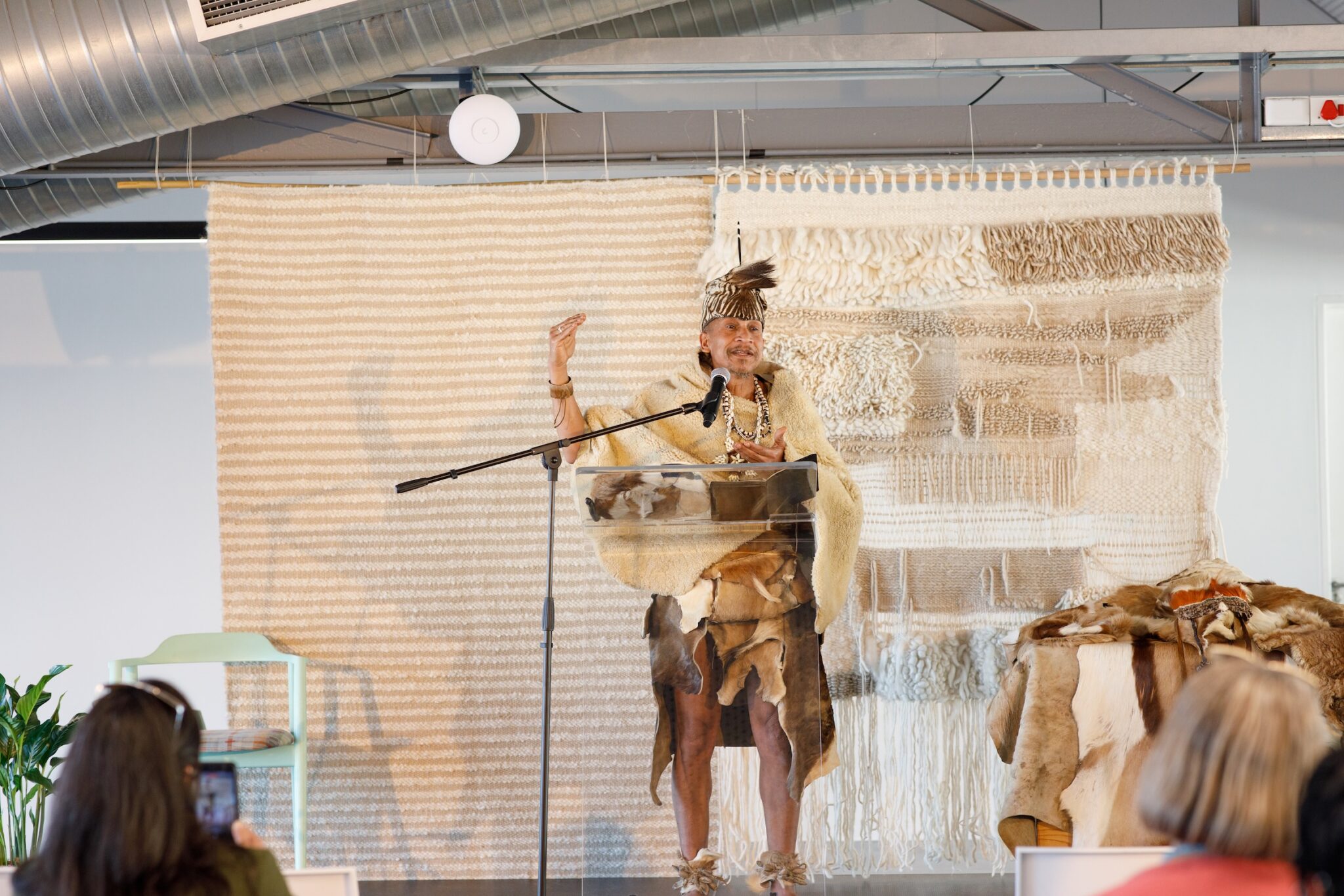
At Africa Textile Talks 2025, Maria Caley delivered a keynote exploring how garments in Namibia carry history, politics, and meaning from leather and skins with spiritual value, to trade cloth shaped by colonial influence, to today’s reimagined expressions of identity and care. Her talk reminded us that fashion is never just about clothes. Listen to the full keynote on our podcast, Twyg Talks, or watch it on YouTube. You can read the transcript of her keynote below.
My name is Maria Caley. I am a lecturer at the University of Namibia, specialising in textiles and fashion design. I am also a fashion and textile designer
After graduating, I became a fashion designer and participated in numerous platforms across Africa. A couple of years ago, I realised it was very challenging to continue this fashion business, because I used to operate alone. The work I am going to share with you today demonstrates how I still create fashion, but with more meaningful creations that give me motivation to continue. At the same time, they engage with social and political issues around my town and country, transitioning from wearing leather to adopting trade cloth. The adoption of trade cloth in Namibia gained new meaning, and much of today’s fashion and textiles carry connotations of politics and social status. I will share some of that with you today.
Namibia is located just north of South Africa and is predominantly a desert country. It is mainly desert, and on the other side is the sea. Due to the arid climate, Namibia lacks the resources to grow or keep animals that provide fibres for creating textiles. Consequently, most Namibians historically wore leather. Namibia and South Africa share significant political history. Namibia was once a province of South Africa, known as South West Africa, and gained independence in 1990. Despite our independence, our economies remain closely linked, and traces of colonial and apartheid influences persist.
 Image of Namibians provided by Maria Caley
This image shows different ethnic groups from Namibia participating in a traditional cultural performance. These state-sponsored cultural festivals are influential in maintaining and creating identities among Namibian people. Our independent country ran on the idea that “we must be united.” But even though we are united, we are actually different. Many Namibian ethnic groups use a lot of leather for clothing. In the image, you can see the Awambo people, some San communities, which South Africans refer to as the Khoisan. We also have the Tswana people and the Kavangos, which is my ethnic group. In the image, they are all wearing leather, but how they manipulate it and adorn themselves differs according to the group.
Skins were not just a physical covering but also spiritual protection
When we look at traditional clothing, it is embedded with a lot of meaning. Even if different groups wear the same leather from the same animal, how they adorn it gives it a different meaning. Leather, skins, and furs were used to cover and protect the body, both physically and spiritually, because certain skins were believed to have powers from the animal they came from. Skins were not just a physical covering but also spiritual protection.
They also carry certain status symbols. For instance, most of our royals would wear cheetah skin. If you were found wearing cheetah, you were committing a crime and would be dealt with. Certain skins symbolise or carry a status. There were also different cultural values for each skin used for clothing or protection.
These are two sayings or idioms from my language. One of them is “Ogo kwa muvhika mohunyu za simbungu”. It means that one was carried in a baby carrier made from a hyena, which was considered very rare. Most of the skins hunters would get were from common animals roaming around. To get a hyena and make a baby carrier out of it, you must be very lucky.
Another saying – “ogo mukadi galimanga ndjareko” – means that a woman has tied her apron with a certain flair. It also indicates that the woman is very strong-willed and can do a lot of things by herself. This was probably one of the earliest feminist ideologies among traditional communities.
We often look back in the archives because we find inspiration in where we come from. Most Namibian people have changed so much. Although during state-sponsored festivals you can see them wearing imitation traditional clothing, it is not quite the same because it has changed so much, and a lot has disappeared.
 OvaHerero women, Palgrave Album, F. Hodgson (1876)
This image shows Herero women and how they used to dress. Currently, Herero women wear very iconic Victorian-style dresses with a horn-type headdress. But this is what they used to wear: it was all leather. The headdress was called an “ekori,” and the whole front and back apron was also leather. They had a cloth that covered their body, all adorned with metal details to keep it weighted and close to the body. The ankles were also heavily adorned with metal and beadwork. As a woman, a Herero woman could not walk fast because of how heavy the garments were. It became the expected flair of a Herero woman: to walk majestically and very demurely.

Another fascinating image comes from the archive of ethnographic museums in Berlin. I stumbled upon this while working on a restitution project. These cloths and blankets were handmade in the 1800s from leather and fox fur, stitched together. They are wide, almost two metres, and all made by hand. For a long time, we were taught that the Nama people made patchwork because they came across lappies or off-cuts and started making patchwork dresses. This changed the story for me: the Nama people already knew how to make patchwork from leather by hand. When trade cloth was introduced, it was just a matter of transitioning to a different material.
Traditional clothing in Namibia changed due to various agents of change. Early traders and explorers brought European clothing and goods when they travelled through Namibia, exchanging them for kettles and so on. By the time missionaries settled in Namibia, most Namibian groups were already used to European goods. There was friction between traders and missionaries as they competed for influence.
Men had to shave their heads and wear European clothing
When trade cloth was first introduced, it was worn in a traditional style, draped around the body like skins. Colonial influence came with the Germans and later the missionaries. As they introduced the Namibian people to work, building infrastructure and railways, people were instructed to change how they dress. Women were told to cut their hair, discard their skins, and wear European dresses. Men had to shave their heads and wear European clothing. This was traumatic because traditional clothing was so particular, and women and men looked very different. There are many narratives in the indigenous language about how people felt about this transition: it was traumatic and humiliating.
The trade cloth introduced to Namibians was cheap and flimsy, like cheesecloth. The colour was not what Namibians were used to. Namibians used a traditional ointment made from wood pulp, often used to treat rashes, to cure the fabric and change its colour. Because it was flimsy, they would bead the bottom of skirts to weigh them down.
When work and mission were introduced to the Namibian people, they also created a look. Most school-going children were asked to sew specific dresses. These were introduced by Finnish missionaries because they found children wearing cloth and aprons in a traditional style. They didn’t like that; they wanted them to wear Eurocentric-style dresses. All school-going children had to wear this style, and it has become part of Namibian aesthetics.
The Herero people were the first to come into contact with missionaries and colonial settlers. They were not keen on Christianity but wanted to work and learn to make dresses. Some missionaries were ruthless in trying to convert the Herero because changing how they dress was a form of influence and dominance. They had to shave their hair and start wearing scarves, which were initially very simple, just tied around the head.
Through time, the Herero, Damara, and Nama people stuck more to the scarf. Religion became popular because, living around the mission, there was nothing else to do but what the missionaries did. Church-going became a social gathering for Herero men and women. Churchgoing Herero men and women had to dress in a Eurocentric way: suits for men and dresses for women, who always covered their heads.
The remaking of the scarf actually tried to indicate something very powerful. I would say it was the start of a symbolism of resistance
With time, the making of the headscarves started changing. At the beginning, they had to cover their head because they wanted to show that they were women, not men, and they didn’t want to walk around with nothing on their heads. The shapes of the scarves started changing in the 1950s. The remaking of the scarf actually tried to indicate something very powerful. I would say it was the start of a symbolism of resistance.
 OvaHerero women in Kaiser Street, Windhoek (no date), courtesy of Maria Caley
Here are two women. You can see the headdresses changing. The one on the left is a Herero woman with the horn protruding from her head. On the left is probably a Damara or Nama woman. Herero women didn’t want to look like Nama or Damara women, so they did theirs differently. As humans, we want to look unique, and clothing is one way to show that.

Trade cloth became even more popular. The first trade cloth traded by Portuguese traders was more striped, popular among the Awambo and Kavango people. Even though many versions existed, a few were particular. Among royals, they mostly wore blue and white. That particular striped cloth was only worn by the kings and royals.
Then you’ve got the soft pastel flowers that were traded through by the Nama people. Only after 2019 did that start changing drastically, and now you see them still wearing florals, but very bright. I once asked one of the Nama designers why the colour is changing so drastically. He said maybe it’s the restitution because the Nama also have a part of that conversation. So maybe it’s an unconscious decision to be bright and loud.

There was a transition from handmade patchwork to printed. Chinese manufacturers now bring in bright colours and patch-style prints. Many seamstresses are happy with this version because it’s more efficient; they don’t have to patch the fabric themselves. For the Awambo people, fabrics were previously dyed before ceremonies. Now the Chinese are bringing in pre-dyed pink fabrics (the colour for the Awambo people) so they don’t have to spend time redyeing fabrics for ceremonies. As they embrace efficiency, some cultural values are also dying with it.
The Ohimba people are one of the most unwavering groups; they have stuck to their traditional style. Men may buy scarves to tie on the back, and women still use the leather apron for the back, while the front becomes textile. Nama people are still vibrant; colours have become brighter, and many versions are made from printed patchwork. Traditional headdresses have also become very colourful, with social status attached. Certain women, if married, must tie it in a certain way; young girls must tie it differently. Only specific fabrics are allowed for scarves. The scarf can also indicate political and social standing; for instance, if you are related to a deceased person, you may print a photo of them on your scarf.
 Tuli Mekondjo as Black Saara during her performance at Dak’Art Biennale, Dakar, Senegal, 2024. Photo: Pierre de Perouges
Many artists and fashion designers in Namibia are creating fashion with meaning. Cynthia Schimming was involved in the repatriation story; this is one of her fashion installations in Berlin. Tuli Mekondjo is also a Namibian visual artist working with archives to find ancestry. She found a story in a Finnish missionary school about ‘Black Saraa,’ who became a Christian, was baptised, and shortly after died. The story says she went to heaven and became white. Some archives are disturbing. Sara Olawleh created a performance where she wore Awambo clothing and then revealed traditional clothing underneath. Many artists and designers collaborate to create fashion with meaning.
- Feature image of Maria Caley by The Dollie House
- Maria Caley is a lecturer at University of Namibia and specialises in textiles and fashion design