Rethread founder Alexa Scheempers started her sustainable fashion brand with the best of intentions. “But it became unrealistic for me to grow and run a proper business without incorporating new clothes,” she says.
In 2019, Rethread launched with an upcycled collection of clothing that Alexa produced during her Masters in Fashion Enterprise Creation studies at Amsterdam Fashion Institute. Now better known for its new garments than for its upcycled design pieces, Rethread has since evolved along with Alexa’s understanding of sustainability and what it means to run a sustainable business. Rethread produces small runs of clothing that Alexa knows will sell well. Sustainability remains a core pillar, as does remaining flexible for the health of the overall business. “Sustainability is not just about natural fibres,” she says. “It’s also sustaining the livelihood of your employees and the economy.”
Today, Rethread is a cool-girl household name, stocked by AKJP Studio and with media personality and actor Julia Fox counted among its fans. Alexa as a person is inextricably linked to the brand’s success, known for her transparency and eagerness to share her entrepreneurial expertise with her social media followers. I recently sat down with Alexa to discuss Rethread’s evolution and to reflect on the common stumbling block encountered when building a sustainable fashion brand: the gap between intention and what’s possible. She spoke about striving for measurable sustainability standards while maintaining a viable business, particularly within South Africa’s manufacturing landscape.
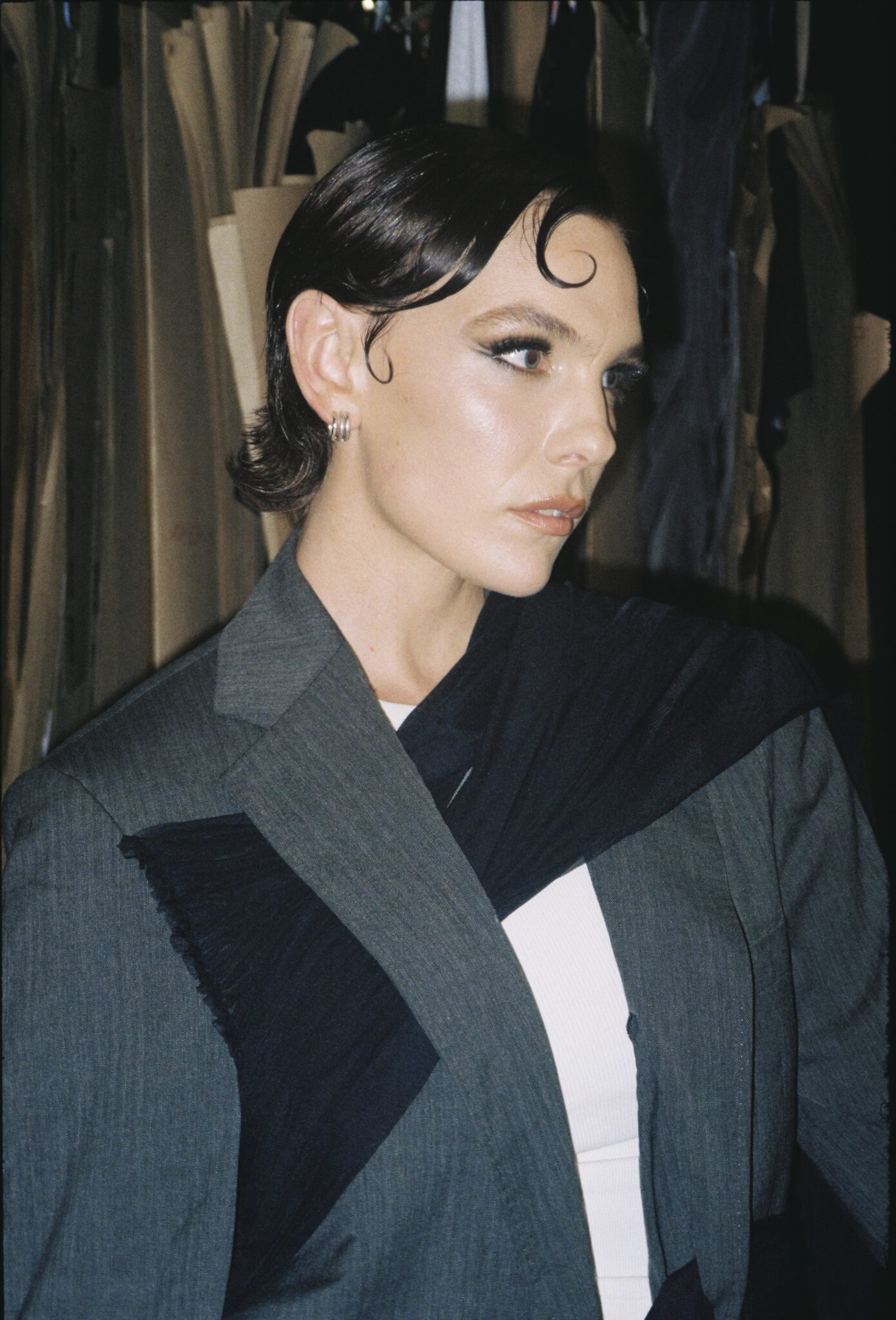
Alexa Schempers wears an upcycled Rethread blazer. Image: Mishelle-Lee Collins
Growing Rethread
Alexa returned to South Africa during the COVID pandemic in 2019 and went to live in her home town, Knysna, where she began developing upcycled samples. Soon after, she started producing new garments with a CMT (cut measure trim factory) in Cape Town, moving between the two cities before relocating to the Mother City permanently in 2022. This move was a major turning point for the brand.
“I don’t think you can isolate the growth to one moment,” says Alexa. “It was a sequence of events – the consistency of our work and lots of other little things contributed to the momentum.” Social media was a key tool from the beginning, leading to big growth points in sales and online followers. First, several international influencers posted themselves wearing Rethread, and then Julia Fox mentioned the brand while wearing a custom denim set in a recording of her podcast in early 2023.
Around this time, the Cango dress – a midi with a fitted bodice and long, modular straps – started selling particularly well. “That was the first taste of financial consistency that I had since starting the brand.” To keep up with demand, Alexa hired a second employee, and two more a year later, forming the team of five she manages today.
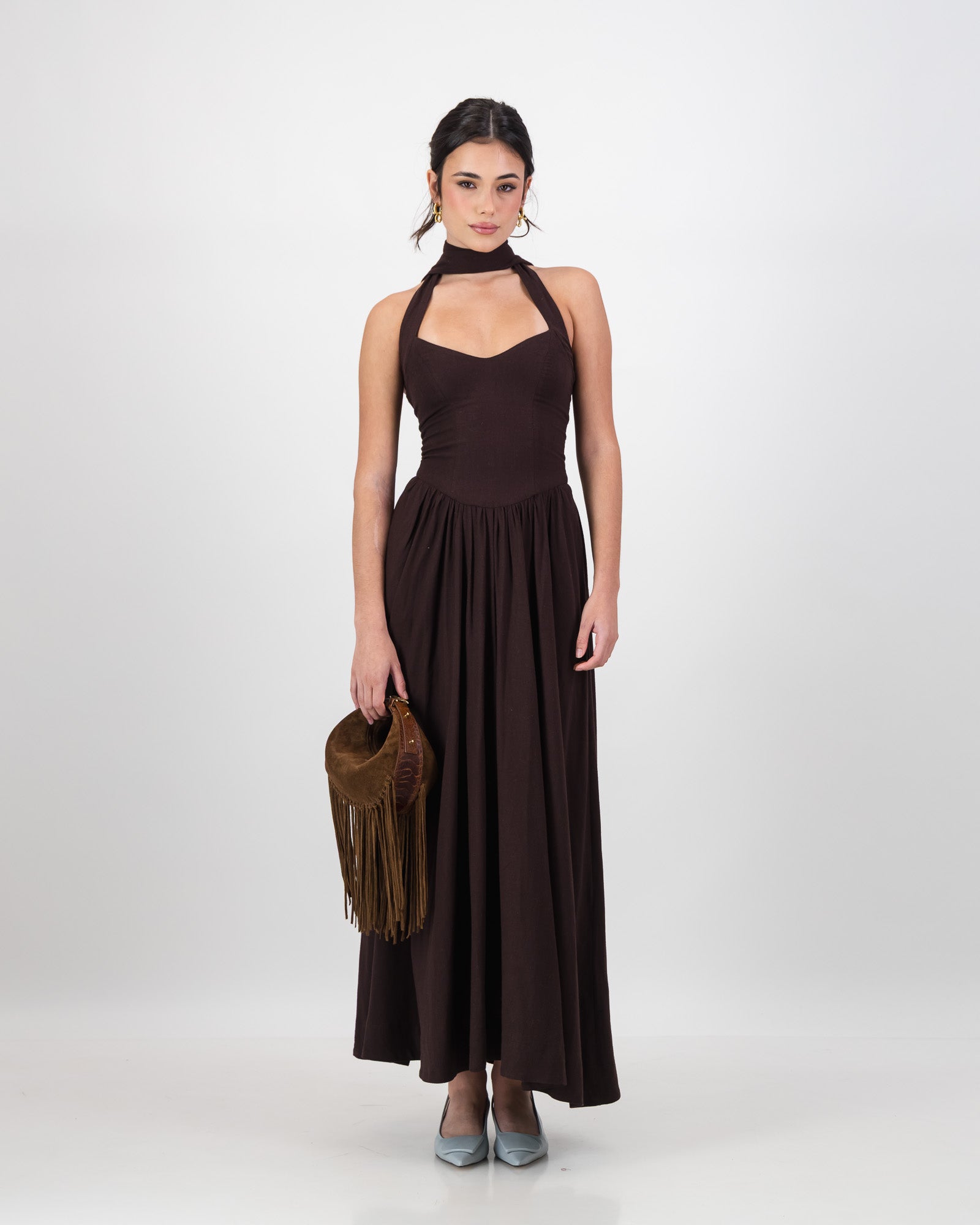
Cango dress. Image: Courtesy Rethread
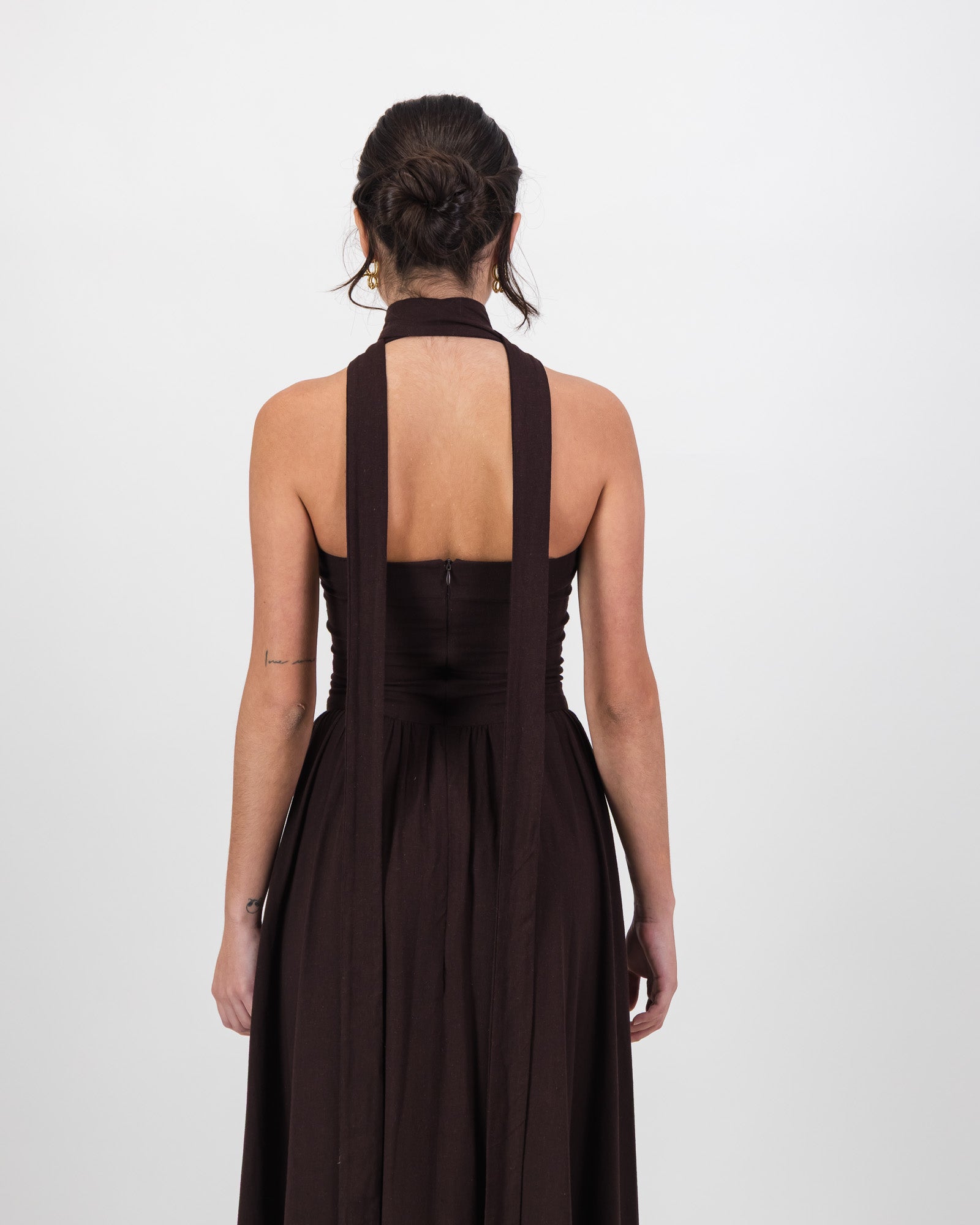
Cango dress. Image: Courtesy Rethread
An evolving approach to sustainable design
“Considering the amount of clothing waste the world has, you’d think we’d be overwhelmed with pieces to upcycle,” says Alexa. “But finding the right garments to work with is really challenging.” Additionally, most CMTs – the production houses responsible for making a brand’s clothing – work in a traditional way, cutting patterns out of virgin fabric. When upcycling, each item needs to be taken apart with care and cut cleverly to maximise the fabric. “It’s essentially alternations and deconstruction,” says Alexa. “This requires a tailor, which is expensive.”
During the first year of Rethread, Alexa narrowed her upcycled lens to only working with shirts and blazers, but even so, the limitations on supply and scalability were slowing her down.
Rethread has settled on a balance that reflects Alexa’s own wardrobe: a mix of vintage, new and upcycled pieces. The brand maintains a core offering of one-off co-ords (matching sets) made from second-hand men’s blazers, and is set to release a new upcycled collection in July 2026 – its first since 2023. “We want to return to our roots a little bit.”
The brand creates about 20 new designs a year, with two collections. Each collection is released garment by garment, over a few weeks. This helps spread the manufacturing load, and creates a sense of excitement without overproduction.

Rethread x SS26 campaign. Image: Candice Bodington
The realities of local production
Rethread is committed to local manufacturing, despite the challenges it poses. Brands need to work with multiple manufacturers, each with their own speciality. Cutters, CMTs, dyers, washers all operate under different roofs, with varying levels of consistency, standards, time frames, and quality. This is not unique to South Africa, but for smaller brands, it can be a major hurdle. “We’re managing each little item in the supply chain,” says Alexa.
With so many stakeholders, there is plenty of room for things to go wrong – like the time 50 pairs of jeans were washed after construction instead of before. “One small miscommunication and the whole batch was unusable,” says Alexa.
One of Rethread’s commitments to sustainability is small-batch production. The brand typically produces first runs of between 30 and 50 units. Many CMTs, however, require a minimum run of 100 units. “You’re forced into taking risks,” says Alexa. “We have to decide if it’s worth it, both financially and from a sustainable perspective.”
“Sometimes you have to forfeit certain things just to get to a point where you can make the more sustainable options viable”
Material choice presents another challenge. Many of Rethread’s pieces are made from 100% cotton, but some require stretch, where Alexa would ideally use recycled fabrics. In South Africa, access to these materials is limited. Sustainable fabrics — like recycled nylon or GOTS-certified cotton — often need to be imported, with minimum order quantities of around 1,000 metres per colour. “As a small business, if you want to run two colours, you’re spending R200,000 just on the fabric,” she says. “The outlay completely messes with your cash flow.”
This has shifted how Alexa speaks about sustainability. “A lot of people don’t even start because they think, ‘I want to do sustainability, but I can’t afford it,’” she says. “Sometimes you have to forfeit certain things just to get to a point where you can make the more sustainable options viable.”
Recently, Rethread reached that point, purchasing its first 1,000 metres of cotton from a local mill for its Contour T-shirts — a style almost guaranteed to sell out.
Transparency as strategy
Alexa’s personal brand is closely tied to Rethread’s. Online, she offers a hyper-transparent look into what it takes to run a successful fashion brand – from in-depth discussions on alterations to sample pieces to showing Rethread’s actual monthly sales figures.
“When I first started, I had 200 followers,” she says. “Since the beginning, I’ve been sharing my ups and downs, taking people through the process. That ended up becoming a core value of ours: being open.”
Followers are invited to weigh in on styles and colour choices, leading to brand loyalty and products that sell. “We always ask, are we making stuff people want?” Alexa says.
It’s also a way to share their sustainability journey. “Without context, people don’t understand that certain things aren’t happening because of limitations, not because you don’t want them to,” says Alexa. “It’s a way to share the full picture, and to protect myself and the brand.”

Rethread x AW25 campaign. Image: Luke Houba
Next steps for Rethread
Alexa’s guiding principle is reinvention, whether through upcycling or designing modular pieces. At the heart of her design process is versatility, “Because we want people to get as much wear out of their garments as possible.”
Rather than retiring garments after a season, items are slowly phased out as demand for them stops, with any unsold stock donated to Clothes To Good. The Cango dress, for example, has been stocked for nearly three years – a lifetime in a world of fast fashion. Now, as the dress enters retirement, its silhouette will be translated into a top, a skirt, and a pair of trousers, extending the lifecycle of a garment known to sell well.
Recently, Rethread partnered with Muna, an online resale platform which allows the public to resell their Rethread pieces in exchange for store credit. Muna is the middle man for resellers wanting to pass their local labels onto someone new and earn some money. It also pairs with brands to help shift dead stock, posting unsold items across a network of other resell platforms.
At the start of 2026, Alexa launched her first online course, sharing how to implement her year planner. She hopes to expand into more courses, alongside community-based offerings like workshops.
“You can get so stuck in the daily operations of making and selling,” she says. “But what really excites me is the connection and community side of things.”
Rethread’s journey reflects the realities of making sustainability work: less about perfect decisions and rigid ideals, and more about negotiation and compromise. For Alexa, progress is better than perfection. She’s building a solid foundation, allowing her to make better choices over time. It’s an outlook other small South African businesses can learn from, and, luckily, she’s more than willing to share.
- Rethread is available at AKJP Studio and The Lobby in Sea Point. The public is welcome to visit Rethread’s showroom at the Old Castle Brewery in Woodstock on Saturdays, or by appointment during the week
- Rethread is releasing its AW 2026 collection over the next few months – at the end of March, April, and May – culminating in the release of its upcycled line