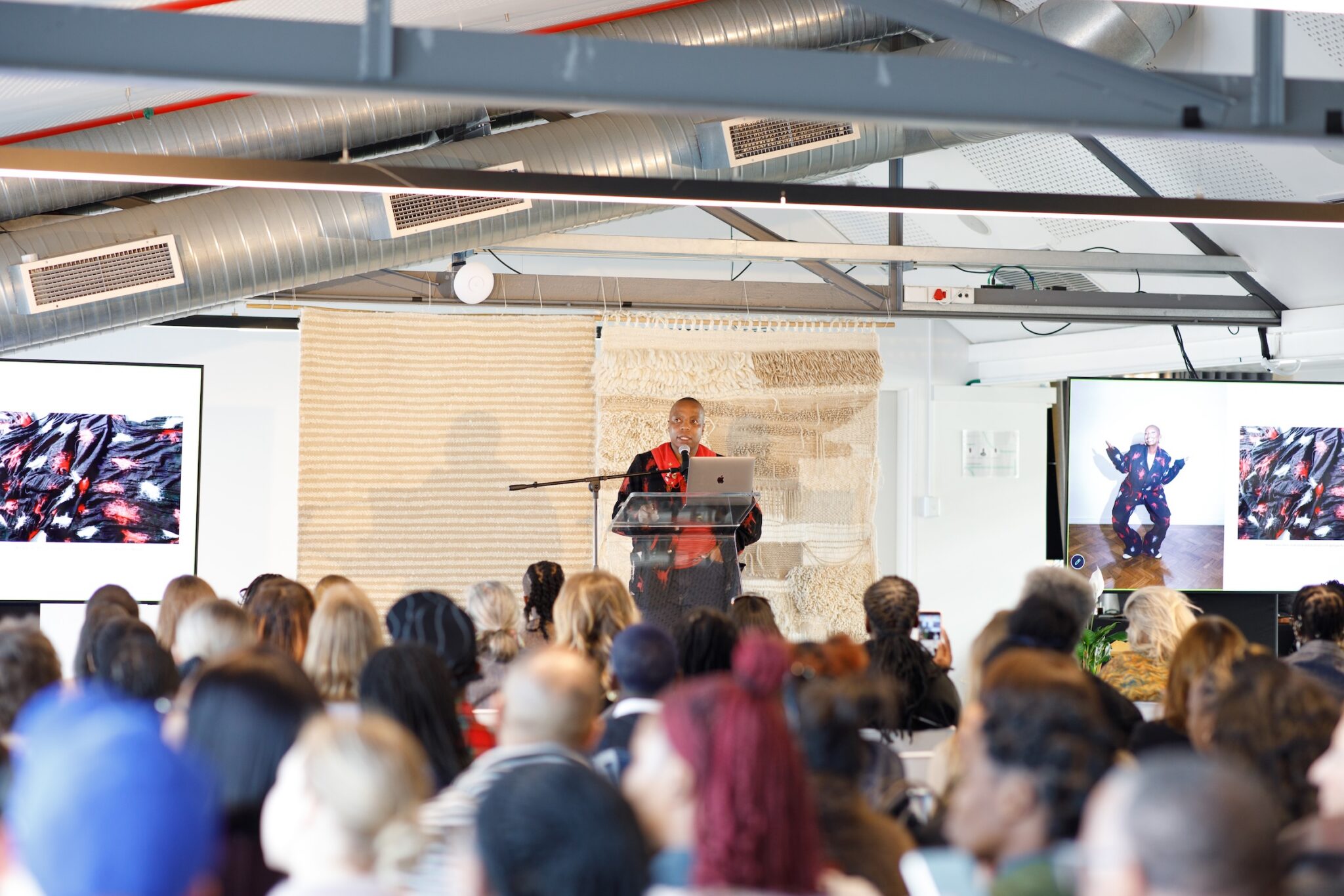
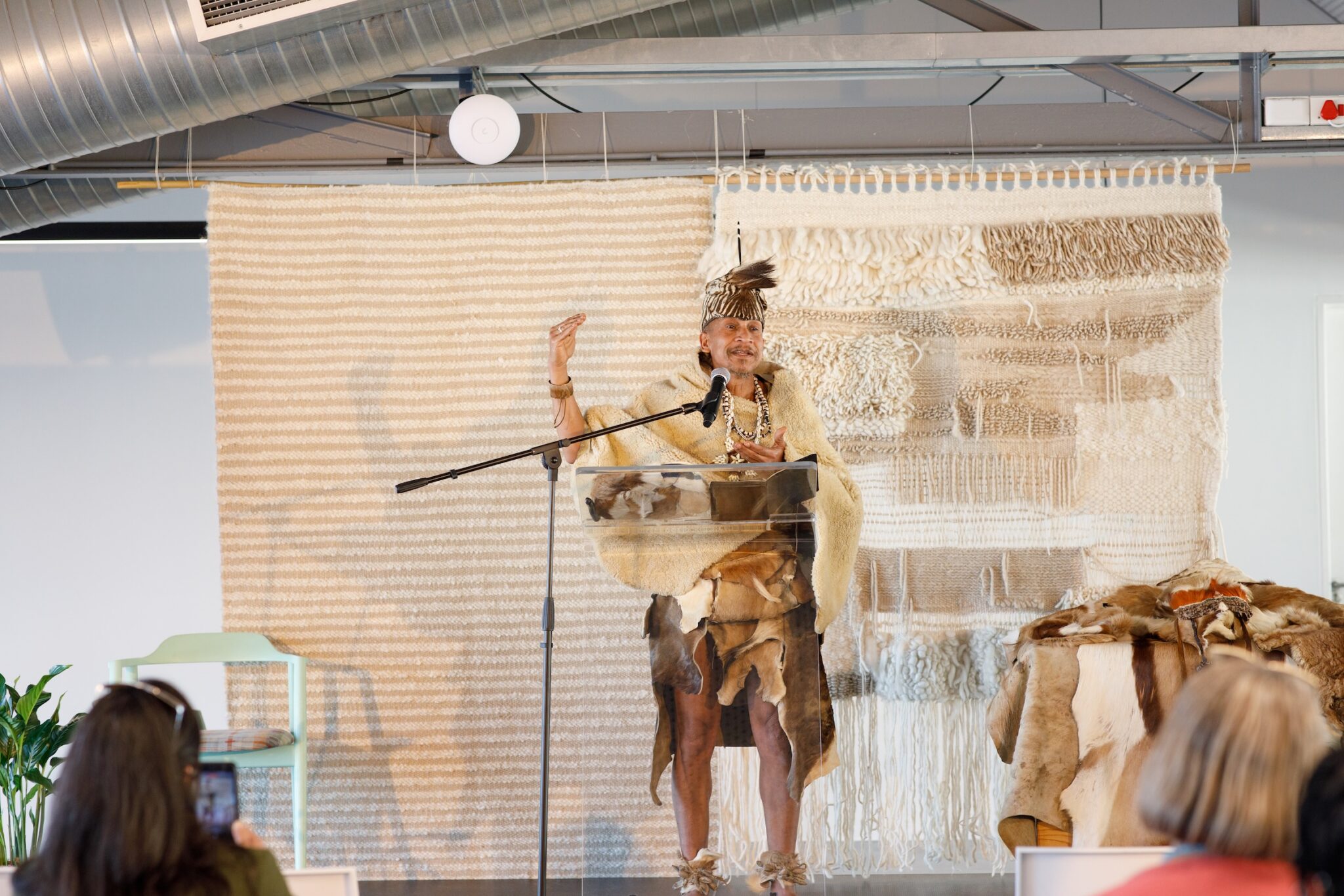
The founder of The Revival in Accra, Yayra Agbofah works in West Africa’s largest second-hand market, Kantamanto, where he upcycles textile waste dumped by the global North. H&M supported Yayra’s trip to Cape Town where he delivered a keynote at Africa Textile Talks 2025. You can listen to the podcast here. And read the transcript of Yayra’s keynote below:
Fifteen years ago, I used to go to the beach with my dad. We played. When I had my son, I wanted to take him to the beach as well, so he could experience what I experienced as a child. But I couldn’t, because now we have to jump over obstacles at the beach. And it’s not cool.
We have a beautiful coastline – it’s amazing. And this is not the suburbs or a rural area in Ghana; this is the capital. This is Accra. Waste, much of it textile waste, takes over our beaches which doesn’t make sense.
This is because we don’t have the right resources to deal with textile waste. Tonnes and tonnes of clothing come to Ghana every week, and a lot leaves as waste. We haven’t figured out how to deal with this. You might be wondering, “What is waste?” or “What does the waste entail?” These are unsellable items. One example is warm clothing, which is shipped to Ghana regularly. Ghana is very hot. Even at the sight of winter clothes in Ghana, I sweat. To take over our entire market? It’s just crazy. Nobody goes to the market to buy winter clothes.
Most people don’t go to the market to buy used underwear that is heavily stained, either, but we find lots of it. This gives us the impression that we are a dumping ground. In 2025, why should a place like Accra be seen as a dumping ground for global waste? There is a big problem that needs to be changed.
 Accra has become a dumping ground for the fashion waste from the global north. Image: Supplied by The Revival
Locally, we call used clothing obroni wawu, which literally means “dead white man’s clothes”. The used clothing industry has existed since the 60s – that’s six decades. We see clothes come to us in good condition that were in fashion decades ago. We wondered, why would somebody give away this amazing suit, this nice jacket? The person is probably dead. That’s why we call it that.
In our culture, we don’t throw clothes away
In our culture, we don’t throw clothes away. We either pass them on or give them to somebody who needs them. The system was good a few decades ago, but now it’s messed up. It has become so broken; we are overwhelmed with used clothing in really bad condition.
With the influx of fast fashion, it’s overwhelming – first the quantities and then the volumes of waste. That is why The Revival came into existence: out of pain, out of urgency, out of the fact that I see the problem but can’t ignore it.
I’ve been working in the Kantamanto market for two decades as a trader. I’m also a stylist on the side, sourcing most of my stuff from Kantamanto. The conversation is, “Business is not good. The things I buy, when I open [the bales] I’m not able to sell everything. I’m always making losses, but I cannot stop this business because there are no other options. There’s no plan B. I inherited this business from my mom. I cannot close it down because I don’t want to be the one who closes the family business.”
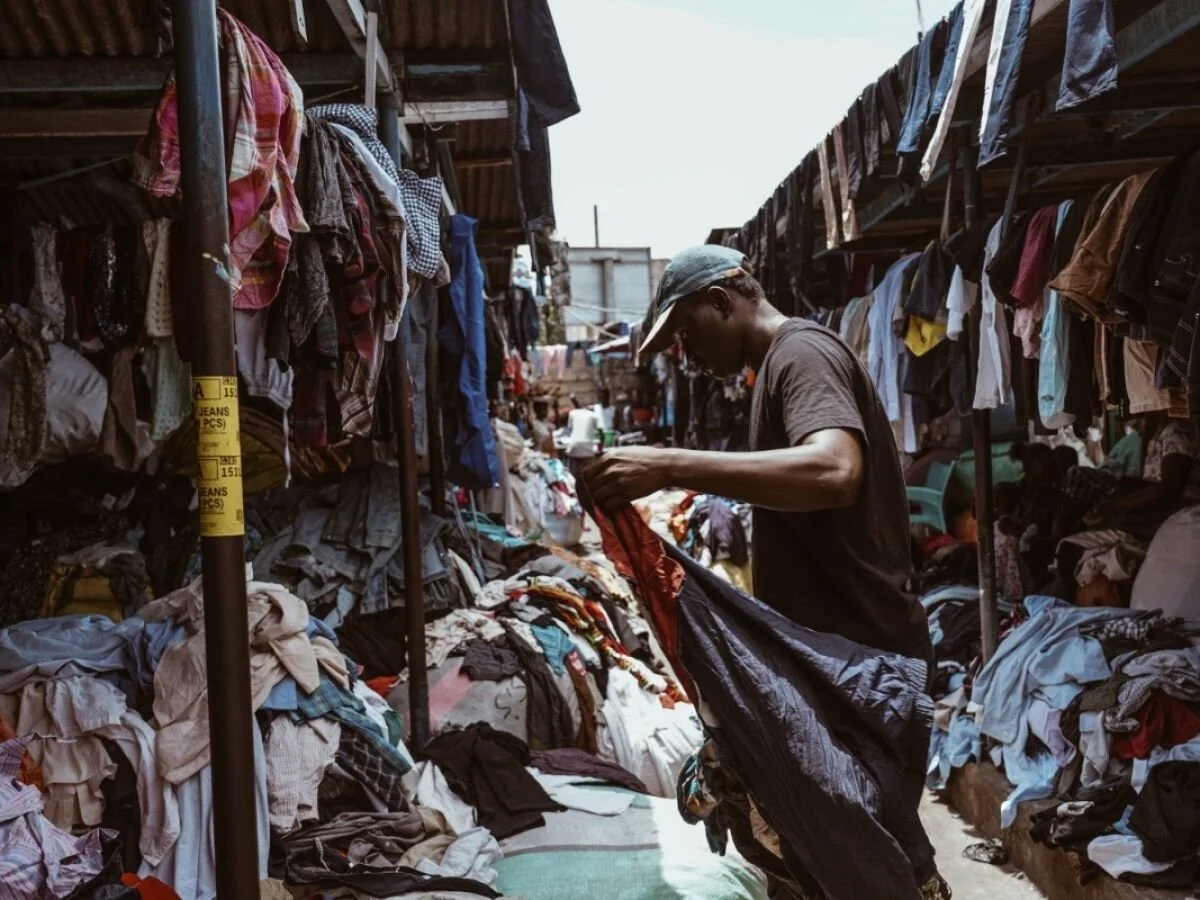 Yayra Agbofah at Kantamanto, Ghana. Image: Supplied by The Revival
So people are in the second-hand trade not because they are benefiting, but because they hope it might get better, and because they are holding onto family businesses.
We decided to team up with like-minded people in the community to start doing something about it.
The first thing we decided to do was find a way to stop the waste from leaving the market to end up in landfill or on the beaches. We started intercepting this waste. At first, we didn’t have much idea of what to do with it. All we wanted was to stop it. But along the way, we started collecting it. More people joined.
Kantamanto is a place where we are very resourceful. We always find a solution. Repair came into place because some of the items we collected needed a stitch or a wash. Others just needed to be ironed and were good to go. We started repairing and giving them back to the traders who gave them to us.
We’ve created over 60 jobs in the market
We also started upcycling. It gave us an opportunity to scale up how much waste we collect and how much we put back into circulation. Through that, we’ve created over 60 jobs in the market, and we’re still growing.
Education is key to what we are doing because we realised many people in the market were not aware of the problem. They didn’t know that most of the clothes they sell are donated clothes. So why do we pay for them?
In the second-hand industry supply chain, everyone except the [second-hand] retailer makes money: from the selling country to the shipping lines, the freight forwarders and customs. Yes, the government makes money, too.
But the market retailer is the one who does not make money and is uncertain. Whatever they buy [in a bail], whatever they take from the warehouse, the moment it leaves, it never comes back. There are no return points. In mainstream retail, you can return items. That hasn’t happened in Kantamanto. If it’s trash, [the retailers have to] deal with it. The market is 75% women, and they have to pay and carry this burden. I got tired of it and decided to do something.
We’ve had great milestones. We train and work with many institutions globally because education is at the core of this problem. If the education system was right, rooted in circularity, we wouldn’t have this problem. We also organise workshops because we feel it’s important to include people in our process.
That’s one of the ways we convert people. Every quarter, we organise a workshop for both kids and adults and take them through our process. We say, “Come, let’s upcycle together. Work with designers, become supporters, and then together we’ll do it.”
People buy clothes and easily dispose of them, because they don’t understand the value in the craftsmanship
People feel part of something. When you involve people in the process, they tend to feel ownership, and that’s what we don’t have in the fashion system. There is no ownership. That is why people buy clothes and easily dispose of them, because they don’t understand the value in the craftsmanship. Getting people involved in the process is extremely important.
Community is very important to us. Without community, we wouldn’t have gotten to where we are. And the problem is affecting the community. We cannot progress without working collaboratively. Without collaborative efforts, we will not win this fight. We all need to come together and connect our expertise, both social and environmental.
On January 2nd, there was a massive fire at the Kantamanto market. This was devastating, but it didn’t break us down. It made us stronger.
Kantamanto provides a livelihood for over 30,000 traders, and the only way to keep going was to rebuild the market. In six weeks, with the help and support of everybody coming together, we rebuilt it. And as we speak [31 July 2025], the market is 90% operational.
The most amazing thing is that while there was a fire, the next day, there were still containers bringing in stuff, which puzzles me. As part of the Global Change Award – which I’m honoured to have won – we’re setting up the Environmental Circularity Act, which we’ve already started piloting.
Kantamanto is the only place where circularity is being practised on a large scale
This award is going to push us and fund our project. We’re setting up circularity in the Kantamanto market, the first of its kind, because it’s much needed. Our goal is not to allow a single T-shirt to leave the market. In my view, Kantamanto is the only place where circularity is being practised on a large scale.
But we need resources. That’s what’s missing.
We’re working with people to transform textile waste into materials for building, furniture, and string ties. The goal is to create 60 more jobs, women-led, mainly for women from marginalised communities in the market, many of whom live in slums. They carry heavy loads, 55 kilos on their heads, transporting used clothing from warehouses to the stores.
We developed an online course in 2022, available on FutureLearn, about the circular economy and creative ways we’re tackling the situation in Ghana. We’re also collaborating with pineapple farmers, who face serious issues. Many didn’t want to go to work anymore because they came back with bruises from the crowns of the pineapples.
Some of them came to the market and bought fossil-fuel-based clothing to use on the farm. Out of curiosity, I asked why. The problem could be solved with textiles, and I had so much denim waste.
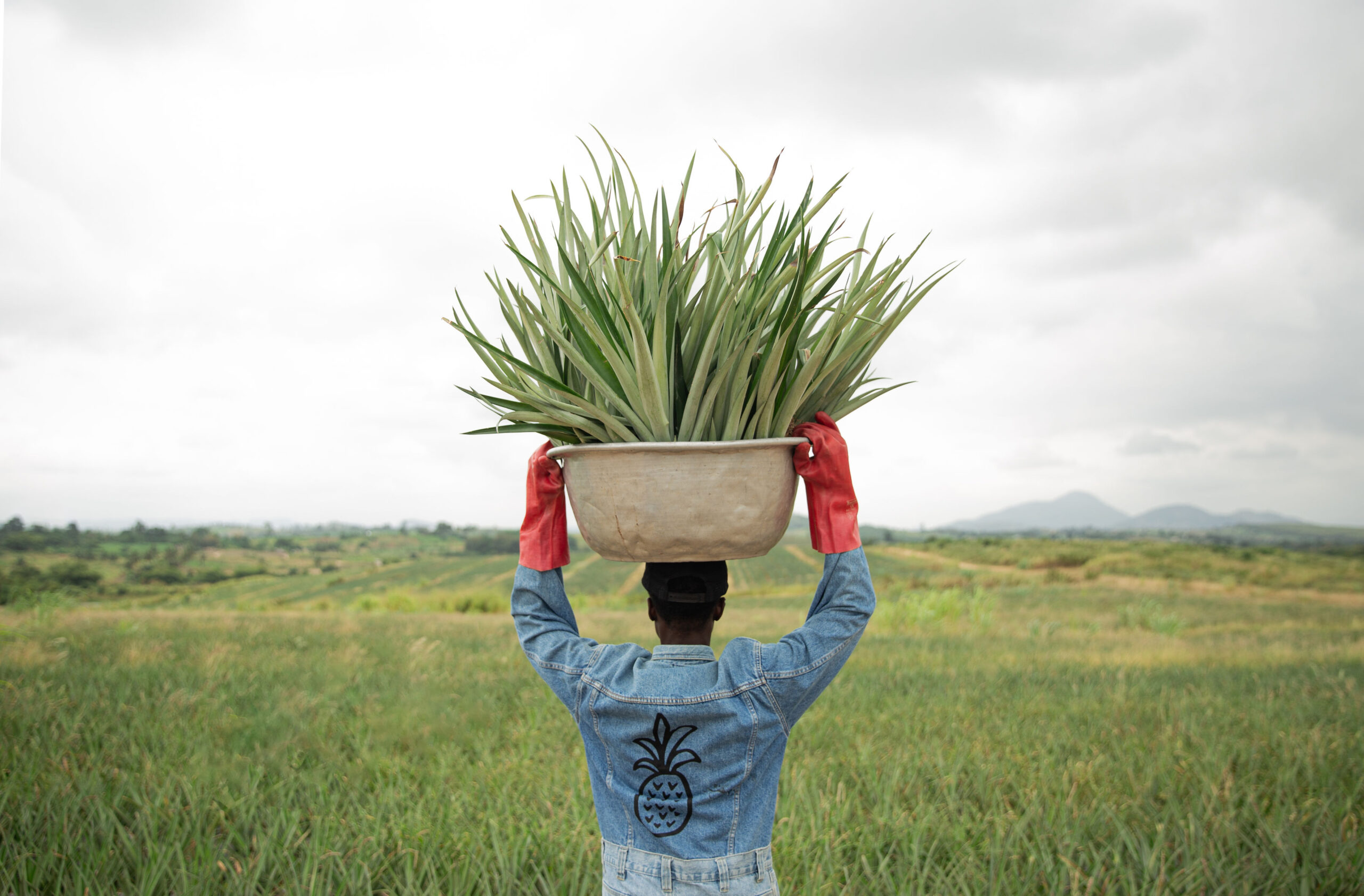 The Revival makes uniforms for people working on pineapple farms. Image supplied by The Revival
We collaborated with farmers to co-design uniforms for them. They love it. So far, we’ve distributed 800 units and aim to distribute 8 million more across West Africa in five years.
What really matters to us is shared ownership. That is where ownership comes in. We always work with people and do not claim ownership. We’re not gatekeepers. Transparency is very important to us. Everything we do, we make sure it’s open and transparent.
- The transcript has been lightly edited for readability
- Yayra Agbofah is a winner of the H&M Foundation’s Global Change Award 2025
- Images: Supplied by The Revival
- Video of Yayra Agbofah at Africa Textile Talks produced by The Dollie House