

This December and January brought gale force winds, ice cold sea swims, tourists, traffic and parties to Cape Town. Then, as the holiday season slowed, the Investec Cape Town Art Fair brought hurricane-like energy to the city, with thousands of art lovers, collectors, galleries, artists and creatives flocking to the city to exchange art and ideas.
Since its inception 13 year ago, Investec Cape Town Art Fair has become the largest international art fair on the African continent and is considered to be one of the most important annual events in Cape Town. Taking place at the Convention Centre, the 2026 edition had its highest attendance to date, with 34 000 people from 34 cities around the world visiting 126 exhibitors featuring nearly 500 artists. Along with the official programme, there were multiple off-site, fringe events that added to the art week’s attraction and relevance.
Twyg was a media partner of the fair, and we showcased our first print project in collaboration with Letterhead, MakeSpace by Wunders and Orms. Guided by our focus on nature, culture, fashion and textiles, here is Jackie May’s selection of highlights from Investec Cape Town Art Fair 2026.
Thuli Gamedze

Thuli created upcycled shirts for the Twyg x Letterhead x MakeSpace by Wunders booth. Credit: Supplied
Thuli Gamedze’s work feeds Twyg’s curiosity with discarded and pre-worn clothing and textiles. Last year our contributing writer, the much-missed Ufrieda Ho (1974 – 2026) interviewed the Johannesburg academic, designer, deep thinker and artist about her project, After Library.
By borrowing Thuli’s upcycled clothes and accompanying texts, people can access difficult South African histories and narratives and understand why the wearer is part of the story. As Thuli told Ufrieda, “What was interesting for me is that clothes as objects are worn on your body and follow you around everywhere; it makes them a good mediator between the wearer and things like the text someone reads, or the art they see, or something else they experience.”
This year, Thuli created three garments from used clothing printed with her manifesto. These were in our In Circulation booth along with other printed matter that use the art of storytelling to make fashion good. Besides these garments, Thuli had large framed works made from textiles at the Kumalo | Turpin gallery booth. This new gallery is dedicated to exhibiting the next generation of leading artists from the Global Majority.
Amy Rusch

‘What arrives with first light, and the goodness of silence’ is Amy’s award-winning work. Credit: Mia Thom
At school, Amy Rusch was fascinated with found plastic waste. She experimented with it and with coloured thread she inherited from her Belgium great-grandmother. At the art fair, Amy was awarded the Materiality Prize in partnership with Homo Faber for her 2026 work titled, ‘What arrives with first light, and the goodness of silence‘. She used found plastic bags and thread to create this work that was inspired by early morning walks with her father from their camp site to an archaeological site called Kurukop in the Nama Karoo region in the Northern Cape.
As Amy told me, “People think my work is abstract but there is often a direct link to an experience and place in reality.” She recalls how she and her father would set off before dawn finding their way through the rocky veld without torches, allowing their eyes to adjust to the changing light and listening to night sounds shift to dawn sounds. At the Kurukop site where geological formation began to accumulate from about 300 million years ago, she marked tracings of petroglyphs (rock engravings).
For her award-winning art work she used geological maps of Kurukop as “gentle guidelines”, thread and found plastic which is always at sites of rock paintings. The plastic is a material of our modern time, whereas the rock painting is deep time. She says: “I’m often thinking of archaeology and time and surfacing of things… and ideas unfold during the making process. I use the thread to bring a moment to the surface, or points of clarity. The plastic represents the oscillation of time.”
Gerhard Marx

Gerhard’s Espalier sculpture. Credit: Everard Read Gallery
Walking through the high-energy exhibition halls of people and noise, I was immediately struck by these Gerhard Marx’s pieces. They are beautiful and delicate. I’m gullible so initially I thought they were real twigs. They are not. Branches and fragments of branches have been cast in high-definition bronze creating three-dimensional drawing-like sculptures of the horticultural practices of grafting and of training plants to grow horizontally. The sculptures created a visual resting spot elegantly set against white walls of the Everard Reed booth. For a few quiet moments, they whisked my mind away from the intensity of the Investec Cape Town Art Fair to somewhere calmer: a garden.
Occupying the Gallery
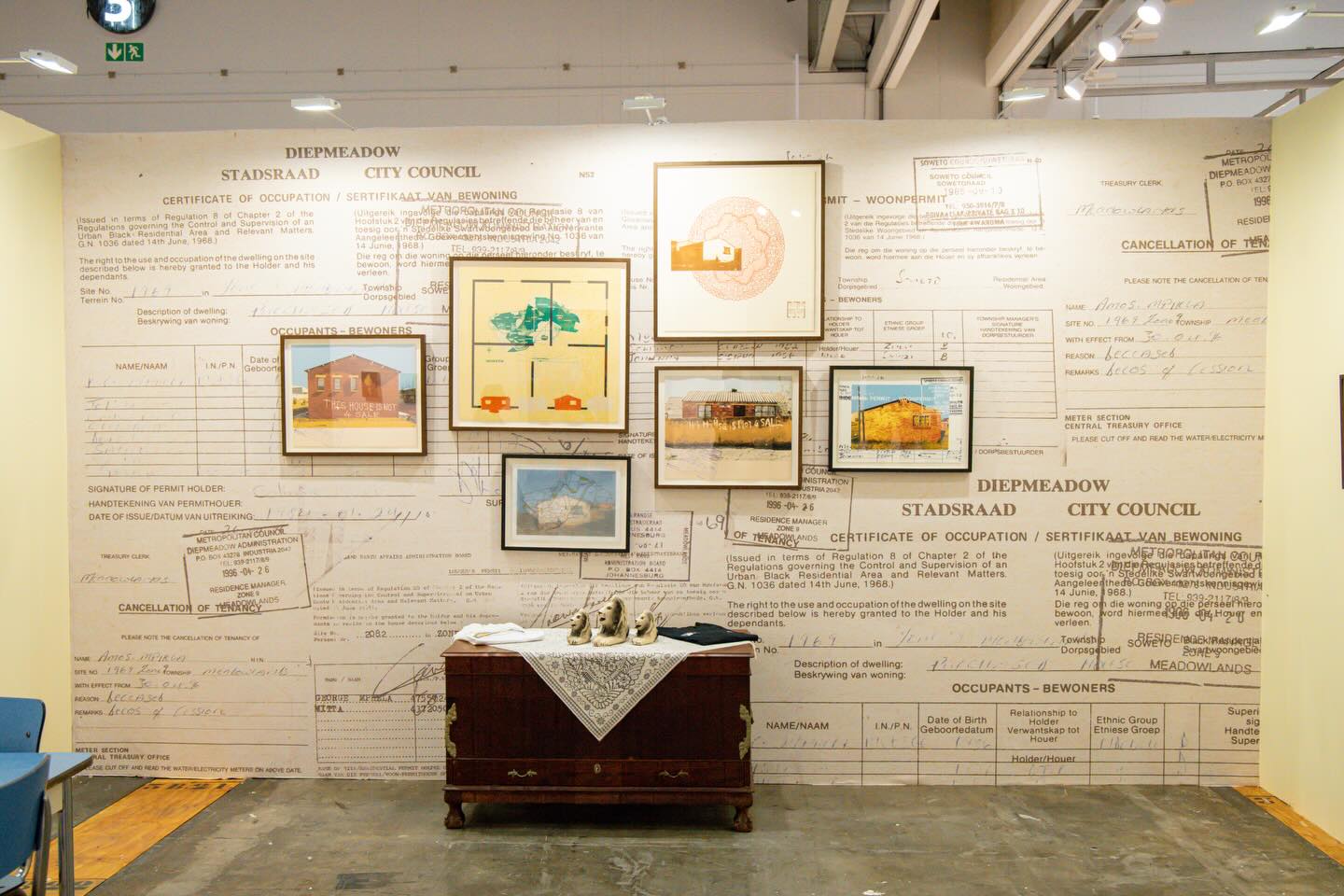
Hoek Swaratlhe, a photographer from Soweto, has worked with Occupying the Gallery to produce a body of art works. Image via Instagram
Founded in 2023 by artists Mary Sibande and her partner Lawrence Lemoana, Occupying the Gallery is an inclusive and fluid arts collective where emerging artists – called occupants – are invited to collaborate with art and cultural institutions to produce new works. Lawrence says, “As an artist you have to give back to society. We use our currency to connect young, emerging artists to opportunities and to mentors.” Through mentorship programmes and artist residencies, they support young artists to investigate their ideas and learn new skills to produce challenging art. “As artists, we find ourselves in the commercial art environments and now we want to create enabling environments for artists to flourish,” says Lawrence.
It was here that I “discovered” Hoek Swaratlhe, a photographer from Soweto.
For one of his projects, he cycles around Soweto, Johannesburg, photographing original township houses to archive what is left of them. The houses, designed by Douglas Calderwood, are known as NE51 houses which means non-European housing of 1951. Douglas researched the ‘Native Housing problem’ for South Africa’s Council for Scientific and Industrial Research to create “national standards for state funded-housing while minimising cost”. He designed three housing types designated NE 51/6, NE 51/8 and NE 51/9 which were built by the Apartheid government in the thousands across South Africa for three decades. These four-roomed matchbox houses consist of a kitchen, a living/dining room, and two bedrooms.
Working with Occupying the Gallery, Hoek has expanded beyond just photography into creating fine art works. By linking Hoek with academics, lawyers, printmakers, galleries, Occupying the Gallery has supported him to explore “history, architecture, and the lived realities of people within the four-room township houses”.
Hoek writes on his Instagram, “Through the mediums of photography and printmaking, the project reflects on the notion of home as an object and subject of memory, inheritance, resistance, and survival within South Africa’s spatial organisation history”.
Jamal Nxedlana
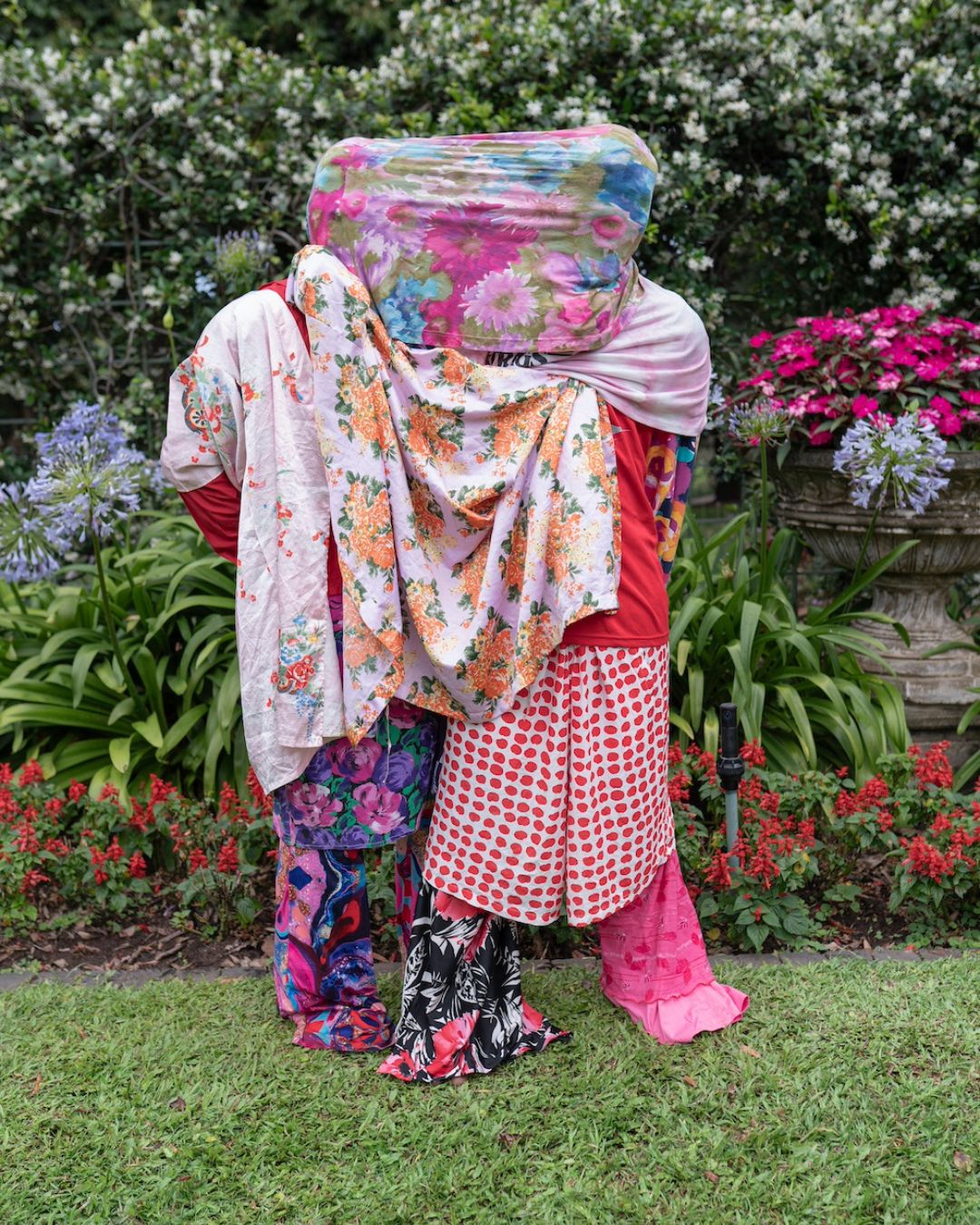
Theatrum Vestis, 2025. Credit: Courtesy of the artist and No Man’s Art Gallery

Detail of Computer vision, 2025. Credit: Jonathan de Waart via No Man’s Art Gallery
I first encountered Johannesburg-based Jamal Nxedlana more than a decade ago when I fell in love with his online magazine and digital agency called Bubblegum. It was a brave and progressive organisation, which paved the way for many subsequent online cultural magazines. Still working as a cultural organiser, he is also a practicing visual fine artist based in Johannesburg and Geneva, Switzerland, and represented by the Dutch gallery, No Man’s Art Gallery.
Treating clothing as “carriers of data, memory, and desire”, Jamal has been studying how used clothing circulates from the global north to the global South, focusing on Johannesburg’s second-hand clothing markets as his site of research. Using photographs, geolocations, label data of clothes, Jamal creates work that both critiques the current exploitative and extractive global fashion system as well celebrates the joyful and affirming role of thrifting and upcycling in local youth cultures in Johannesburg.
In an essay about his work, Mpho Matsipa writes that Jamal’s “creative preoccupation with a tumultuous city with a long history of extractivism, offers rich grounds for speculating about how discarded personal artefacts – ‘transitory kinship structures’ – become vehicles that enable dreaming of a future within and against the structural failings that mark our present.”
Jamal uses found objects, photographs, data visualisation practices, film, stitch, collage and print techniques for his ongoing research project. Curator Mariella Franzoni writes, “The project reframes discarded textiles as active sites of knowledge and imagination, proposing material practice as a decolonial way of rethinking contemporary systems of circulation and meaning.”
Rewoolution

The Rewoolution’s wool cube conceptualised by Viviers Studio and Hoven. Credit: Zander Opperman
From a creative collaboration between Viviers and Hoven emerged the “wool cube”. This installation was one of multiple activations during the week of the art fair curated by Lezanne Viviers in association with Hoven, international trend forecasters Li Edelkoort and Felipe Fimmano, Krone and House and Leisure. The backdrop of the cube was created by hand stitching together metres of wool padding from Gerber & Co. Hanging in what looked and felt like a cocoon, were various fashion and design pieces selected to display creative uses of wool, and to illustrate the connection between land, animal and community. The exhibition notes pointed out that the cube explores wool as both a material and cultural medium across its value chain.
Included in the installation were Nina Kruger, Frances van Hasselt, Leila Atelier, Tali Lehr-Sacks, Adrian Pepe, Rita Trafford, Viviers Studio, Adrian Pepe, Aelahn, Anika Lotter, Cape Cobra Leathercraft, Connade, Frances van Hasselt, Helderstroom Alpaca, Leila Atelier, Naked Ape, Nina Kruger, Pascale Theron, Polo South Africa, Quenti Alpaca, Rita Trafford, Tali Lehr-Sacks, UNI FORM, Viviers, and Viviers x Karoo Baba.
Rewoolution is a continuation of Viviers Studio and Hoven’s collaborative curatorial project Wool World, first launched at the Klein Karoo Wool Festival in 2025.
In Circulation

Twyg collaborated with MakeSpace by Wunders, Letterhead and Orms to produce a print newsstand. Image: Jackie May
Of course, I must mention our booth.
In Circulation is a contemporary newsstand that positions fashion as a cultural and civic practice. It was produced by Twyg and co-curated by copywriting studio Letterhead, MakeSpace by Wunders and Orms. Through a call for zine ideas that use the art of storytelling to make fashion group, we selected five concepts, edited the copy and design, and Orms printed them. We also hosted a zine-making workshop for six creatives who hand-made publications. In the booth, we included two creatives who submitted copy printed on clothing items: Thuli Gamedze and Loabilwe Morake. Letterhead added select publications from Index, a Letterhead and MakeSpace print project.
Finally, we created our first print edition, a small 16-pager, which has got us thinking about future print editions. The booth was a space for gathering and presented fashion not as image or commodity, but as a medium for exploring labour, cultural histories, materials, regional production and alternative systems within fashion. The focus is on ideas that move through hands and communities.
- Feature image: Jamal Nxedlana presented by No Man’s Art Gallery at Investec Cape Town Art Fair 2026
- Next year’s Investec Cape Town Art Fair takes place from 19 – 21 February 2027 at the Cape Town International Convention Centre


