Next-generation leather has been all the rage in the last 20 years. Leather has always been a no-brainer material in human societies, maximising what we can get out of the animals we hunt and farm. However, industrialisation and mass manufacturing have transformed what is natural and intuitive into something toxic and deadly. Innovators, researchers, and designers are meeting the issues of waste, harmful chemicals and overproduction with forward-thinking strides in plant-based leathers, but we’re still many years from these being widely accessible and sustainable solutions. But, as is often the case, we don’t always have to reinvent the wheel. While we push for an industry to return to historical and natural processing for cow leather, a forgotten and unexpected player is reemerging.
Ira and James Ambani, a Kenyan husband and wife duo, began their business as middlemen between local fishermen and fish processing manufacturers around Lake Victoria in east Africa. However, as the continent’s largest lake, competition in the area was fierce, and the water body faced increased threats from overfishing. Seeking to maximise their business, the couple then looked to the desert lake of Lake Turkana, in northern Kenya. “Getting there was a challenge,” says James. “The road is bad, it’s a marginalised community, it’s a desert, along the way there are bandits.”
Despite the challenges, their small fish processing factory began to take root. They had a new problem. “We realised, in processing, that we get the main product, which is the fillet, and we get lots of byproducts. That’s the head, the skeleton, and then the skin.” The heads and skeletons were easy enough to solve. They began drying and crushing the bones to produce animal feed. “But the skin, we had no use for it. We used to bury it.” This is standard practice across the industry, where it’s estimated that only 1% of fish skin is utilised in seafood production. The rest is often destroyed or thrown back into the sea. James estimates that a single Kenyan fish factory can produce about 20 tonnes of fish skin in a day, leaving a huge gap in the market for capitalising on this waste product.
“And then at one point my wife suggested, ‘Why don’t we transform this fish into leather?’”
Met with hesitation from her husband, Ira set off to research. The pair made contact with the Icelandic company, Atlantic Leather, which was the leading producer of fish leather in Europe.
Fish leather is rather obscure in the fashion world and its rarity has it categorised as an exotic leather even though, unlike python or alligator, it’s an agricultural byproduct. And it has an almost forgotten history across several coastal communities in the world. Since at least the 10th century, the Nanai, Nenets and Evenki people of present-day Russia used salmon and catfish to fashion gloves and coats. In northern Japan, the Ainu people fashion boots and jackets from salmon. Inuit groups in north America relied on halibut and whitefish for ceremonial garments and bags.
Today, Atlantic Leather has revived fish leather practices originating in Iceland’s medieval age for the modern day. It was Atlantic Leather that made Ira’s idea a reality, becoming one of their first clients.
It’s unclear if there have ever been indigenous uses of fish leather in Africa, as fish skin doesn’t preserve well if untreated, and the process differs greatly from that used for cow or goat hide, which have been in greater abundance and used regionally. But the characteristics of African fish like the Nile Perch and Nile Tilapia found in Lake Turkana and Lake Victoria have added a new dimension to the centuries-old industry.
Speaking to the BBC, Atlantic Leather’s sales manager, Steinunn Gunnsteinsdóttir, says, “Fish leather is actually nine times stronger than lamb or cow leather of similar thickness. This is because the fibres in fish skin criss-cross rather than (go) just up and down.” This is similar to how a twill weave, like that used in denim, tends to be stronger and more durable than a plain weave. Plain woven fabric is made by threads strung horizontally and vertically, where a twill makes use of a diagonal structure that allows the yarns to interlock much closer together.
And of all fish, Nile Perch, which is in greater abundance in Kenya, produces one of the strongest leathers in the world. Ira found this out after working with the Kenya Industrial Research Development Institute (KIRDI), which provided research, training and infrastructure as the Ambanis added a new facet to their fish processing organisation. Since the Nile Perch is 2m in length, this large fish has an advantage over salmon or catfish alternatives because of the greater yield of leather for every fish, which has also brought down the cost of the material.
 Rose Munene, left, holds a large fish hide, while Everlyn Akinyi degreases a bucket of fish hides at Ambani Fish Leather
Because fish leather was new to both KIRDI and Ambani Fish Leather, the majority of what they sold to Atlantic Leather was semi-processed skins, which the Icelandic company would then further process into high-grade materials for industry use. It was after attending the United Nations (UN) Blue Economy Conference in 2019 that the duo realised they needed to take even greater ownership of this network. The UN are highly encouraging of the production of fish leather, which offers not only enhanced economic opportunity to fishing communities but could aid in conservation efforts and, as a result, took to Ambani Fish Leather like a fish to water, inviting the brand to demonstrate their offerings at expos in Dubai and Italy.
This meant that Ambani Fish Leather had to purchase the processed version of their material back from Atlantic Leather. “I was showcasing a product that we can’t even manufacture. It was hell,” says James.
Their next challenge was to bring the entire manufacturing process home, which meant more research and training. James explains that the processing of fish leather differs greatly from that of cow or goat, which local communities were familiar with. It was also imperative that they create their products in the most conscious way possible. This has involved social aspects such as working with an all-women team of artisans from rural Kenya and environmental aspects like using vegetable tanning instead of chrome.
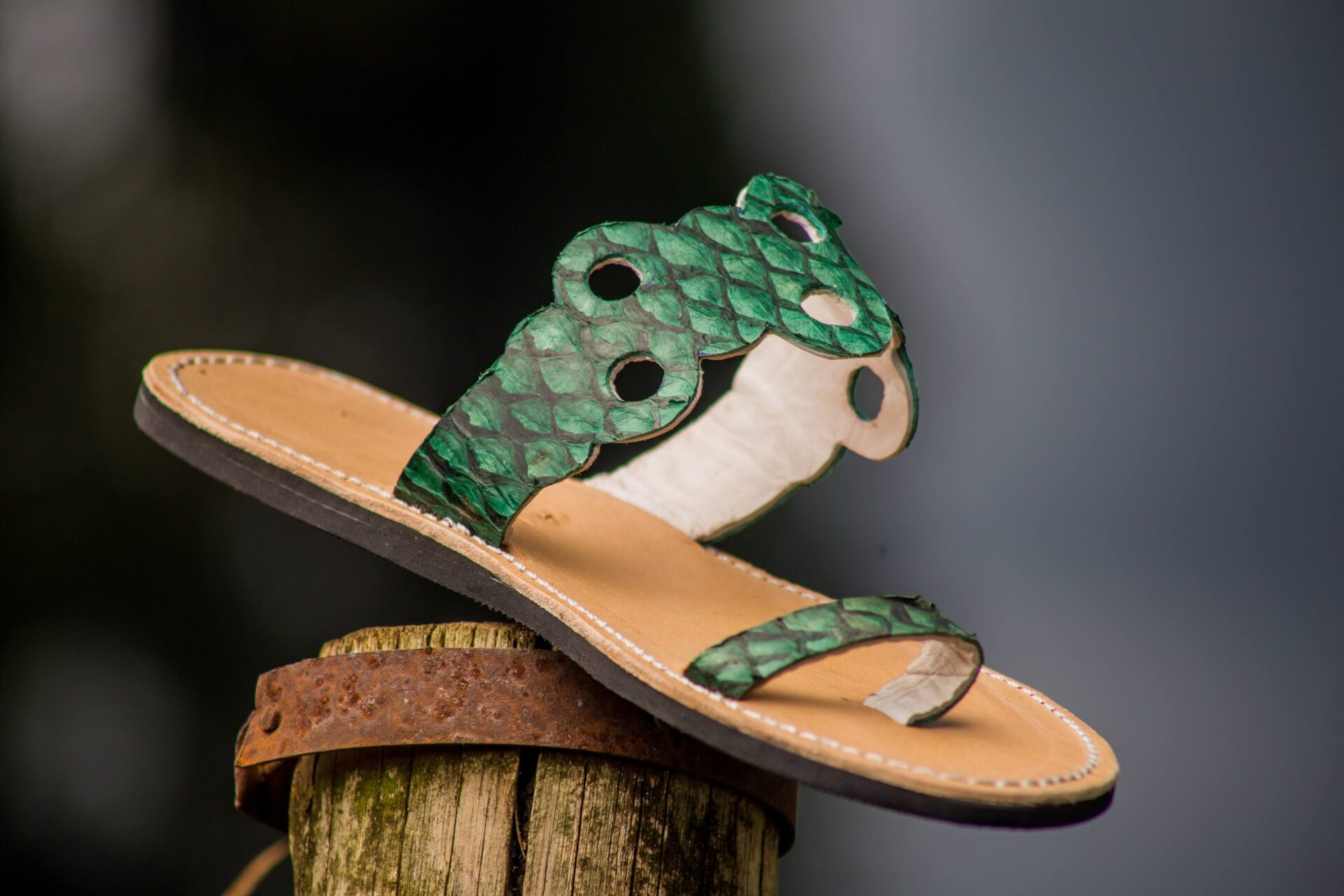 A pair of sandals made by Ambani Fish Leather
Tanning is the process by which animal skin is turned into leather. This process prevents the material from decomposing and decaying, as well as making it heat or water-resistant. Traditionally, tannins are derived from natural sources like tree bark, fruit or leaves. This is a labour and time-intensive process, which often smelled so bad that tanneries had to be positioned far away from everyday life, creating the impetus for the invention of chrome tanning in the 1800s. Unfortunately, this process relies on artificial and harmful chemicals, which are often improperly disposed of and lead to environmental destruction.
“Everything has to be done locally to make it sustainable,” James says. Following further assistance from KIRDI as well as a study trip to Singapore to learn from exotic leather suppliers, the couple were able to set up their own tannery and processing centre, which made their product accessible to local designers like Deepa Dosaja, who produced a fish leather collection in 2019.
Now, Ambani Fish Leather has graduated to making its own products. This was a great learning curve for the brand. “We have no technology, we have no know-how, we have no machines. All our work is manual,” James says of their beginnings. Now the brand has trained local artisans who combine these new fish leather techniques with traditional goat leather work.
 Coni Qwaresma wears a waistcoat and holds a wallet both made by Ambani Fish Leather
You can shop for various accessories and jewellery from their website, all produced artisanally in Kenya. The brand’s looking to expand offline, of course. James says people often expect fish leather to smell, and it’s difficult to communicate its unique aspects on digital platforms.
“It’s very soft,” says Thando Mazomba who is amongst many things, the venture development manager at OceanHub Africa. OceanHub Africa provides funding and support to businesses in the Blue Economy. “In fact, one of my colleagues had bought an Ambani Fish Leather handbag six years ago. Hers looks much better than mine, so it ages really, really well.”
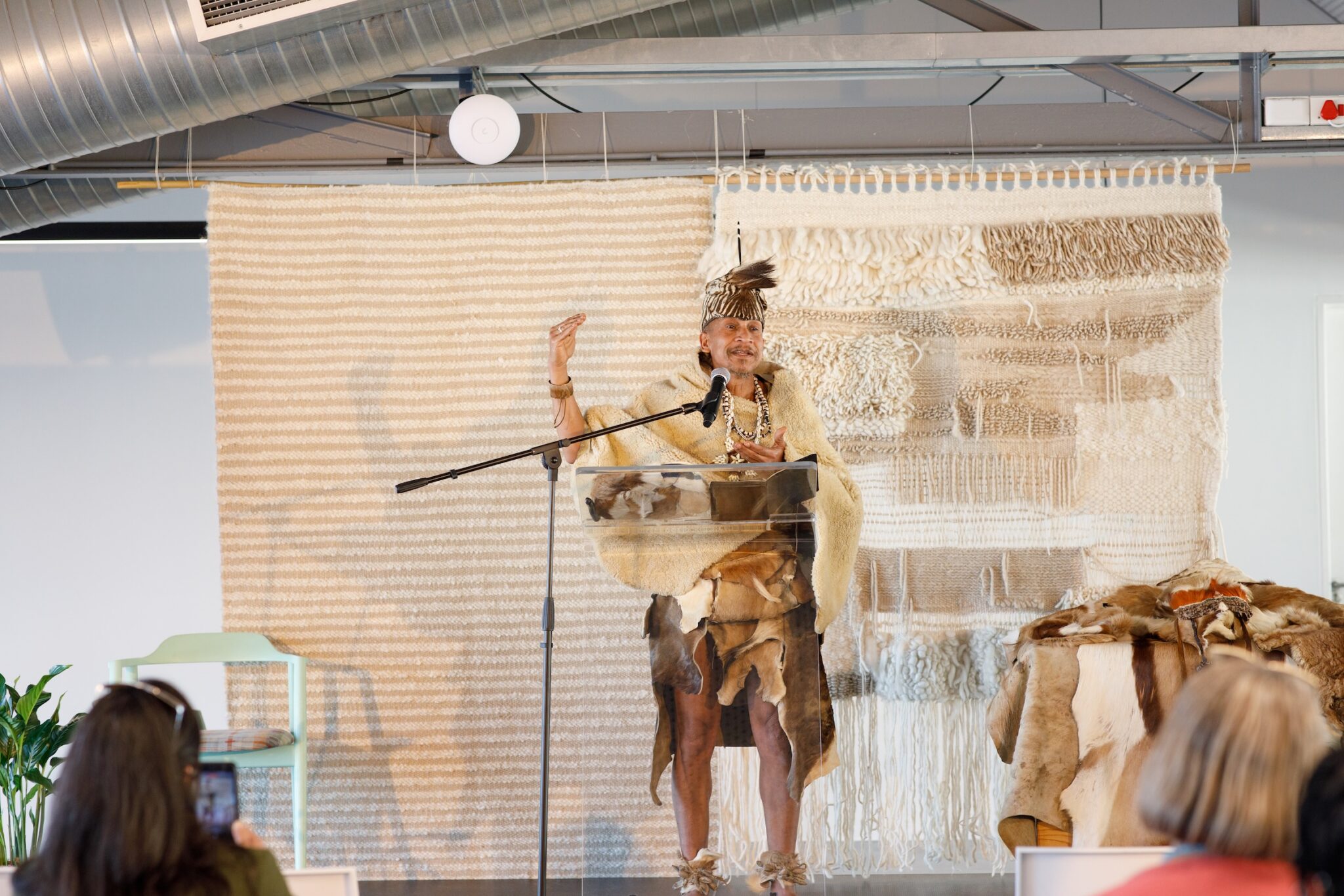
“The Blue Economy space is really, really small, which makes it great,” says Thando. She first came across James, who was dressed in a fish leather waistcoat, at a Blue Invest Africa event in Mombasa last year. “We tend to overlook fashion,” Thando says. OceanHub Africa’s mission is to empower entrepreneurs and solutions across the continent, innovating practices to meet social and environmental issues.
More than just providing funding, OHA is a holistic accelerator offering mentorship, life coaching and access to a rich network of investors and collaborators. What’s most remarkable about the Ambani Fish Leather story is how sustainable fashion cannot operate in silo. It’s a group effort, which crosses continents, cultures and communities, dependent on the collaborative contributions of government institutions like KIRDI, ventures like OHA, regional designers and local communities.
- Visit Ambani Fish Leather’s website here
- Images supplied