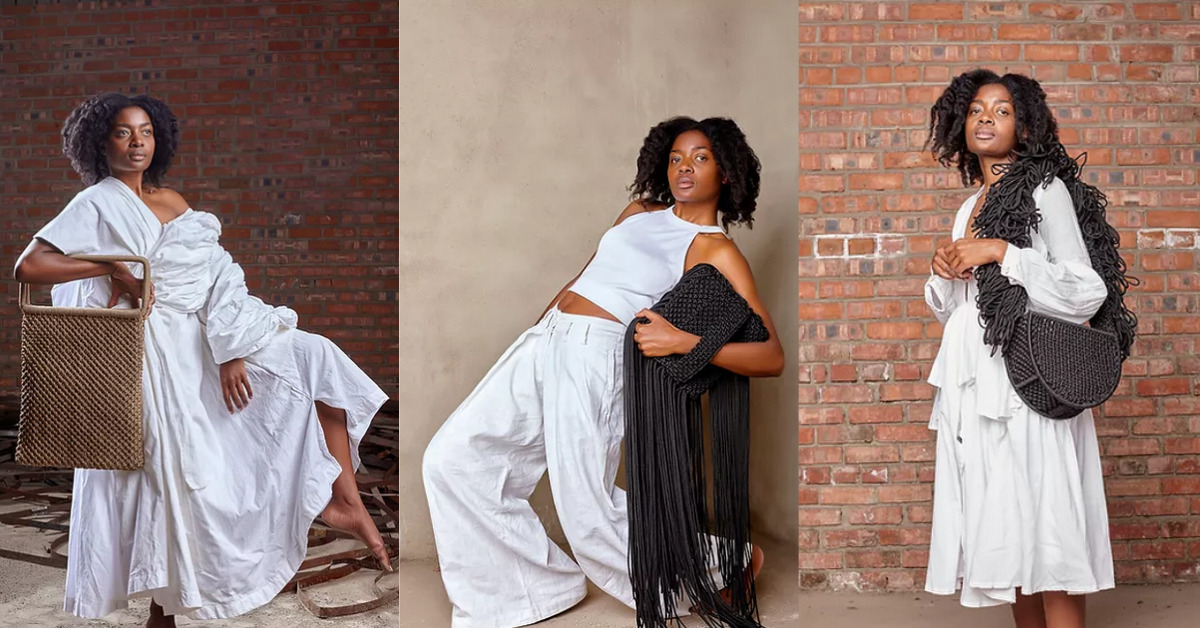

Vanhu Vamwe’s people first ethos echoes through all aspects of their thoughtful and care-filled design process They create sculptural, avant-garde accessories, working with artisans in Zimbabwe and Ecuador, with sustainability and ethics top of mind.
Vanhu Vamwe, Shona for ‘One People’, was co-founded by Zimbabwean-born Pam Samasuwo-Nyawiri and her husband Simba Nyawiri. After spending six years deep-diving into what it means to instil care in design, the Vanhu Vamwe duo is back and more committed than ever to their vision of creating considered accessories, rooted in culture and community.
We caught up with this dynamic duo who are based in Canada to find out more about the journey of nurturing and evolving their brand.
Tell us briefly about your design history?
We started as ‘Syms & Pams’ in 2010, hand-knitting avant-garde accessories in our makeshift home studio. We’ve always had a deep-set passion to create and a love for handcrafted goods because there is something about a human imprint on a product that elevates storytelling.
This period led to Pam diverging from her career in journalism and going to university to study a B.A. in Fashion Accessories with a specialisation in leather luxury goods, and then an M.A. in Culture, Style & Fashion. And, finally, a Design PhD.
All this was not to learn how to design but to understand global fashion and help us find a niche in the industry. The journey has been a delight as we have stuck to our ethos of design and created a path that suits a demographic that understands our work.
What motivated your focus on care for people and planet?
The idea to follow a sustainable path came about as we were creating a foundation for our ethos and values for our brand. At the time we had no idea that what we were doing was “sustainable” or “ethical” – the terminology was not even familiar to us. We were motivated by the preservation of traditional crafts and through this practice, we realised that we were actually onto something very precious.
We started to read blogs about other brands who had similar values and then noticed they were using terminology such as “sustainable” and “ethical”. So, we started to implement the terminology too.
But, beyond the terminology, we always say we are not fashion people. We intentionally don’t identify what we do as being “fashion”. What we practice is humanity.

What does sustainability mean to Vanhu Vamwe?
For us, sustainability is a process of nurturing. It’s a process that is linked to the way of life of humans, our environment, and our livelihoods. It cannot be separated from our day-to-day living, as it becomes the backbone or blueprint of how we work with others within and outside of Vanhu Vamwe.
Sustainability is important to us, as it provides structure and an opportunity to create a legacy that is linked to a culture of consistency. Consistency breeds sustainable development, and this is particularly important in the work we do in different communities around the world.
What practices do you implement?
Sustainability can only be functional if intentionality exists. We are very aware of how important it is for us to turn our responsible values into actual sustainable outcomes by ensuring that we continue to revisit our brand sustainability roadmap.
We understand the needs and desires of our environment and our artisan partners. Our leadership is grounded by a sustainability style that understands the power of human connection and good communication in constituting a sustainable business. Relationships and cultural awareness are a practice that holds our sustainable structure. Everything else follows from that.
What influences your collections, the style, colour, look, and feel?
Our work is highly influenced by life experiences and storytelling. We invest a lot in research and sampling, which are practices that we think are lacking in the design field. There is a lot of work created that is influenced by other people’s work. Instead, we try to focus on creating our shapes, colour story, and mood from our own concepts.
We realise that it is impossible to create something completely original, because we all draw inspiration from the world around us. But, we try to use our own stories to create so that our collections are personal to our brand.
The naming of our bags comes from our overall collection concept as we are very particular about creating meaningful pieces that speak to the heart of anyone who purchases our work.

Tell us about your recent collection, Dreamers & Travellers.
Dreamers & Travellers [a collaboration with Macrame weavers and Zimbabwean wire artists] was a collection we designed after the passing of our son. It was a difficult time. We were so far away from home and we needed to reconnect with our roots, thus the consistency in the tassels seen in the collection. We felt so scattered from the ‘natural’ environment, and the longing for home was so overwhelming.
As immigrants, we are caught up in the dream of travelling from home, and then something significant happened in our life that made us understand the importance of our roots. Dreamers & Travellers reflects hope and passion, entwined in culture. The shapes in the collection represent strength and growth as the tassels take you on a journey of calm and clarity even in times of pain.
This collection was a part of our healing journey. The experience of these pieces was a gift not only to ourselves, but to many others who share our story of pain and a longing for a place called “home”.
Can you tell us about your experience in the fashion industry in Zimbabwe?
We cannot be the voice that represents fashion in Zimbabwe. But, we can tell you of our experience returning to implement a creative hub in our home country. We are continuously amazed at the creative talent Zimbabwe holds. The artistry and raw productivity should be regarded with the utmost respect.
We are certified leather designers, but our sustainable practices are environmentally centred. When we come into a community, we use materials that are accessible, kind to the environment, and offer a foundation for social innovative communities. Materials that are sustainable breed innovation. Our current collection is made out of 100% recycled para-cord, which is 100% made from recycled plastic PET bottles. The result of this construction is an environmentally friendly rope with a luxury appearance.
What are your thoughts on inclusivity and slow fashion?
Fashion itself is a hard knock to inclusivity. There are so many layers to fashion. How do we create products that have been made with so much awareness, love, intentionality and accessibility to everyone while ensuring that our artisans are well paid, and our brand has has a fair profit margin to continue building more design communities? It is very difficult.
Slow fashion should be accessible to everyone, we agree, but the truth is slow fashion is also elitist. Not only do the price points reflect this, but the demographics that slow fashion brands target already cancel out anyone out of that class. So, as we continue to pursue inclusivity in its many forms, we must bear in mind that not everything works for everyone.

What are the most fulfilling parts of the work you do?
We are very personable people and we are very involved in the community. Our design structure is based on being in the community during the whole process of making. This means sleeping and eating where our artisan family eats and sleeps. What a joy to see design as an opportunity to gain more cultural awareness.
Unfortunately, COVID has created a barrier regarding that aspect of our design practice. But, we continue to find fulfilment in the change our work contributes to, in the community. We elevate humanity over profit and we are so motivated by the servanthood aspect of our work.
Our career has been full of highs and lows, but we continue to be enchanted by the creativity we bring to life as a team. Sometimes we look at products and say, “Did we do that?!” We are guided by the everlasting beauty of God’s creativity in our work. That is what excites us!
What one thing would you change about the world when it comes to African fashion or brands?
We have nothing to change. We have great respect for the evolution of time and place, which includes the multitude of African brands that are showcasing the magic of African aesthetics in so many different ways. There is a time and place for everything. The vision for African fashion, that we have always desired, is unfolding. We are here.
What African sustainable and ethical brands do you admire?
We are obsessed with a ‘Made in Zimbabwe’ brand BATIQUA (@batiqua). Their story is very inspiring. It is a story of perseverance and community. Their sustainable and ethical practices should be a blueprint for brands globally.
 Pam Samasuwo-Nyawiri and Simba Nyawiri
- For more information, check out Vanhu Vamwe’s website and follow them on Instagram
- Images supplied and from website


