

After an almost two-year-long mentorship and intercontinental correspondence with Paris-based alternative fashion school, Casa93, two South African sustainable designers – Nkosazana (Zaza) Hlalethwa and Khumo Morojele – showcased their work as part of Casa93’s show at Paris Fashion Week on Tuesday, 4 October 2022.
In August, two French Casa93 students, Isis-Christana Mbango and Freddy Lassey, joined two of the True Fashion 2021 South African mentees, Khumo and Zaza, in an immersive, collaborative mentorship programme in South Africa. The True Fashion: Season 2 project was co-created by the French Institute of South Africa (IFAS), with Casa93 and Khayelitsha’s Ekasi Fashion Alliance, and funded by the Institut Français in Paris and The City of Paris.
“If you want sustainable fashion, you need sustainable projects. It takes time. It’s not a one shot. Which is why, at the French Institute of South Africa with support from the Institut Français in Paris, we are committed to establishing partnerships and creating opportunities around such projects” says Sophie Boulé, the cultural attachée and deputy director of IFAS. She adds:
This season, we wanted to focus on exchange. Between mentors and mentees and also between cultures. We wanted them to inspire each other and learn from one another.
The focus of this True Fashion: Season 2 project was the creation of two collaborative outfits, which they began working on in South Africa and completed at Casa93 in Paris ahead of Paris Fashion Week.
“It has been incredibly affirming to know that what I considered a hobby my mom taught me could be a sound enough garment to be seen at one of the most prestigious fashion week’s in the world,” says Zaza.
The Casa93 show, titled CARJACK, represented a generation filled with angst and rage at the persistence of the status quo and a simultaneous determination to take on the world.
“The runway show was a disruption of the industry by students and practitioners who have been outcasted and rejected due to finance and lack of qualifications. It represented a reclamation – taking something that’s ‘not yours’ and breaking down the doors that were closed in your face while filling up the space with your once silenced voices,” says Khumo. Zaza adds:
CARJACK was about a reclaiming, breaking into the industry, a dismissal of gatekeeping, the recognition of the labourer, and dethroning of capitalism. It promotes imperfection, process, chaos, and unraveling after being tied into the constricts of capitalism.
These sartorial expressions of systemic fault lines and non-conformity featured recycled and upcycled fabrics with a colour palette featuring an abundance of black, grey, white, and deep red.
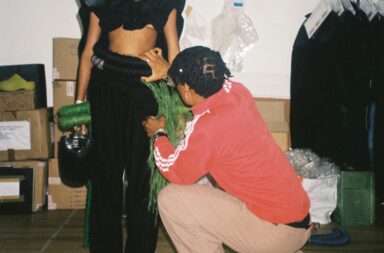
Khumo and his Parisian partner, Isis’ look was inspired by a trip to the Karoo where they explored the wool value chain in South Africa, coupled with the inner-city energy and innovation witnessed during their time in Khayelitsha and the people they collaborated with there. “Highlighting the importance of including diverse narratives in fashion and shifting power dynamics was our main aim,” says Khumo.
They created an all-black outfit with green accents. It featured a pure mohair and wool green scarf made with a handloom, a knitted upper bodice with leather patches, and a pair of woollen black suit pants. The look was finished off with pure mohair and woollen green and black hoop ring accessories, worn on the hips and wrists, to pay tribute to the traditional hoops and rings women of the Ndebele tribe.

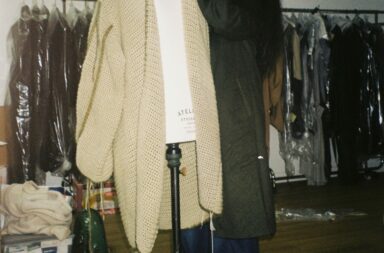
Zaza and Freddy’s collaborative look was inspired by the liberation of Black women in Southern Africa. The elaborately crocheted jacket that Zaza created was inspired by a visit to the Slave Lodge Museum where they saw an image of a woman named Nasia – a free Black Cape Muslim woman and the wife of Hadji Hassan Nudin Ibanu Abdallah (also known as Carel Pilgrim). He was a respected imam, tailor, and the first free Black Cape Muslim to make a pilgrimage to Mecca.
Zaza says, “In the photograph, his wife wears a modest, A-line dress with a scarf around her shoulders. Reinterpreting this, I crocheted an A-line, modest coat dress. Instead of a scarf around her shoulders, I added a hood in the shape of Nasia’s scarf.” Under the coat, a leather bodycon dress, made by Freddy, was revealed. The 11 panels of the dress were inspired by a visit Freddy and Isis made to the Constitutional Court in South Africa, where they learnt that South Africa has 11 official languages.

A few days before the show, on a trip to view the venue, Khumo spotted Thebe Magugu showcasing amongst other emerging brands. He also ran into design duo MMUSOMAXWELL at the airport on the way home. “It was heart-warming to see that, slowly but surely, South Africa is becoming a part of the global fashion industry,” he says.
The youth are rewriting the rules on their own terms and demanding justice – when it comes to fashion and beyond. Casa93’s approach to cross-cultural collaboration is telling of the types of idea exchanges, relationships, and cultural shifts that we’ll need to embrace to get us there.



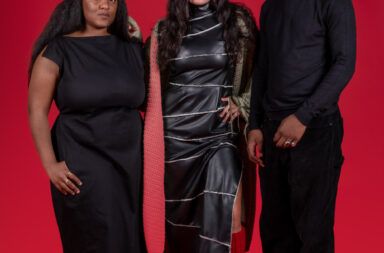
- The True Fashion: Season 2 project was co-created by the French Institute of South Africa (IFAS), with Casa93 and Khayelitsha’s Ekasi Fashion Alliance, and funded by the Institut Français in Paris and The City of Paris. The project was supported by the African Fashion Research Institute.
- To learn more about True Fashion: Season 2 and the intercontinental journey, read this article.
- Images: Photos by Eric Garault
- Film photos by Khumo Morojele


