“At the District Six Museum, we are trying to facilitate a pilgrimage of return. We want people who lived in District Six to feel a sense of belonging because if you don’t have roots, you feel lost,” says Tina Smith, Head of Exhibitions at the District Six Museum.
The story of District Six is a story of uprooting. District Six is a former inner-city residential area, in Cape Town, that was a melting pot of culture. In the 1970s, under the rule of the Apartheid regime, over 60 000 District Six residents were forcibly removed and relocated to peripheral areas on the Cape Flats. But, places are made by the people that inhabit them, and so the District Six Museum is still on a continuous journey to tell the story of the area by listening to the stories of its people.
The Museum and its projects exist to serve people from District Six, first and foremost. The praxis of the museum has a focus on evoking and archiving memories from a time and place that was ignored by the history books. As Tina says, “our mission is to make the intangible tangible.”

When the Museum was first established in 1994, as South Africa ushered in a new democracy, District Six residents who were forcibly removed used to walk in and tell their stories. The Museum staff realised that they needed a way to document and record all of these subaltern stories. So, Tina began the Huis Kombuis Design and Craft Memory Project in 2006 to create a space for return and remembering through a revival of traditional home-based crafts like embroidery, sewing, and appliqué work.
‘Huis Kombuis’ directly translates to ‘home kitchen’. “A lot of the stories told when the museum started were about street spaces and the exterior. We wanted to harness this energy of District Six and look at the interior spaces and how this links to identity and belonging,” says Tina.
As memories were shared and the common themes from their home lives were evoked, one of the things that everyone shared was the idea of the kitchen as the hearth of the home and food as a connector within families and the community.
Every week, for 16 years, this group has come together to create a living archive. “Every week new memories come out. You won’t believe it,” says Tina. “New memories come out all the time. We create different entry points into District Six. This is what we do each week to uncover new memories. It’s a theatre of memory. I just create the context for it to be enacted.”
The workshops allow for the forgotten voices, fragile memories, and skills of the elderly, retired homemakers, as well as former residents who had worked as seamstresses in the clothing industry, to be acknowledged and made visible.
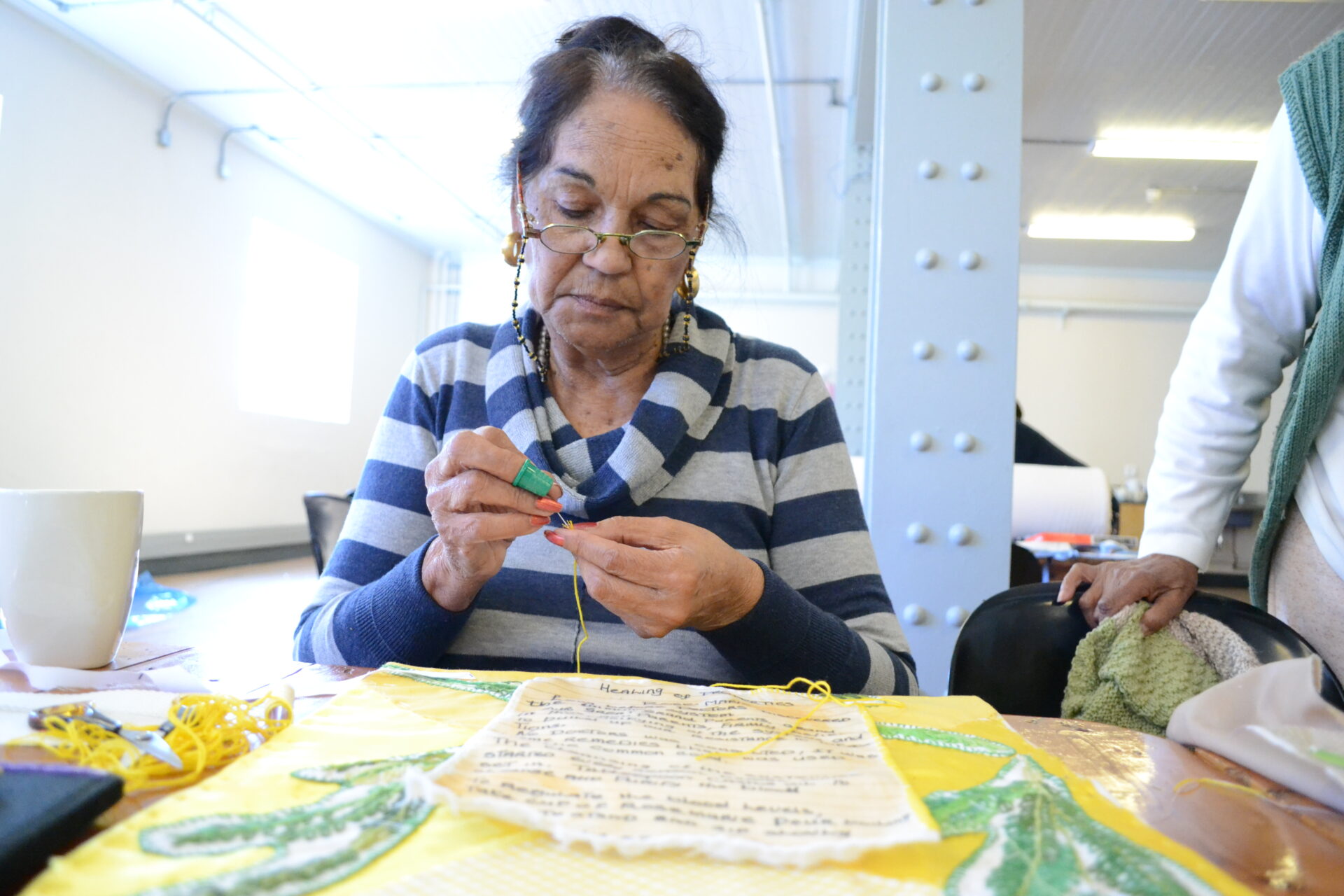
As soon as Tina and the group of District Six residents started exploring the intimate interiorities of home life, memories of home crafts surfaced. Embroidery was a generational skill that got passed down and everyone had a story to tell about their grandmothers and mother sewing – an inventiveness and artisanal skill that was linked to the need to make ends meet.
Many of the women were seamstresses and worked in the garment industry. The building that now houses the Homecoming Centre used to be a popular fabric store and haberdashery shop where many women would work and stock up on supplies for their sewing projects. With this in mind, Tina used embroidery and home craft-inspired projects as a healing process and to encourage the return of memories.

“People learnt from their parents and grandparents teaching you – whatever skills they had. They may have been poor, but they had rich imaginations. There was no lack of that. District Six was filled with self-taught seamstresses, cooks, bakers,” says Tina. As the Huis Kombuis Design and Craft Memory Project continued through the years, Tina had the idea of harnessing all these skills and continuing the exploration of the interior by creating a cookbook that captures the essence of District Six.
“The cookbook foregrounds this whole geography of a people and community. Food is about the geography of people. You can see the multiculturalism of the place and how this influenced food and identity,” says Tina.
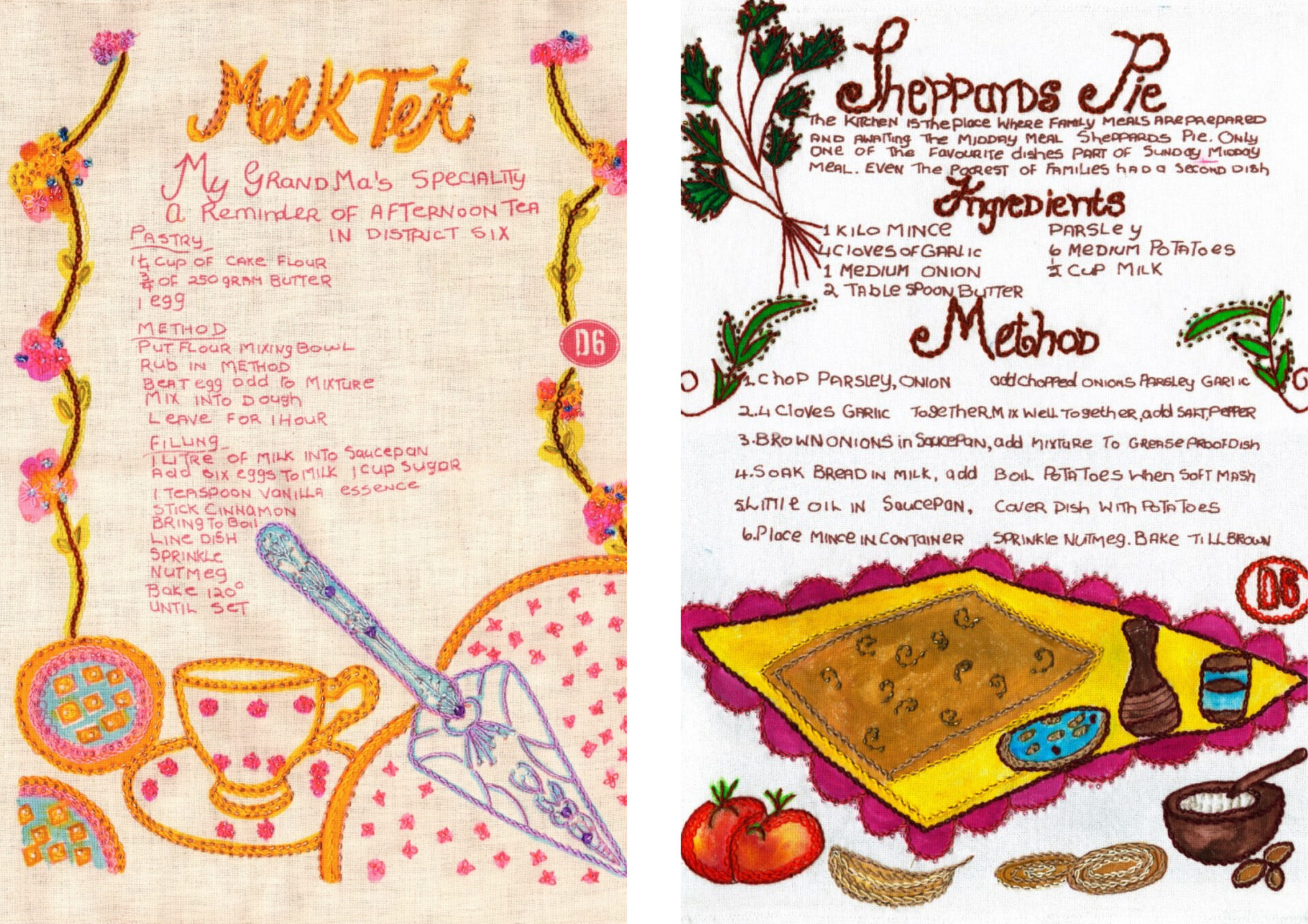
The creation of the District Six Huis Kombuis Food and Memory Cookbook, which is based on hand-embroidered recipes that the residents made and shared with their community, became an important part of tactile healing. The generational home craft of embroidery allows the agile hands to move while the mind wanders and recalls memories that have been tucked away for years.

Food is another important element of community and bridging cultural divides. Kitchens are sacred places. A kitchen is a space for connecting over food, sharing, practicing community care, and creating the fabric of the everyday. They are sites of memory and nurturing spaces.
“The way people cooked was very instinctual and recipes were never written down. It was always ‘A bitjie van die and a bitjie van dai – a bit of this and a bit of that’,” says Tina. This made writing the recipes down for the cookbook quite challenging and a slow process.
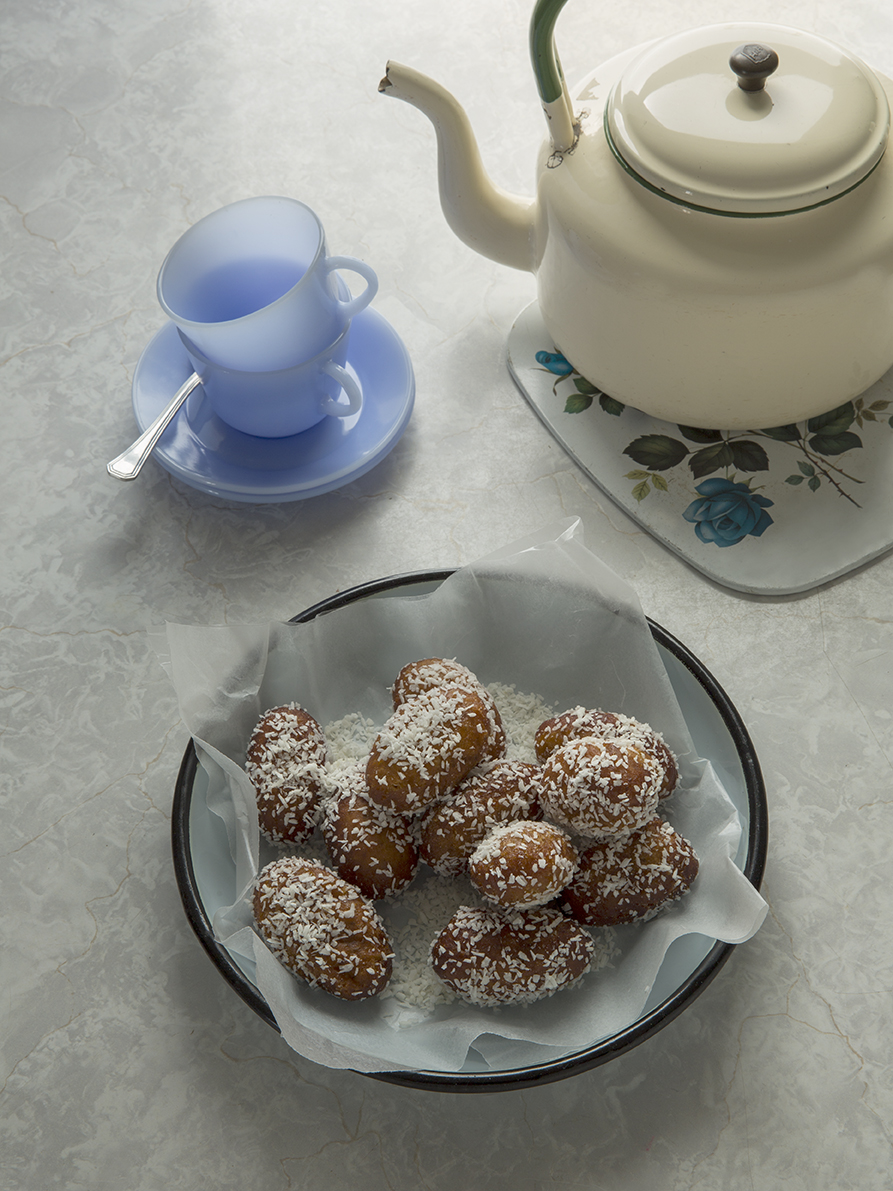
If there are two common themes throughout the cookbook, it’s that: nothing went to waste and everything was about sharing. The cookbook is about cooking with “affal” and “stretching the pot”. Affal was the parts of the animal that butchers would discard because nobody wanted to eat them. But, the residents of District Six could not afford the prime cuts of meat and so “affal” became the basis of many of their meals.

And, when they cooked, they shared. So, “stretching the pot” was a saying used to describe the way people would add ingredients to their meals to make sure they could feed as many people as possible because, in District Six, houses were open houses. “When the Christmas Choir or the Malay Choir bands would play in front of the houses and they would be invited in to eat. Everyone was welcome and everyone had an open house – whatever you had, you shared,” says Tina.
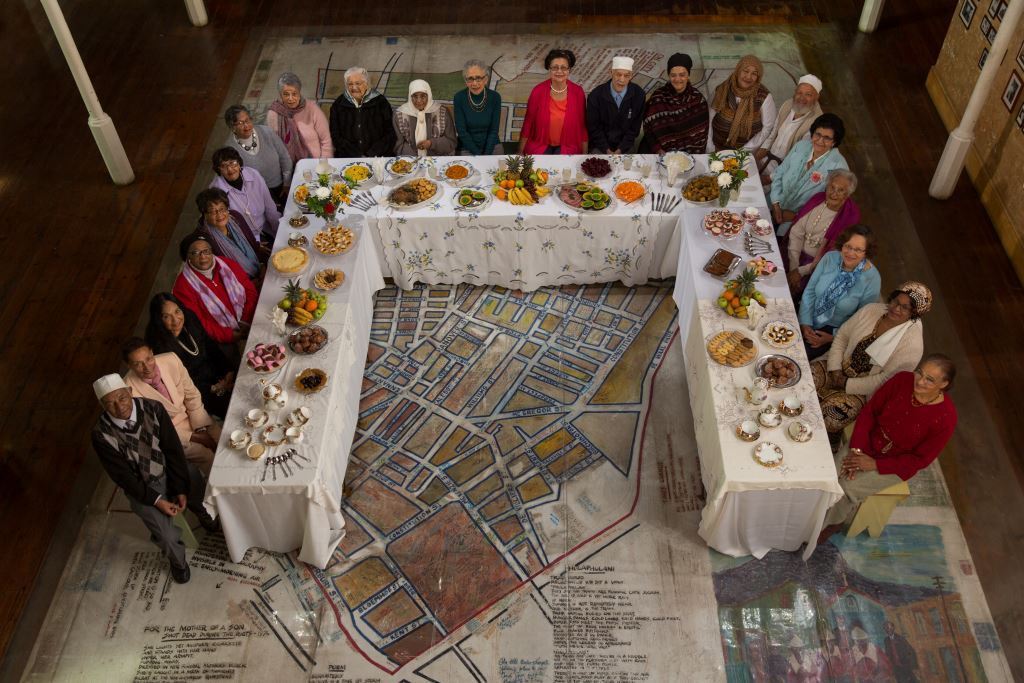
“When we launched the cookbook, we threw a tafel (table) filled with tasters of food from the book. The room was filled with gratitude and people were so proud of themselves, their cultures, histories, and heritages, and the sense that their stories are valid and important,” says Tina. This celebration speaks to pride and reclamation of authorship that is so important in rewriting the canon. We need ordinary people to tell their stories because their stories become the fabric of our city.
Walking through the Museum and paging through the cookbook reminded me of how much we still need to learn from the past; how much we need to dig into the everyday archives held in tangibles like textiles and food.
To reimagine a more equitable future, we will need to evoke a radical empathy that allows us to engage with the humanness and lives of people who were left out of the historical canon – starting in our own cities.
The Huis Kombuis Memory Project is a living example of the enactment of memory and the importance of paying homage to times past – through sewing, food, sharing, community, and thorough care.
“The spirit never dies. You can take District Six away from us, but you cannot take the spirit away. And, stories never end. They just continue through generations,” says Tina.
- Images supplied by Tina Smith.
- The cookbook is just one of many projects. For more information about the District Six Museum and the Huis Kombuis Design and Craft Memory Project, visit their website.
- You can purchase a copy of the District Six Huis Kombuis Food and Memory Cookbook at the gift shop in the Museum.