

Over 100 cultural and historical buildings, and countless homes in Gaza have been destroyed by Israeli attacks since 7 October 2023. Yet, in the apocalyptic wrecking of mosques, museums, and universities, a dress survived the bombing of the Rafah Museum.
Made for a young girl, the blue-black fabric of the diminutive thobe has been sun-bleached and weather-beaten, and, in parts, shredded. In spite of the damage, the brilliant red, green, and white threads of its tatreez embroidery still stand proud.
It’s fitting that this is the final item on display in Thread Memory: Embroidery from Palestine, a testament to the unwavering spirit of Palestinian liberation.
 Dress from Gaza, 2000-2010: “This thobe, made for a little girl, was damaged in the targeted bombing of the Rafah Museum in Gaza, whose collections were largely destroyed by Israel in 2023. The force of an explosion threw the dress onto a roof, where it was inaccessible for eight months until the museum’s team could retrieve it. As well as the violence of the bombing, exposure to the elements has left its marks on the garment – the fabric has been weakened by the rain and bleached by the sun.” Photo: Grant Anderson
This exhibition, currently on display at the V&A Dundee in Scotland, explores and celebrates a centuries-old needlecraft. More than just complex and vividly coloured surface decoration, tatreez serves as a living archive – personal and collective – documenting time, place, resistance, and identity through female labour and adornment. The motifs, colours, placement, and techniques used in tatreez reveal not only who made or wore it, but also where that person comes from. For example, tatreez from Gaza is often identified by its fuchsia and pink shades, while dresses from Bethlehem typically feature pointed sleeves. Motifs like combs or looms may indicate a local textile industry, while the use of indigo signals a period of mourning.
Thread Memory’s curator, Rachel Dedman, has spent over a decade working on this exhibition, which has travelled through Lebanon, Palestine, the UK, Saudi Arabia, and now Scotland. “It’s constantly evolving and shifting,” she says. “It feels, to me, like a huge privilege – to work on this subject and also to get to do this over and over.”
In these difficult times, Rachel says, it’s vital to tell Palestinian stories, celebrate Palestinian heritage and support the next generation of Palestinian artists and fashion designers.
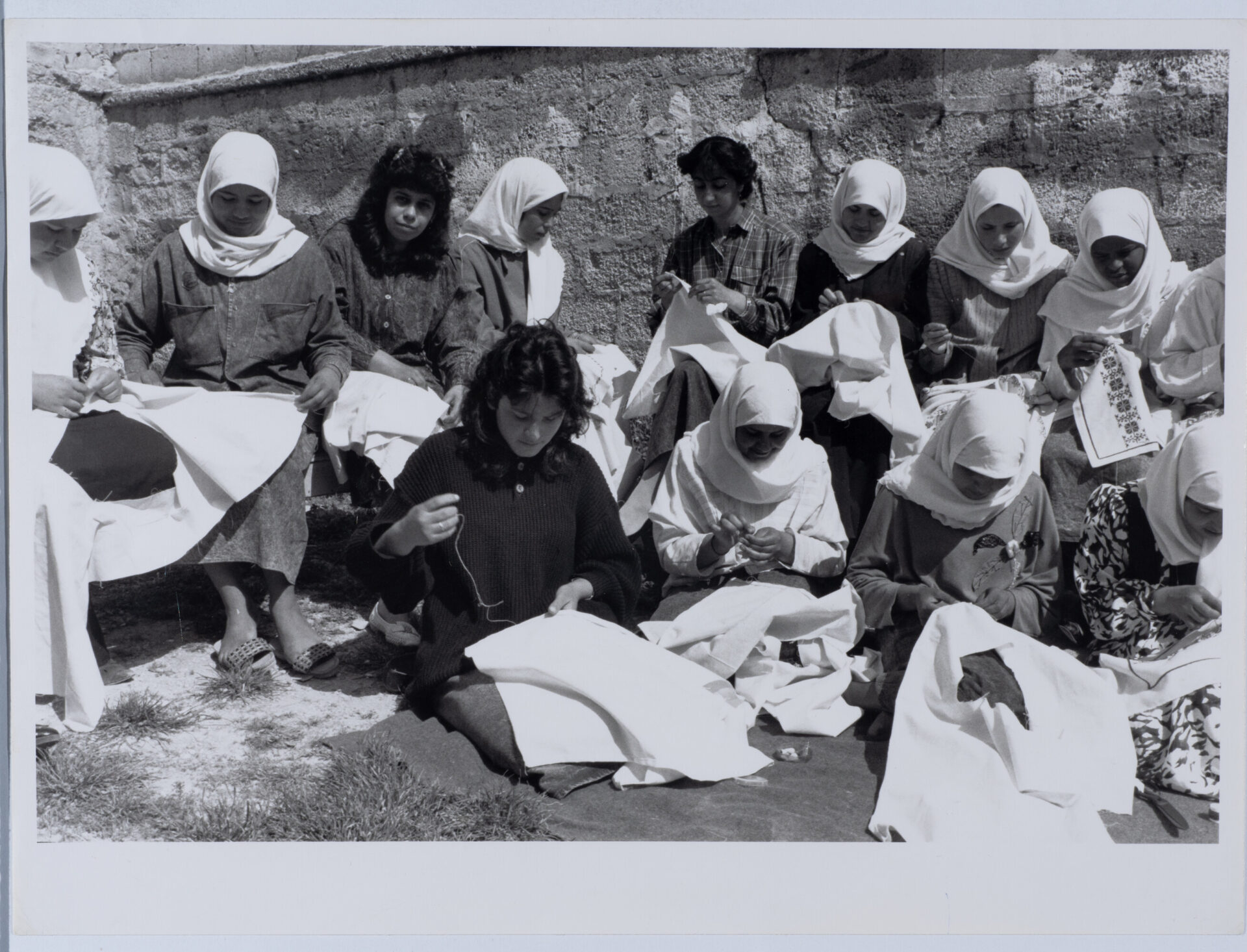 Members of the Qalandiya Camp Women Handicraft Cooperative Society participating in one of the society’s projects. 1958. Palestinian Museum Digital Archive. Courtesy V&A Dundee
Her involvement began in 2013, when the Palestinian Museum reached out to her while she was working as an independent curator in Beirut. “Then, the Palestinian Museum was being built in the West Bank,” she says. “It didn’t exist yet as bricks and mortar, but they were already thinking about what it means for a museum to be transnational. A Palestinian museum can’t exist only in Palestine because then access would be too limited – there’s such a diaspora.”
Rachel’s appointment as curator has the advantage of her having freedom of movement. She was able to travel across Lebanon, Jordan, and Palestine to engage with various Palestinian communities, collectors, museums, and institutions. “Palestinian women would throw open their homes to me with these chests, trunks, or cupboards full of incredible dresses, and we would go through them one by one, and they would teach me,” she says.
“For such a material and tangible subject, much of its meaning is contained in oral history. It’s about stories and storytelling. It was through talking and learning and feeling that I really began to speak the language of tatreez.”
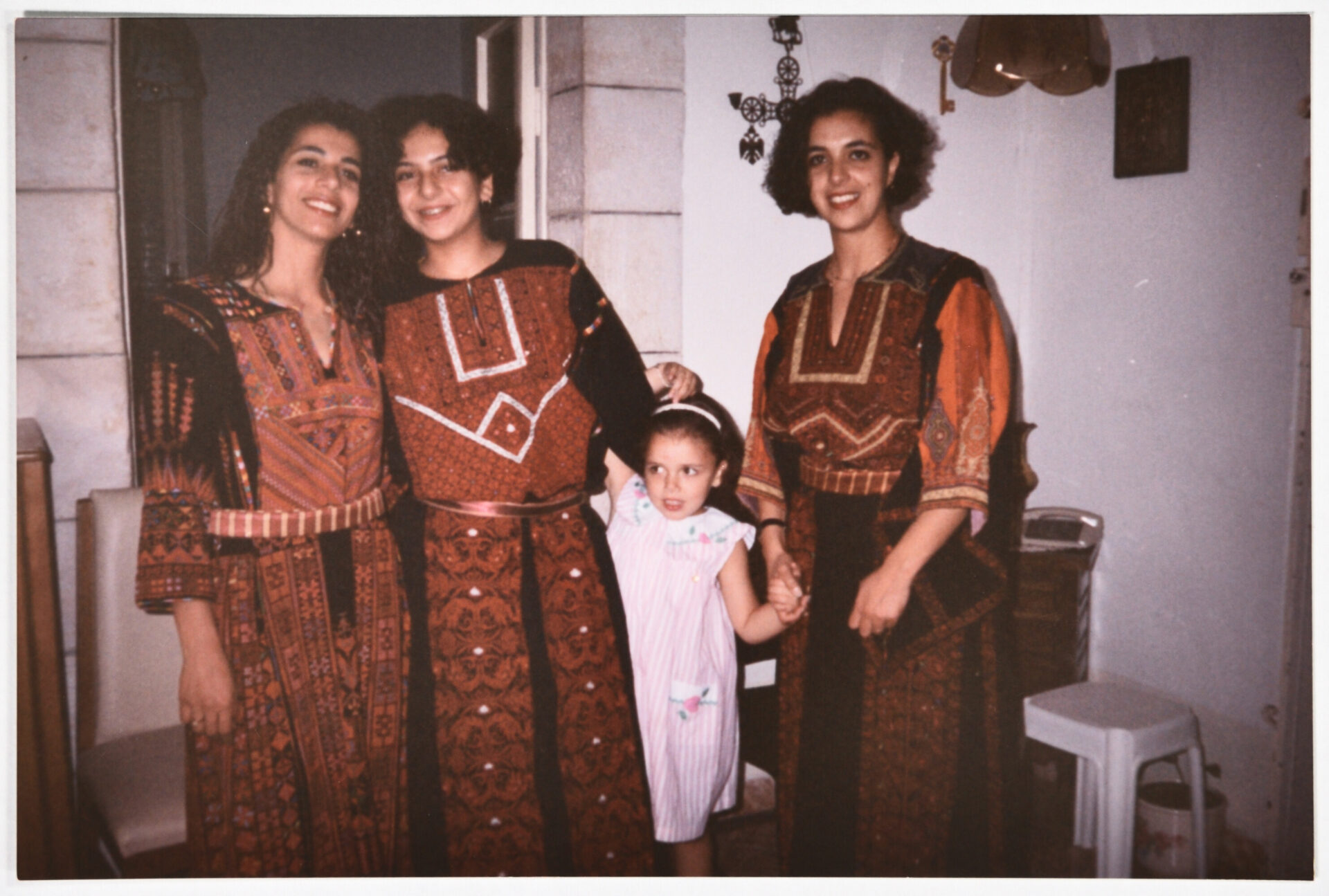 From thee wedding of Naifah Ashrawi’s daughter Hala. 2001. Palestinian Museum Digital Archive. Courtesy: V&A Dundee
Over the last three to five years, there’s been a notable rise in popularity for textile-based crafts such as embroidery, weaving, and knitting – both in domestic and fine art contexts. While there are many reasons for this, ranging from the pandemic forcing us indoors to the growing alienation of a digital society. What’s most significant about textile art is how not art it is. Whether through the clothes we wear or the cushions and throws we use to decorate our homes, textiles are an easily accessible touchpoint for all of us. Even if we aren’t makers, we still engage in the language of material and embellishment.
And while our individual or cultural tastes may differ, there are always common threads that unite us. A significant section of Thread Memory is dedicated to the use of indigo in Palestinian mourning dress. Rachel explains that blue is the colour of sadness, particularly among Bedouin women who dye their garments with indigo or stitch only with indigo-coloured thread. The moment the dye has faded naturally, is the moment the mourning period ends. Indigo also carries spiritual or medicinal significance in communities across Asia and Africa. For example, it’s used for healing in West African cultures and for protection in East Asia.
Indigo is a physical manifestation of the ways we can empathise with and connect to people whose experiences may seem far removed from our own. A further reminder that the suffering of Palestine is the suffering of us all.
 Intifada dress, 1987-1993: “At this time, Palestinian flags were confiscated in protests and Palestinian colours banned in public. In response, women started stitching “Intifada dresses”, which combined traditional Palestinian motifs in national colours with new designs associated with nationhood and resistance. This dress features birds singing to one another above the sacred golden dome and minaret of the Dome of the Rock in Jerusalem. Such garments turned women’s bodies into sites of active political power. The dress would have been stitched in secret, perhaps by candlelight, in a village under siege. The slow nature of tatreez, many months in the making, reflects the steadfastness of Palestinian women, and the idea that resistance is a process, not a single event.” Photo: Grant Anderson
Resistance and revolution are also key themes in the evolution of tatreez, which the exhibition highlights through pieces like the Intifada Dress, born in response to the censorship of Palestinian flags and colours. In protest, women stitched national colours and motifs onto their dresses, often in secrecy and with limited resources, turning their bodies into sites of “active political power.”
A significant portion of contemporary tatreez follows this path, featuring the flag’s red, green, white, and black, along with symbols of Palestinian nationhood and liberation such as phoenixes, doves, indigenous flowers, and mosques.
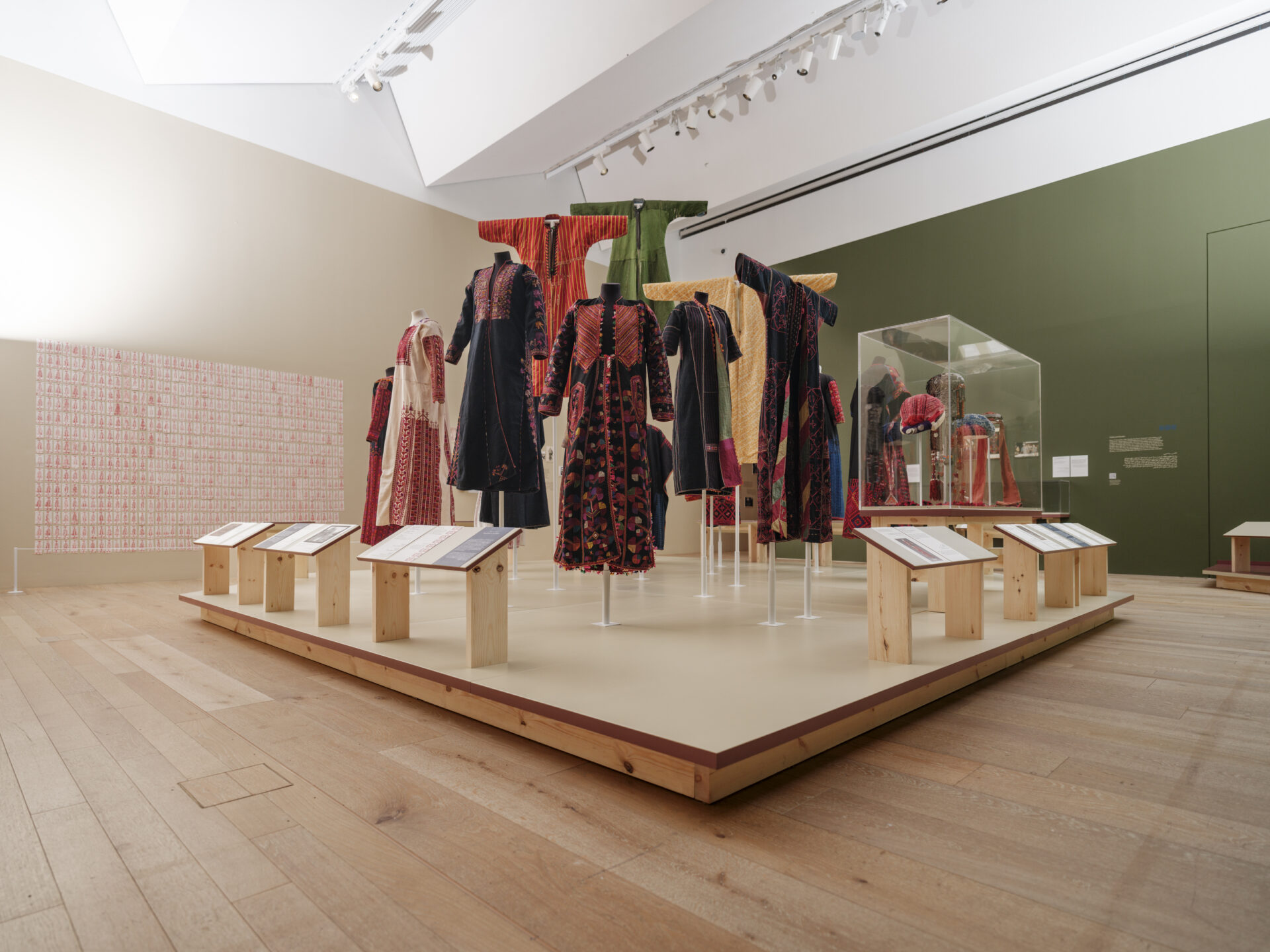 The exhibition is on at V&A Dundee, Scotland, until early 2026. Image: Grant Anderson
But it wasn’t (and isn’t) always like this. One of the most influential forces on modern tatreez is the legacy of the 1948 Nakba, which dismantled textile centres, disrupted trade routes, and necessitated a unified Palestinian visual language. Yet this age-old practice has always existed within the realm of fashion, shaped by both collective and personal acts of novelty and necessity. This is an aspect often overlooked when we speak of traditional dress, which is frequently seen as static or unchanging.
“In that process of travelling and doing fieldwork in the Middle East, I met women who continue to embroider today in different contexts,” says Rachel. “We’re trying to bridge that gap between the historical heyday of tatreez from 150 years ago and the present, and how the craft has evolved – being politicised, commodified, and transformed in all these ways.”
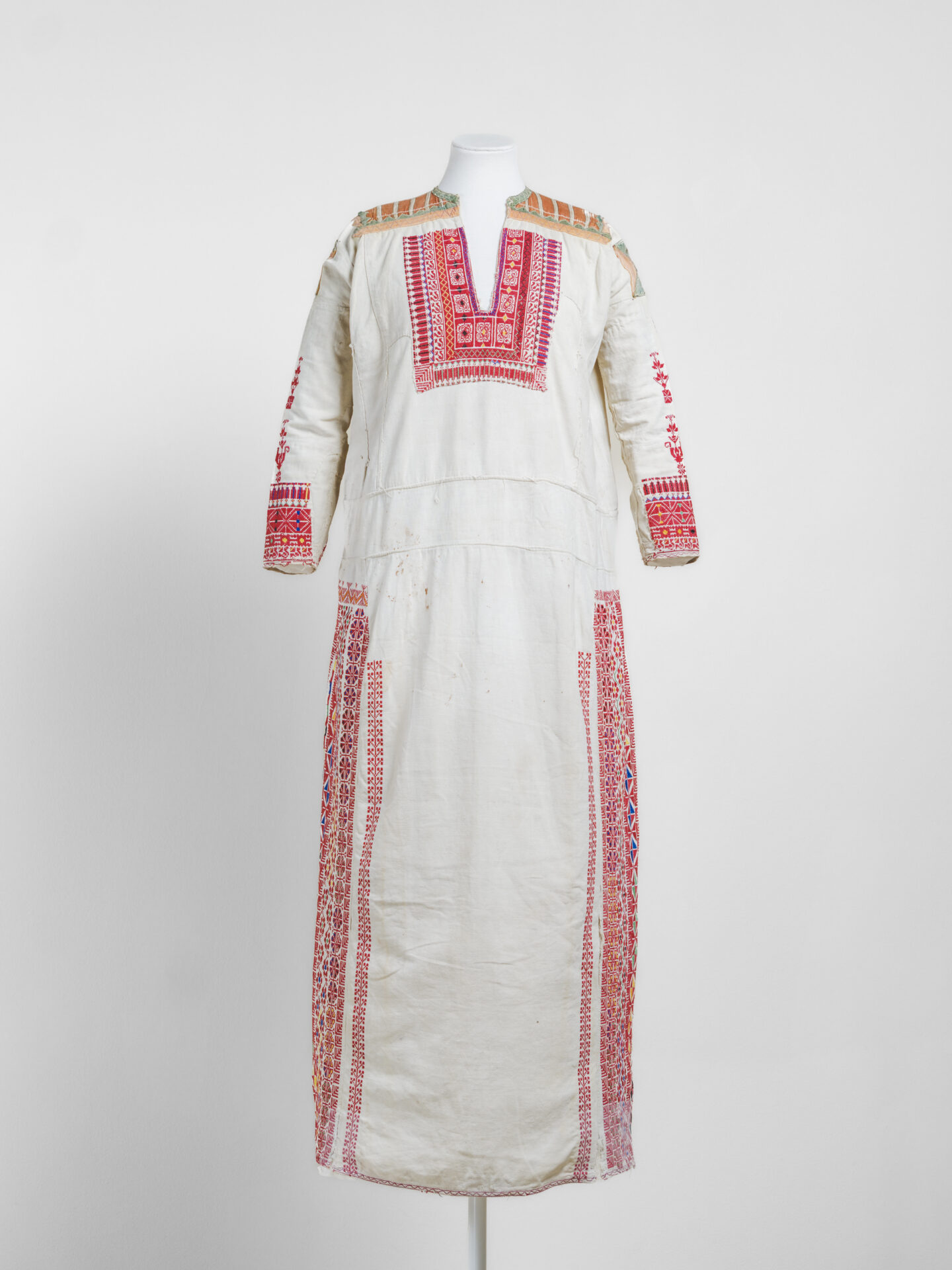 Dress from Beit Nabala, c. 1920-1930 with later additions, The Palestinian Museum Collection: “This was an everyday dress, worn for work in the fields and at home. A large patch around the chest panel, now sewn closed, indicates how its maker breastfed her babies in an ankle-length garment. The sleeves have been darned and repaired several times over. This dress was worn by at least two different women, as it has been lengthened around the waist to fit someone taller. Such dresses, shaped by many hands over time, bear witness to the life of the village before its destruction.” Photo: Grant Anderson
An example of transformation is a white linen dress featured in the exhibition. Dated between 1920 and 1930, it’s one of the last remaining artefacts from the village of Beit Nabal, which was destroyed in 1948. Like most thobes, the colours, motifs, and placements offer clues about its origin. But it’s not only the cuffs, chest, or hem that speak to us. The entire garment bears the traces of many hands and many lives. The chest panel once had an opening for breastfeeding, allowing a woman working in the fields to nurse without undressing. The waist has been extended to fit a second wearer, who must have been two to four inches taller than the first. The sleeves have been patched and darned several times.
These traces of everyday life are what I found most compelling about the exhibition. So much of our conversation around Palestine is – rightly – framed by grief, anger, and resistance. But in the face of something so vast and overwhelming, it’s just as important to honour Palestinians as individuals: people capable of beauty, creativity, and joy, just as much as protest or struggle.
Thread Memory presents tatreez as a multifaceted art form. The exhibition includes imagery from the Palestinian Museum’s Digital Archive and several digitised photographs donated by Palestinians and diaspora communities, meant to counter the external authorship of colonial-era photography. It references artists like Suleiman Mansour and Nabil Anani, who exalted the rural woman in her tatreez-decorated thobe as a national symbol. And it looks forward too. The work of contemporary designers is displayed alongside historical garments. One of them, Zeid Hijazi, draws on the long-standing relationship between Scotland and Palestine – Dundee, where the exhibition is being held, has been twinned with Nablus for many years – by using tartan embellished with tatreez in a costume imagined for the heroine of Bedouin Hacker, a Tunisian film about a radio hacker broadcasting protest messages.
There is, on one hand, a sense of grief in knowing that these dresses and crafts could outlive the places and people they came from. But on the other hand, their survival is proof that Palestine will always persevere.
Rachel says tatreez is a stitched version of the Arabic term sumud, meaning steadfastness. If you’ve ever had both the immense pain and joy of tackling a needlecraft project, you’ll know it’s slow work. It’s repetitive actions and continuous commitment. It’s understanding that while each step may seem small or tiresome – perhaps even delayed by setbacks – eventually, it comes together into something powerful. And it always comes together. You just have to keep going.
- Feature image: The wedding of Naifah Ashrawi’s daughter. 2001. Palestinian Museum Digital Archive. Courtesy: V&A Dundee
- To better reflect the enormity of the destruction, “and countless homes in Gaza” was added to the first paragraph along with a link to The Conversation article
- Thread Memory: Embroidery from Palestine is free and on show at V&A Dundee from 26 June 2025 to autumn 2026. It expands upon an exhibition with the same title that was shown at Hayy Jameel, 23 January to 17 April 2025, curated by Rachel Dedman
- All images by Grant Anderson. Courtesy of V&A Dundee


